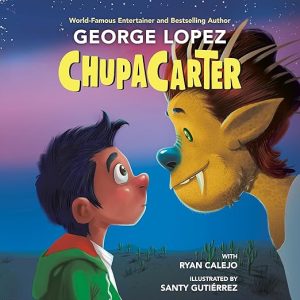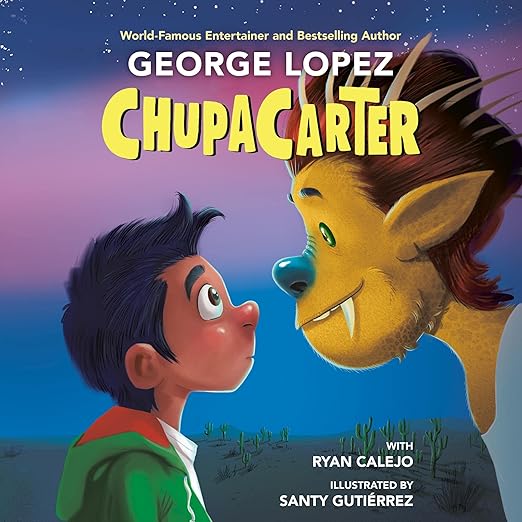
Jorge, twelve years old and recently uprooted to live with his grandparents, finds a friend on his first disastrous day at a new school. That friend turns out to be a young chupacabra. If that premise made you immediately think of E.T., the comparison is apt and ChupaCarter seems to know it, engaging the classic misfit-befriends-a-creature formula through the specific lens of Latinx folklore and George Lopez's own experience of growing up navigating cultural margins. I listened to this audiobook with my nephew on a long drive, which is exactly the environment this kind of middle-grade story was built for: attentive enough to engage an adult, paced well enough to hold a ten-year-old through three hours and fifty minutes.
Kind, a Good Listener, Great Taste in Sneakers
Lopez wrote this as the first book in a series, and the construction shows the structural awareness of a writer thinking about a sustained world rather than a single story. Jorge's friendlessness at the new school, his complicated feelings about being sent to live with his grandparents, and his navigation of a social hierarchy that already has its own dynamics are all established economically in the opening chapters. Carter, the young chupacabra whose name is a Lopez touch that manages to be funny and warmly humanizing simultaneously, is introduced as a character whose nature contradicts his mythology: the legendary bloodthirsty livestock killer turns out to be 'kind, a good listener, and has great taste in sneakers.' The gap between Carter's reputation and his actual personality is where the book's humor lives, and it is a fertile gap.
Giordan Diaz narrates, and he is well-matched to the material. Lopez's comedy background is audible in the prose, which has specific rhythmic timing, and Diaz honors it without trying to out-perform it. He differentiates the characters, particularly the contrast between Jorge's defensive interior voice and Carter's enthusiastic, genuine warmth, with enough distinction that younger listeners can track the emotional landscape without difficulty. For a book that Lopez described as inspired by his own childhood, Diaz brings a cultural authenticity to the delivery of the Latinx cultural references and Spanish vocabulary that occurs naturally in the text.
Cattle Turning Up Dead Raises the Stakes
One parent reviewer noted that the book is 'funny and is helping my child with understanding the culture of Latinos,' which captures the dual function Lopez is attempting. The book is genuinely funny; the humor is not condescending in the way that some educational multicultural fiction can be, where the jokes feel like they are serving a lesson rather than a story. Lopez's comedy instincts mean that the cultural specificity feels like flavor rather than curriculum. Another reviewer noted that their children from ages three to fifteen all found something in it, though the core audience is clearly the middle school range where Jorge and his peers live.
The central moral question the book poses, whether Jorge should trust Carter's innocence and protect him from exposure when cattle start turning up dead nearby, carries genuine weight because Lopez takes Jorge's dilemma seriously. Protecting a friend who looks dangerous to the people around you is not a trivial problem, and ChupaCarter does not resolve it easily. That seriousness underneath the comedy is what separates the book from lighter fare and gives it the texture that makes it worth re-listening.
A Belligerent Principal Who Stays One-Dimensional
At just under four hours, this is a short audiobook by middle-grade novel standards, and while the first installment resolves its central conflict satisfyingly, listeners will likely want to continue into the series rather than treating this as a standalone. The worldbuilding around chupacabra lore and what Carter's existence means for the broader mythology is introduced but not fully developed in this volume, which is appropriate for a series opener but may feel slightly incomplete for listeners who came for the creature lore specifically.
The belligerent principal who suspects the truth serves as a one-dimensional antagonist, and Lopez does not attempt to complicate that characterization. For adult listeners, that simplicity might occasionally feel thin. For the ten-to-thirteen-year-old core audience, a clearly antagonistic authority figure is part of the genre's established vocabulary, and the characterization works well at that level.
Lopez's decision to root the story in his own childhood experience, growing up navigating economic constraint and cultural margins in ways that shaped both his comedy and his self-understanding, gives ChupaCarter a specificity that distinguishes it from purely commercial middle-grade fiction. Jorge's resentment at being sent to live with his grandparents is not generic adolescent grievance; it is tied to a particular kind of family dislocation that Lopez knows from inside, and that specificity makes Jorge legible to readers whose specific circumstances are nothing like his. Giordan Diaz's narration communicates that layered interiority with enough lightness that the humor of the Carter premise never gets buried under it. The audiobook maintains its comedy and its emotional honesty simultaneously throughout its nearly four-hour run, which is a harder balance to sustain than either element alone.
Warm Rather Than Token for Latinx Families
Middle-grade listeners between roughly eight and thirteen, particularly those with an interest in folklore, monsters, or the specific pleasure of a misfit-and-creature friendship, will find this audiobook satisfying and funny. Latinx families will find the cultural references warm rather than token. Parents looking for audiobooks that work on long car trips or shared listening sessions will find Diaz's narration and Lopez's pacing well-suited to that format. Younger children who are read to may enjoy it with an adult alongside, though some of the social dynamics around bullying and alienation are pitched at an older awareness.
- Voice: Giordan Diaz honors Lopez's comedy timing while bringing cultural authenticity to the Latinx folklore and references woven through the text.
- Big ideas: Friendship across difference, protecting the vulnerable from misunderstanding, navigating cultural identity
- Atmosphere: Warm and funny, with genuine emotional stakes underneath the creature-feature premise
- Worth it?: A winning middle-grade audiobook that uses chupacabra mythology and Lopez's comedy background to tell a real story about belonging and trust.
Common Questions
Is this audiobook appropriate for children who are not familiar with Latinx culture or folklore?
Yes. Lopez includes enough context for the cultural references and the chupacabra mythology that non-Latinx listeners can follow everything comfortably. The cultural specificity adds texture rather than creating barriers.
What age range is this audiobook best suited to?
The core audience is roughly eight to thirteen, with the bullying and social dynamics pitched particularly well at the ten-to-twelve range. Younger children will enjoy the creature elements and humor with an adult present; older teens and adults may find it moves quickly through its emotional material but will still appreciate Lopez's comedic voice.