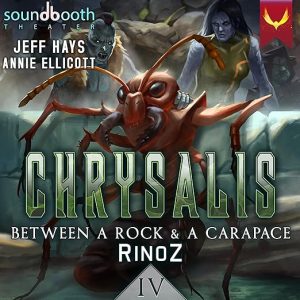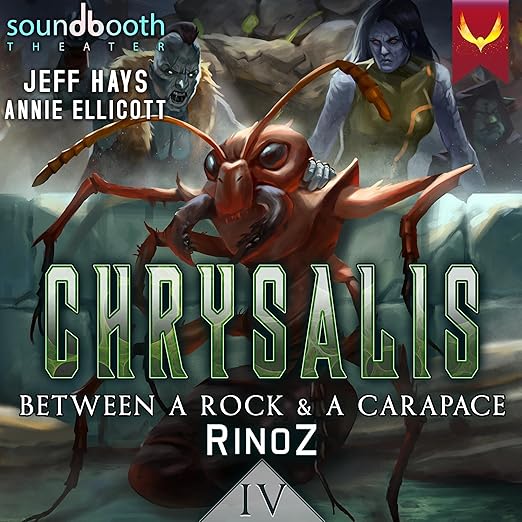
There is a peculiar joy in being deeply invested in an ant. I came to Chrysalis 4 having binge-listened to the preceding volumes over a fortnight of evening commutes, and I found myself genuinely attached to Anthony, the human consciousness reborn as a monster-evo ant, in a way that the genre's premise probably should not enable but absolutely does. RinoZ has built something rare with this series: a protagonist whose literal inhumanity becomes a vehicle for examining what it means to choose loyalty over survival, community over individual power. The Soundbooth Theater production, with Jeff Hays returning, felt like coming home.
Book four opens in the aftermath of the Garralosh battle, one of the series' defining confrontations, and does something structurally interesting: it does not immediately escalate. Instead, it breathes. Anthony has triumphed. The Colony is secure. Now what? The answer is down. The Shadow Sea, the second stratum of the Dungeon, offers a radically different environment from the upper levels, and RinoZ uses that geography to introduce new categories of threat, civilization, and strangeness that the surface world's rules could not generate.
Is Chrysalis 4 Worth Your Time?
This is, by most readers' accounts, a transitional book in the series arc, the bridge between the first major narrative cycle and whatever comes next. That is not a criticism so much as a structural observation. RinoZ knows what he is doing: the Shadow Sea needs to be established as a living, dangerous place before it can become a home for the Colony's ambitions. The bizarre monsters, the ancient civilizations that have survived in the depths for thousands of years, and the terrifying poisons all serve this establishment function. Some of the episodic quality of the stratum exploration means individual sequences do not carry the same weight as the Garralosh arc, but the cumulative sense of a world growing larger is effective.
Anthony himself remains the book's great pleasure. His humor, his relationships with Tiny and Crinis, and his stubborn insistence on looking at every problem from a slightly lateral angle are deployed with consistent skill. RinoZ has never lost sight of the fact that a story about an ant needs to be funny as well as earnest, and that balance is well-maintained here.
The Best Parts of Chrysalis 4
Jeff Hays is the defining voice of this series. His Anthony is warm, self-aware, and genuinely funny, a combination that the written page delivers but that Hays elevates through timing and a kind of delighted commitment to the absurdity. One reviewer who noted binge-listening through books two through five specifically praised the narration as part of what made the experience work. Soundbooth Theater's production adds depth to the ensemble sequences, particularly the Colony scenes where multiple voices are needed to convey scale and community.
The seventeen-plus hours pass faster than they should for a book in a transitional arc, which is a tribute to both author and narrator. RinoZ fills the Shadow Sea sequences with enough invention to prevent the pacing from sagging even when the overarching plot is in a holding pattern.
Before You Commit to Chrysalis 4
Readers who found the Colony-defense storylines of earlier books the series' emotional core may find the solo-exploration structure of the Shadow Sea sections less satisfying. One reviewer specifically noted hoping future books would not focus entirely on the Anthony-in-isolation dynamic the fourth book's ending sets up. That concern is legitimate, the series' warmth comes from Anthony's relationships, and extended periods where those relationships are strained or absent can make the book feel thinner.
There is also a structural twist in the middle sections involving Anthony being driven into deeper stratum by circumstances rather than choice. Some readers found this less satisfying than the earlier books' more agentive plotting. It reads as a setup move for the larger arc rather than a fully developed confrontation.
Should You Listen to Chrysalis 4?
If you are already in the Chrysalis series, you keep going. Book four is essential to understanding where the series heads next, and Hays's performance alone makes it worthwhile. New listeners should absolutely start at book one, the monster-evo LitRPG premise and the Colony's emotional significance only work with the foundation in place. Readers drawn to humor-inflected fantasy with genuine heart and no interest in a straight-faced power fantasy will find this series in general, and this volume specifically, a rewarding extended commitment.