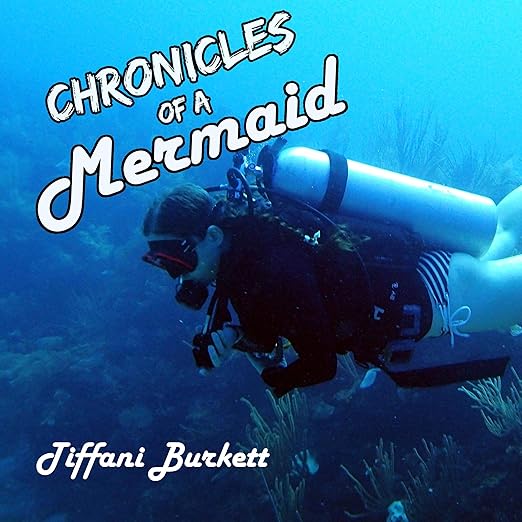
Before You Press Play
- Performance: Tiffani Burkett is her own credited reader, so a first-person memoir about her own incompetence in the water reaches you in the voice it happened to.
- What it covers: Learning to dive from zero, a relationship under strain, solo travel across Asia, self-deprecating humor
- Feel: Fast, funny and a little unvarnished
- Our call: A likable short self-published travel memoir, best taken with the perfect ratings treated as a small sample rather than a consensus.
Two one-way tickets to Thailand and no ability to swim: that is the setup, and in a novel it would read as invention. Tiffani Burkett left a job and a Northwestern Montana winter, put her things in a backpack and went to become a scuba diver anyway. The audiobook runs a shade over five hours in her own voice, which is about right for a story that moves this quickly.
The Verdict, Briefly
Burkett earns her first act before anyone gets wet. Six months of isolation, an absent partner and endless snowfall put her into what she calls a blue hole she had drowned herself in, and the trip is a rescue attempt aimed at a relationship and at a self, in that order. The framing keeps the travel writing from floating loose of consequence. Nothing that follows is a holiday, and the book never once pretends that it is.
Wendy Braden's five-star notice gets the recommendation exactly right: "You don't have to like scuba diving to enjoy this book. But you will be impressed by the scuba part." That is a more honest pitch than the description manages, and it matches what the book is doing, which is using a certification course as a frame for three months of being somewhere unfamiliar and underqualified.
Her register arrives in the first line of her own description, and she never deviates from it: "The two things I've always feared most in life are drowning or being paralyzed. So, naturally, I started scuba diving and racing motorcycles." Sarcastic and self-deprecating is the promise, and the humor is the load-bearing element rather than the decoration.
Three months and four countries is a lot of ground to cover in a short book. Thailand, Indonesia and the Philippines all get time, and so does Japan, and the compression shows in how quickly the narrative moves between them. Places arrive, register and are gone, which is closer to how backpacking actually feels than a chapter-per-country structure would be.
Why Chronicles of a Mermaid Works as an Audiobook
Rebecca Johnson, at five stars, came looking for books about travel and scuba and stayed for something more particular: "her take on females in the sport as well as her views on dive instructors." That is a narrower and more useful recommendation than any of the comparisons on the listing, and it points at the material the book handles best.
Self-narration is never a neutral choice on a memoir this far inside its own head, and Burkett reads this one herself. Every joke at her own expense reaches you from the person it is about, and the admission at the center of the premise, that she booked the ticket without knowing how to swim, arrives without the small distance a hired reader inevitably places between a text and its author.
Comparisons on the listing line this up against Elizabeth Gilbert's Eat Pray Love, Cheryl Strayed's Wild and Jill Heinerth's Into the Planet, which is ambitious company and only half accurate. Burkett is not writing a redemption arc with a publishing house behind her. This is a self-published third volume by somebody who simply kept going, and the rougher edges are part of what makes the diving passages convincing.
David Black's five-star notice is the clearest signal about who this suits. That reader does not dive and never plans to, and bought the book anyway on the strength of Burkett's motorcycle titles, calling the result an adventure written for everyone. The diving is a subject here, not a gate.
Points to Consider
The listing files this as book three of Chronicles of a Motorcycle Gypsy, a series title that shares no words at all with the book's own. The description resolves the confusion, calling this a standalone third entry in a sequence of travel memoirs, but anyone searching the series name and expecting motorcycles will find three months of diving in four different countries instead.
Thin is the kindest available word for the public record. Twenty-one ratings sit behind five written responses, every one of them five stars, and one of those five is a garbled run of words that never resolves into a sentence about anything at all. Another comes from a repeat buyer who misspells the author's first name while praising her third book. Read the 4.6 as a small-sample number rather than as a verdict.
Two notices predate the recording outright. This audio edition carries a February 2021 date, while readers posted in November 2020 and in early January 2021, which means those two are describing pages rather than hours. It is a small point, and it matters if you were planning to let the average stand in for an assessment of the audio edition.
Coverage is uneven by design and the book is honest about it. Four countries inside three months means some places get sustained attention and others get a passing mention, and a listener hoping for a proper account of any one of them will be disappointed. This is a memoir with dive sites in it, not a dive guide with a memoir attached. Anyone hoping to plan a trip from it will be reaching for a phone and a proper guidebook inside the first hour, which is a fair complaint, though not one the listing has invited.
Who Should Pick Up Chronicles of a Mermaid
Anybody who has been talked into something they were unqualified for and went anyway is the natural audience. Burkett books the ticket before she can swim, and the best material in the book comes out of the gap between the plan and the competence. Anyone who has sat through a certification course will recognize the specific flavor of that panic immediately.
Readers who want travel writing without the polish are served here too. Self-published memoir has a particular texture, closer to a long letter than to a magazine feature, and the sarcasm the description promises does turn up on schedule. If what you want is prose that has been through a major editorial process, this is not going to be that, and the listing does not pretend otherwise.
Divers looking for technique will come away empty-handed. Nothing here teaches you to descend, clear a mask or read a table, and the book never claims to be a manual. Come for the story of a person learning to be in the water and it delivers cleanly; come for instruction and you have bought the wrong five hours.
Common Questions
Is the Chronicles of a Mermaid audiobook read by Tiffani Burkett herself?
Yes. The author is the credited reader, which on a confessional memoir means the self-deprecation and the admissions come from the person they belong to rather than from a hired voice. The recording runs five hours and twenty-four minutes, short enough to finish across a couple of sittings.
How much diving knowledge does this audiobook assume?
None whatsoever. Burkett books the trip without knowing how to swim, so the book starts at zero and explains as it goes. Certification vocabulary turns up, but always inside a scene rather than as instruction, and nothing in the description promises technique or training value.