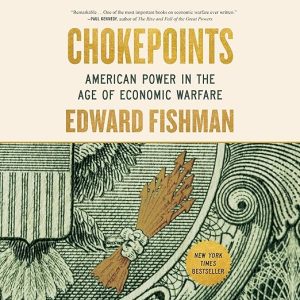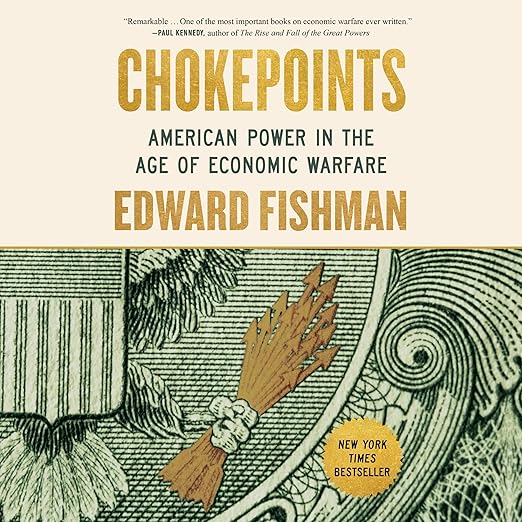
I started listening to Chokepoints during a period when the news cycle was full of tariff announcements and counter-announcements, and the effect was disorienting in the best possible way. Every story that had seemed discrete, the semiconductor controls on China, the SWIFT exclusions for Russian banks, the oil price cap mechanism, suddenly had a history and an architecture. Fishman doesn't just explain what these tools are; he explains who built them, why they were built the way they were, and what was sacrificed in the process. By the end of the first disc, I had rearranged my understanding of American foreign policy in a way I hadn't expected.
Edward Fishman's credentials matter here. He was a sanctions official inside the US government, working on the mechanisms he describes, knowing the people whose decisions he analyzes. That's a different kind of authority than a journalist or an academic brings, and it shows throughout the book in the specificity of the anecdotes and the candor of the institutional critique. He's not writing a defense of American economic warfare, he's writing an honest account of how it was improvised into being, with all the internal disagreements and unintended consequences that implies.
From Iran Sanctions to the China Question
The book's central argument, that control over economic chokepoints has become the defining form of twenty-first century geopolitical power, is supported by case studies that build on each other in a way that feels genuinely cumulative. Fishman begins with the construction of the Iran sanctions apparatus, moves through the Russia response after the 2014 Crimea annexation, and arrives at the far more complex and contested questions of how to confront China without fracturing the global economy in ways that harm the United States as much as its adversaries.
What distinguishes Chokepoints from other economic policy books is its attention to the human dimension of institutional decision-making. The "trailblazing diplomats, lawyers, and financial whizzes" the synopsis mentions aren't abstractions, Fishman gives them names, motivations, and career pressures. Some of the most illuminating passages concern the internal debates within the US government about whether certain tools would work, and the political dynamics that forced decisions before anyone was ready to make them. This is how policy actually gets made, and it's rarely this clearly described.
Robert Petkoff Sounds Like a Real Briefing
Robert Petkoff is exactly the right narrator for this material. His voice carries the kind of institutional gravity that makes you feel like you're being briefed by someone who has sat in rooms where things were decided. He doesn't perform the urgency, he lets Fishman's argument generate it, which is the correct instinct for nonfiction of this seriousness. The seventeen-hour runtime is substantial, but the pacing justifies it. Each section feels necessary rather than padded, and Petkoff's ability to make complex financial mechanisms sound comprehensible without oversimplifying them is considerable.
The Economist named Chokepoints one of its best books of the year, and the Financial Times shortlisted it for its Business Book of the Year Award. Those are not accidental recognitions, this is a book that fills a genuine gap in the public understanding of how American power has been exercised for the past two decades. Paul Kennedy's endorsement, comparing it to the most important books on economic warfare ever written, is the kind of claim that usually makes me skeptical, but having listened to the book, I find it difficult to argue with.
OPEC Basics Help With the Middle East Sections
The book's scope is genuinely global, and some sections, particularly those covering the Middle East and the details of oil market mechanisms, require more background knowledge than others. Listeners without a working familiarity with how OPEC functions, or with the mechanics of dollar-denominated commodity markets, may find a few passages require re-listening. This isn't a failure of Fishman's writing; the subject is complex and he's already simplified considerably. But it's worth knowing that Chokepoints rewards active listening rather than passive absorption.
The book was published in 2025, and some of the dynamics it describes, particularly regarding China and semiconductor controls, have continued to evolve rapidly. Fishman's analysis of the underlying strategic logic remains durable, but specific policy details should be understood as a snapshot of a situation that is still moving.
Yergin, Woodward and Lewis Readers Will Recognize This
Anyone who has watched the news cycle on tariffs, sanctions, and trade wars without a framework for understanding what's actually happening will find this essential. Readers of Daniel Yergin's energy history, Bob Woodward's political reportage, or Michael Lewis's financial narratives will recognize the genre, smart insider nonfiction that makes a complex subject viscerally comprehensible. Business and finance listeners who want to understand how geopolitical risk actually works at the level of institutions and decisions should move this to the top of their queue. It is not light listening, but it rewards the attention it asks for.
Quick Take
- Voice: Robert Petkoff brings the right kind of authority to Fishman's insider account, measured, intelligent, and capable of making dense policy exposition feel like a story being told rather than a brief being filed.
- Big ideas: Economic warfare, US sanctions architecture, dollar hegemony and its limits
- Atmosphere: Propulsive and revelatory, like a very good intelligence briefing written for civilians
- Worth it?: The most important book on how American financial power actually operates that I've encountered in years, Fishman's insider access and Petkoff's narration make seventeen hours feel essential.
Frequently Asked Questions
Does Chokepoints require a background in economics or international relations to follow?
Less than you might expect. Fishman is clearly writing for an intelligent general audience, and Petkoff's narration helps make complex mechanisms feel accessible. Listeners with some familiarity with how sanctions work or how currency markets function will get more from certain sections, but Fishman explains his terms and avoids assuming specialist knowledge. A political science professor assigned it to undergraduate students, according to one reviewer, which is a reasonable benchmark for the accessibility level.
How does Fishman handle the criticism that US sanctions often hurt ordinary citizens in target countries more than their governments?
He addresses it directly and without dismissiveness. Chokepoints is not a celebration of economic warfare, it's an honest account of how these tools were developed and deployed, including their costs and limitations. Fishman is candid about cases where sanctions produced unintended consequences or where the humanitarian calculus was genuinely difficult.
Is the book current enough to address recent US-China trade and technology tensions?
Yes, the semiconductor controls on advanced chip exports to China are a central case study, and Fishman's analysis of the strategic logic behind technology chokepoints is directly relevant to the ongoing tariff and technology wars. The specific policy details will continue to evolve, but the book's framework for understanding why these tools are being used is durable.
How does Robert Petkoff's narration handle the technical financial and legal language in the book?
Very well. Petkoff has a measured, authoritative delivery that makes policy language sound natural rather than stilted. He's particularly strong in the longer analytical passages where Fishman is building a multi-step argument, Petkoff maintains the thread of the reasoning without losing the listener. Several reviewers who came for the content specifically praised how engaging the audiobook format made it.