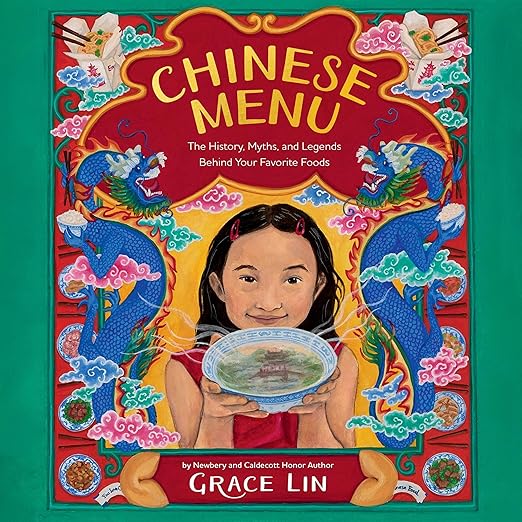
My niece and I spent an afternoon listening to the Chinese Menu audiobook together, pausing every few tracks to argue about whether we could actually replicate the dish being discussed. Lisa Ling narrates Grace Lin's collection of myths and food histories, and within the first chapter, about the connection between scallion pancakes and pizza, my niece had pulled up a recipe on her phone. That is the kind of listening experience this audiobook produces: immediate, sensory, and genuinely educational without feeling like a lesson.
Grace Lin is a Newbery and Caldecott honoree, and the storytelling instincts she brings to her picture books and middle-grade fiction are fully present here. The book is organized like an actual Chinese menu, moving through courses, and that structure creates a satisfying rhythm across six hours. Each dish gets its own story, and Lin draws on real history and folklore to explain origins that most American diners have never considered.
Like Sitting at the Table, Having Tea With Grace
What makes this audiobook work as an audiobook, specifically, is that the stories are built for telling. Lin writes in a register that belongs to the oral tradition: warm, digressive in the best sense, fond of detail that makes you picture the squabbling dragons and hungry monks she describes. One reviewer compares the experience to 'sitting at the table, having tea with Grace,' and that captures the intimacy of the listening experience accurately. Ling's narration reinforces that feeling. She has a measured, clear delivery that carries both the playful tone of the folklore sections and the more substantive historical passages without jarring between the two.
The question of dumplings and frostbitten ears is a particular highlight, a story that explains both the origin of jiaozi and the human need to make food into medicine. The fortune cookie chapter will surprise listeners who assume that origin story is settled, and the wonton soup creation myth is told with the kind of cosmic sweep that makes you understand why cultures attach such weight to soup. Lin never oversimplifies the folklore into something twee. The squabbling dragons are genuinely strange, the monks are genuinely hungry, and the history behind American Chinese food is genuinely complicated.
Letting the Stories Accumulate Into Their Own Truth
Lisa Ling handles the range of material with confidence. She narrates both the scholarly historical context and the traditional story sections, and the transitions between modes feel natural. The pacing across six hours is well-judged: individual stories are long enough to develop properly but not so long that they lose momentum. For family listening, the course structure provides natural stopping points, and Lin and Ling together have made a production that works for adults listening alone as well as for parents and children listening together.
The thematic through-line about resilience is handled with restraint. Lin does not hammer the point that American Chinese food represents cultural survival under enormous pressure; she lets the stories accumulate until that truth becomes visible on its own. By the time you reach the later sections, the connection between the food and the communities that sustained it feels earned rather than imposed.
A Fortune Cookie Invented by Japanese Americans
Listeners expecting a straightforward food history will find this audiobook more folkloric than they might anticipate. Lin is explicit that the stories are 'based in real history and folklore,' and the balance tips differently in different chapters. Some dishes get deeply historical treatment; others get primarily mythological accounts. For young listeners, that mixture is a feature. For adults seeking strictly documented history, it is worth knowing that Lin is telling stories about food rather than writing academic food history.
The illustrated book that this adapts apparently benefits enormously from Lin's visual work, and a few reviewers note the illustrations specifically. The audiobook cannot replicate that dimension, but Ling's narration fills the visual gap more effectively than you might expect, particularly in the passages describing the nine provinces or the geography of specific dishes. The production does not feel like a book stripped of its images; it feels like a listening experience designed for the ear.
The section on American Chinese food's place in the broader cultural landscape is where Lin's framing pays off most directly. She is not simply telling origin myths for their own sake; she is arguing that American Chinese food is undeniably American, a category that took shape through specific historical pressures including the Chinese Exclusion Act and the constraints that shaped what immigrant communities could offer and to whom. That argument, made through stories rather than lectures, is more effective than a more direct historical account might be. By the time Lin makes the point explicitly, listeners have already absorbed the evidence through fourteen dishes' worth of folklore and history.
The framing of American Chinese cuisine as resilience rather than assimilation is the argument that makes this audiobook more than a pleasant collection of myths. Lin is documenting how a community under extraordinary legal and social pressure created something genuinely new, a cuisine that drew on authentic tradition while adapting to available ingredients, customer expectations, and the specific geography of the American immigrant experience. The fortune cookie, which was likely invented in California by Japanese Americans and later adopted as a signature of Chinese-American restaurants, is the most striking example of how complicated that process of adaptation actually was. Lin handles this complexity without simplifying it into either celebration or critique.
Built for Long Car Trips and Kitchen Listening
This audiobook suits families with children roughly eight and up, adults with an interest in food history and cultural mythology, and anyone who has ever eaten at a Chinese-American restaurant and wondered where the fortune cookie came from. It works particularly well for long car trips or kitchen listening, where the sensory associations of food stories can do their best work. Listeners who want strictly documented food history should supplement with more academic sources, but as an introduction to the folklore behind American Chinese cuisine, this production is hard to match.
Quick Take
- Read by: Lisa Ling brings warmth and clarity to both the folkloric and historical sections, keeping the storytelling intimate across six hours.
- At its heart: Food as cultural memory, American Chinese identity, myth and origin story.
- Vibe: Warm, curious, and gently educational.
- Short version: A rich audiobook for families and food-curious adults who want the stories behind their favorite dishes, not just the recipes.
Before You Listen
Is this audiobook appropriate for younger children, or is it better suited to older kids and adults?
The content works best for children eight and up, though younger children who enjoy mythology and folklore can follow along with an adult. The historical sections are substantive but never dry, and the folklore keeps the pacing lively throughout.
Does the audiobook version work without the illustrations from the print book?
Yes. Lisa Ling's narration and Grace Lin's story-focused writing translate well to audio. The visual richness of the print edition is replaced by descriptive storytelling that works for the ear, though some listeners may want to have the book on hand to see Lin's illustrations alongside.
How accurate is the history in this audiobook?
Lin draws on real history and authentic folklore, but she is a storyteller first. The book acknowledges that the tales are 'based in real history and folklore,' which means some chapters lean more folkloric than documented. For serious food historians, this is a starting point, not a primary source.
What dishes get the most interesting origin stories in this audiobook?
The fortune cookie chapter and the dumpling story about frostbitten ears are particular highlights. The wonton soup creation myth is told with genuine cosmic scope. The connection Lin draws between scallion pancakes and pizza in the opening is a memorable hook that sets the tone for the whole collection.