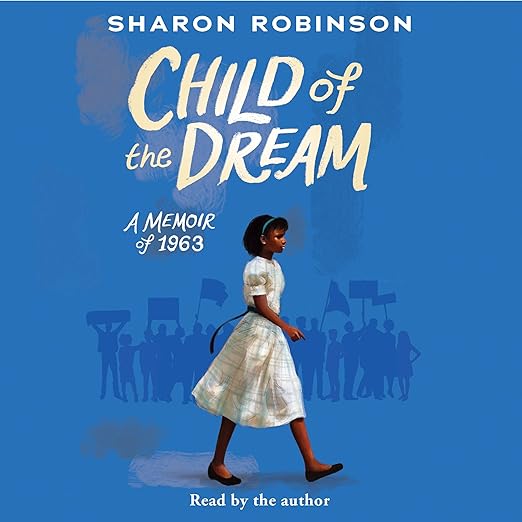
Thirteen arrives in January 1963, the night before George Wallace declares on national television that it will be segregation now, segregation tomorrow, segregation forever. Sharon Robinson turns thirteen into that. Five hours and twenty-four minutes of this audiobook follow a single year in the life of a girl going through puberty, working out her place in a wealthy Connecticut neighborhood where almost nobody else is black, and watching the civil rights movement pass through her own living room. Scholastic published it for young readers in September 2019, with Robinson reading it herself.
Two Stories on One Track She Refuses to Rank
Robinson runs two stories on one track and refuses to rank them. In the first, a thirteen-year-old is embarrassed by her body, anxious about friendships, and negotiating a neighborhood where being one of the only black children is a daily fact rather than an occasional one. In the second, 1963 happens: Wallace on national television, fundraisers in the family's own house, a march in Washington. The memoir's real argument is that these were never separate experiences for the girl living through them, and that treating the private half as trivial is how history gets flattened into something that happened to adults.
Access is this memoir's rarest asset. As Jackie Robinson's daughter, Sharon sat in rooms most people only read about: her family hosted several fundraisers for Martin Luther King Jr. at their home in Connecticut, civil rights leaders of the day telephoned her father for advice and support, and she attended the march herself, which Scholastic's copy names as the March on Washington for Freedom and Jobs. What makes the material work is that a thirteen-year-old's eye records the details an adult would leave out, and leaves out the ones an adult would consider essential.
Puberty in a civil rights memoir sounds like a marketing compromise, and it is the opposite of one. Scholastic is publishing for readers who are themselves around thirteen, and the method is to hand them a protagonist whose private crises run as loud as the public ones, so that the history arrives attached to somebody they recognize. The risk is obvious. A reader who came for the movement may find the personal material an interruption, and a reader who came for the coming-of-age story may find the history heavy. Robinson mostly avoids the trap by keeping the year itself, rather than either thread, as the organizing spine.
Robinson Voices Her Own Thirteen-Year-Old Self
Jackie Robinson is why many listeners will pick this up, and the portrait is not the expected one. A September 2019 entry, five stars, describes a famous father revealed as vulnerable yet warm and strong through that period, which is a more interesting proposition than the public version of him. He appears here as a parent under pressure, fielding calls from people who need something from him, running a household where a teenage daughter is watching every exchange and drawing her own conclusions. That angle is the book's real contribution, and it is not available anywhere else.
Robinson reads her own memoir, and that is the fact this listing hands you in place of a performance. Nobody among the hundred and fifty-nine people who rated it has written a word about how the recording sounds, so the sensible move is to test it against the hardest thing the text asks for: an adult author voicing her own thirteen-year-old self without performing childishness. Start with a passage where the historical material and the adolescent material sit side by side, because that is where an author-read memoir either holds both registers or quietly picks one. Five hours and twenty-four minutes is short enough that a mismatch costs you an afternoon, and long enough to be worth checking first.
A Hundred and Fifty-Nine Ratings, Five Visible Opinions
Behind the 4.6 stand a hundred and fifty-nine ratings, and every one of the five reader entries on this page awards five stars. Both of those facts cannot describe the same room. A hundred and fifty-nine votes averaging 4.6 means a meaningful number of people chose four stars or fewer, and not one of them explained why. The visible column is unanimous. The invisible one plainly is not. Hold that gap in mind, because a buyer reading only the writing here will conclude the book has no critics at all, and the arithmetic says otherwise.
Only one of the five mentions Robinson's voice, and it is describing a live appearance rather than this file: that reader had the privilege of hearing her speak about the book earlier in the year and arrived at the page already convinced. The same response is useful for a different reason, since it identifies the two audiences precisely, an older reader appreciating a youthful perspective on familiar headlines and a younger one being handed a discussion starter. That is a fair account of who the book is for, and it comes from somebody who had reason to know.
Scholastic gives the memoir five hours and twenty-four minutes for a single year, which sets firm limits on what it can be. This is not an account of the civil rights movement and does not pretend to be. The events arrive in the order and the shape they reached one household in Connecticut, which means entire campaigns stay offstage and the vantage point is inevitably that of a family with resources most families did not have. Listeners looking for a survey should treat this as testimony rather than as history, and put something broader next to it.
Jackie Robinson Appears Here as a Father
Middle-grade listeners around twelve or thirteen are the target, the book earns that placement, and the crossover audience is real. In July 2021 a reader described a ten-year-old who loved it and spoke about Sharon as though she were a friend, in a household that had already introduced her to the era's music and where mixed-race family members made the material personal. That is the ideal case: a child listening with an adult nearby who can answer the questions it raises. Five and a half hours divides well across a week of family listening.
Adults listening alone should know they are getting a children's book, carefully made and honestly voiced, but pitched at somebody who does not yet know how 1963 ended. Anyone wanting Jackie Robinson's own story will find him present as a father rather than as a subject. Listeners who need a comprehensive history are better served elsewhere and should not expect this to substitute. For a family with a middle schooler and five spare hours, though, this is genuinely valuable, precisely because it gives a famous year the scale of something a thirteen-year-old simply had to get through.
The Short Version
- Narrator: Sharon Robinson narrates her own adolescence, so the woman recalling 1963 and the girl who lived through it arrive in the same voice.
- Subjects: Civil rights in 1963, growing up in a famous family, adolescence, race in a white suburb
- Tone: Warm, direct and quietly serious
- Bottom line: A short, well-judged memoir that lets a young listener meet 1963 at the height of the girl living through it.
Common Questions
What age group is this audiobook written for?
Scholastic publishes it for young readers, and the record files it under children's audiobooks with a biography tag. The protagonist turns thirteen at the start, which usually signals a middle-grade readership of roughly ten to fourteen, with older listeners perfectly able to follow it.
Does the memoir cover Sharon Robinson's whole life, or only 1963?
Only that one year, which the subtitle states outright. The book opens on her thirteenth birthday in January 1963 and follows the months that came after, so anybody hoping for a full-life account of the author or of her family will find the frame deliberately narrow.
Does this audiobook work as a family or classroom listen?
It suits both. Five hours and twenty-four minutes divides into short sessions without difficulty, the material is written to prompt questions rather than to settle them, and an adult listening alongside can supply the context a young reader will not already have about 1963.
How much baseball is in the book?
Very little, judging by how the publisher frames it. Jackie Robinson appears in the description as a civil rights figure taking calls from movement leaders and as a father at home in Connecticut, not as an athlete at work. Listeners who came for a sports story should look elsewhere.