Before You Press Play
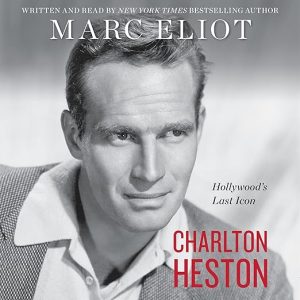
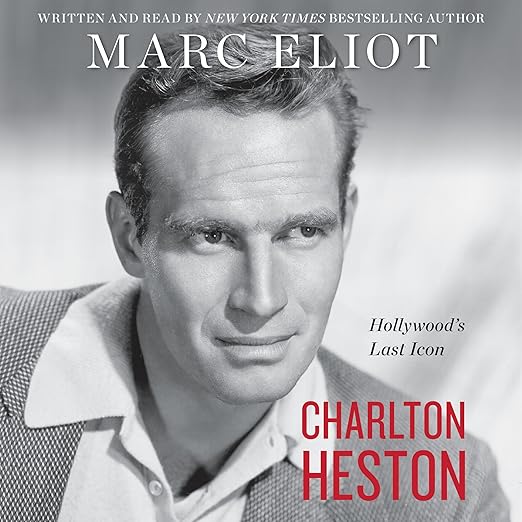
- Read by: Marc Eliot narrating his own biography of Charlton Heston creates an author-invested reading, though a professional narrator might have added more vocal variety across the nineteen-hour runtime.
- At its heart: Hollywood myth-making, political identity shift from left to right, the cost of sustaining an iconic image
- Vibe: Thorough, engaged, and occasionally revelatory
- Short version: Marc Eliot's biography draws on exclusive access to Heston's diaries and personal estate to produce the most complete portrait of this polarizing screen legend yet assembled.
Charlton Heston's career is one of the more genuinely strange arcs in twentieth-century American cultural life. The actor who played Moses in The Ten Commandments, won an Academy Award for Ben-Hur, and embodied the anguished astronaut George Taylor in 1968's Planet of the Apes also marched with Martin Luther King Jr. in 1963, before eventually becoming one of the most recognizable faces of the National Rifle Association and the man behind the phrase "from my cold, dead hands." That is not a simple story, and Marc Eliot's audiobook biography does not attempt to simplify it.
Eliot is the New York Times bestselling author of previous biographies including Cary Grant, Walt Disney, and American Rebel, and he brings the same research-intensive approach to this first full biography of Heston. At nineteen hours and thirty-three minutes, it is a comprehensive undertaking narrated by Eliot himself. His access was exceptional: the author was granted exclusive entry to Heston's personal diaries, letters, and estate, which gives this biography a depth of primary sourcing that separates it from any prior account of the actor's life and the mythology that accumulated around it.
From Civil Rights Activism to NRA Presidency
The biographical subject here resists reduction in genuinely productive ways. Heston's politics shifted dramatically across his life, moving from Democratic activism during the Civil Rights era through staunch Nixon and Reagan republicanism to his late-career identity as an NRA president whose public rhetoric became a flashpoint in American culture. Eliot does not use this biography to adjudicate that arc or deliver a verdict on the man's legacy. What he does instead is follow the story where it leads, allowing Heston's diaries and personal correspondence to complicate the public record at every turn and prevent any single, clean narrative from dominating.
The Hollywood sections are immediately and consistently compelling. Eliot is sharp on the machinery of mid-twentieth-century Hollywood: the competition for prestige roles, the studio dynamics that shaped casting decisions, the particular challenge of maintaining an authentic identity inside what Eliot calls the dreamscape of Tinseltown. Heston emerges as someone acutely aware of his own image and willing to fight for it, both in the roles he pursued and in the public persona he carefully constructed across decades. The biography is as much about how a boy from backwoods Michigan built that persona as it is about the performances that made the persona famous.
Diaries That Had Never Been Public Before
The primary reason is the access Eliot was granted. Heston's diaries had not been made publicly available before this biography, and Eliot draws on them consistently throughout the nineteen hours to show the private man operating behind the public face. Reviewer Galla describes the result as an excellent comprehensive biography that gives full weight to Heston's acting career, from adolescent school plays through early New York stages to Hollywood's golden age, and that comprehensiveness is accurate. This is not a selective portrait designed to flatter or condemn. It is an attempt at the complete record.
Reviewer artemis 1291, who describes having little interest in celebrity biography as a genre, found the book functioning as a history of American cinema, which it partly is and intentionally so. Heston was present at so many pivotal moments in both Hollywood and American political life that following his story becomes a way of following the culture itself across a crucial half-century. Eliot is attentive to those larger historical currents without allowing them to overwhelm the individual life at the center of the narrative.
Cinematic Legacy and Political Controversy, Not Separable
The sheer comprehensiveness of the biography is also its own argument. Previous accounts of Heston's life have tended to focus on either the cinematic legacy or the political controversy, treating the two as separable stories about the same man. Eliot refuses that division, and the nineteen-hour runtime reflects a genuine insistence on the full picture. Listeners who commit to the complete audiobook will come away with an understanding of Heston that is genuinely more complicated, and more interesting, than the caricature in either direction that popular memory has settled on.
More Uniform Than a Professional Narrator Would Be
Eliot narrates his own biography, and across nearly twenty hours, that choice shapes the listening experience considerably. He is an engaged and clearly invested reader of his own material, but self-narrated audiobooks of this length can feel more uniform than what a professional narrator with a wider vocal range would produce. Listeners who are particularly sensitive to narration variety should factor this into their decision when weighing the format against print.
The political chapters require some patience, particularly for listeners whose primary interest is in Heston's film career. Eliot treats the NRA presidency and Heston's transformation from Civil Rights marcher to gun-rights crusader with the same thoroughness he applies to the cinematic biography, which is the correct editorial choice but produces sections that will engage some listeners more intensely than others. The late chapters dealing with Heston's Alzheimer's diagnosis and decline are handled with notable care and emotional respect for the subject.
The Definitive Treatment, as of This Writing
Fans of classic Hollywood biography who want the most complete account of Heston's life and career currently available will find this audiobook essential. The combination of primary source access, Eliot's established track record as a Hollywood biographer, and the nineteen-hour scope makes it the definitive treatment of the subject as of this writing. Listeners interested in how American political identity intersected with cultural celebrity in the second half of the twentieth century will find it equally valuable from that angle.
Readers approaching the audiobook primarily for the films should know they are getting a full life biography that treats Heston's political evolution with as much weight as his acting achievements. That comprehensiveness is genuinely a feature rather than a flaw, but it does affect the balance of what the listening experience feels like hour to hour. At nearly twenty hours, this is a commitment that earns its length for listeners who bring patience and genuine curiosity about the full life rather than just the cinematic highlights.
Does Marc Eliot narrate the Charlton Heston audiobook himself?
Yes. Eliot both wrote and narrated the biography, which lends it an author's investment but also means listeners should be prepared for a single voice across the nearly twenty-hour runtime. His engagement with the material is evident throughout, though professional narrators typically provide more vocal range over such a long production.
What primary sources does the Charlton Heston audiobook draw on?
Eliot was granted exclusive access to Heston's personal diaries, letters, and estate, making this the most thoroughly sourced biography of the actor yet published. Those primary materials allow Eliot to show the private Heston behind the public persona in ways previous accounts could not.
Is the Charlton Heston audiobook suitable for listeners who are not already fans of the actor?
Reviewer artemis 1291, who describes having little typical interest in celebrity biography, found the book worked as a broader history of American cinema and politics. If Heston himself is not your primary entry point but mid-century Hollywood or the cultural history of the gun-rights movement is, Eliot's biography still rewards the nearly twenty hours.