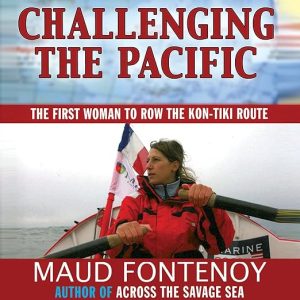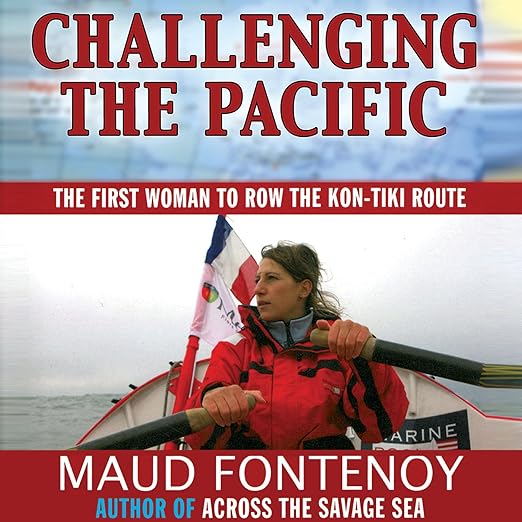
- Performance: Eliza Foss captures Fontenoy's voice with the right mix of vulnerability and steel, keeping the physical and psychological extremes of the solo Pacific crossing vivid through four hours of open-water storytelling.
- What it covers: Solo human endurance, gender and exploration, confronting psychological limits at sea
- Feel: Solitary and intense, with long stretches of quiet punctuated by moments of real fear
- Our call: A genuine adventure memoir that earns its place alongside the great solo oceanic narratives, narrated with the tonal precision the material demands.
Solo oceanic rowing is among the most extreme forms of human voluntary suffering, and Maud Fontenoy volunteered for it twice. Challenging the Pacific is the audiobook account of her second solo crossing, rowing the South Pacific alone, a feat no woman had accomplished before her at the time. She had already rowed the North Atlantic alone, so she arrived at this challenge with a practiced understanding of what isolation, physical depletion, circling sharks, and oceanic weather systems feel like across weeks without another human being. That prior experience is part of what makes this account so specific and so psychologically interesting: Fontenoy is not discovering for the first time what she is capable of. She is testing whether that capacity has limits she had not yet found on the Atlantic.
Eliza Foss narrates, and the question with memoir narration like this is always whether the voice can hold up through the long interior stretches that define genuine adventure writing. The South Pacific crossing was not a series of dramatic set pieces compressed into a four-hour narrative. Most of it was drudgery and pain and solitude, broken occasionally by weather events, marine wildlife, and the specific hallucinations that extended sleep deprivation produces at sea. Foss handles those interior passages with the kind of restraint they require: not performed anguish, but the measured recounting of someone working through what they witnessed from inside a very small boat a very long way from land.
Named one of Time Magazine International's thirty most important people of 2005, Fontenoy already had a public profile at the time of publication that would sustain interest in her account beyond the adventure memoir readership. But the book earns its audience on its own terms rather than on the platform of that recognition. The writing, rendered by Foss with appropriate attention to the prose rhythms, conveys the specific texture of oceanic solitude: the way time changes its character at sea, the way small decisions take on enormous weight when there is no one to consult, the way the body continues to function past the point where the mind would prefer to stop and reconsider what it agreed to.
A reviewer who listened to the audio described it as conveying the challenge authentically, which is the threshold test for this genre: does the listener feel in the boat, or are they reading a report from someone who was? Another called Fontenoy "the epitome of a modern-day explorer and an incredible writer," noting that the narration placed the listener alongside her in the tiny vessel. That quality of presence, the sense of immediate physical reality rather than retrospective summary, is what distinguishes the better solo adventure memoirs from the merely competent ones.
What Stands Out
The South Pacific crossing is more psychologically demanding than the North Atlantic in some respects that Fontenoy explores carefully, and the comparison between the two voyages is one of the book's most interesting analytical threads. Having done it once, she knew precisely what was coming across the weeks of the Pacific attempt. The uncertainty that sustains a first crossing is replaced by a different kind of ordeal: walking back into known suffering with full prior knowledge and choosing to do it anyway. That dimension of the story is the book's most compelling psychological territory, and it gives the account an interior complexity that goes beyond pure adventure cataloguing or record-setting documentation.
The sharks appear with some frequency in the early chapters, and Fontenoy's handling of those encounters is characteristic of her broader narrative approach: matter-of-fact about the danger, unwilling to inflate it for dramatic effect, but entirely clear about the reality of what circling predators mean for someone alone in a small boat in the middle of an ocean with no rescue available within any useful distance. The balance between documenting the experience honestly and dramatizing it in a way that would betray the reader's trust is handled carefully throughout.
Things to Know Before Starting Challenging the Pacific
One reviewer described the book as "a bit repetitive," which is an honest observation about the inherent structural challenge of solo oceanic narrative. The ocean does not provide much variety of setting, and the psychological states available to someone rowing alone for weeks have a limited repertoire. The best solo adventure writing addresses this by going deeper into the interior rather than seeking external novelty, and Fontenoy does this with varying success across the book's four-hour runtime. The middle sections are where the repetition is most noticeable; the opening and closing passages carry the strongest narrative momentum and the most clearly articulated stakes.
At four hours and eleven minutes, the listening experience is brief enough that the repetition concern is manageable. This is not a fifteen-hour expedition narrative that requires sustained engagement across multiple sessions. A single afternoon is sufficient to take the full journey, which makes it accessible to listeners who are genuinely curious about solo oceanic exploration but uncertain about committing to a longer and more demanding treatment of the subject.
Best Suited For
Readers who respond to human endurance narratives, particularly those centered on solo oceanic adventure and the psychology of extended isolation, will find Fontenoy's account a reliable and occasionally remarkable piece of adventure writing. Listeners interested in the specific history of women in extreme exploration will appreciate the historical context the book provides naturally: she was the first woman to row the South Pacific solo, and the book's awareness of that fact is woven into the account without becoming its sole purpose. Those expecting rich description of Polynesian geography or island culture will need to look elsewhere: the open ocean provides very little scenery variation, and the book is honest about that from the beginning.
Questions Listeners Ask
Do I need to have read or listened to Fontenoy's North Atlantic crossing account before this audiobook?
No, Challenging the Pacific stands alone. Fontenoy provides enough context about her North Atlantic experience to situate the South Pacific crossing without requiring familiarity with a prior account. The comparison between the two crossings is actually part of the audiobook's psychological depth.
How does the Challenging the Pacific audiobook handle the long stretches of oceanic monotony that define solo rowing expeditions?
Fontenoy goes inward rather than seeking external variety, examining the psychological states that solo endurance produces across weeks without human contact. One reviewer noted some repetition, which is inherent to the subject. The four-hour runtime keeps this manageable compared to longer treatments of similar subjects.
Is this audiobook suitable for listeners with no background in sailing or oceanic rowing?
Yes. Fontenoy writes for a general audience and does not require technical knowledge of maritime navigation or rowing. The book is primarily a psychological and endurance memoir rather than a technical account, making it accessible to anyone interested in extreme human achievement regardless of maritime background.
How does Eliza Foss's narration compare to having Fontenoy narrate her own story?
Foss delivers the material with emotional restraint that suits the memoir's measured tone throughout. Fontenoy does not narrate her own account in this production, and Foss brings the interiority of the solo crossing experience across effectively without performing emotions that the text conveys through circumstance and physical detail.