Key Details
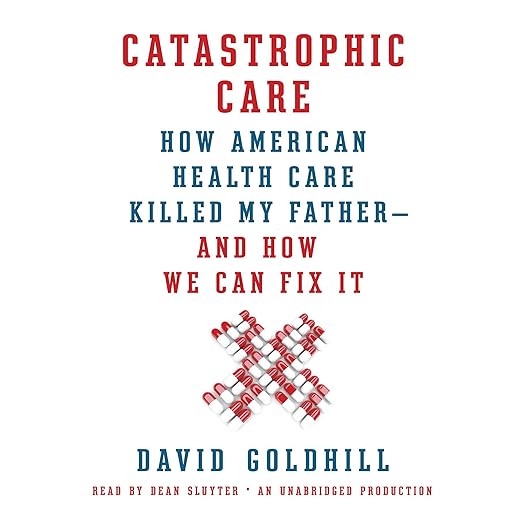
- Read by: Dean Sluyter brings a measured, intelligent delivery that suits the analytical tone - clear without being dry, and he never lets the density of the argument obscure its structure.
- At its heart: The insurance-driven failure of American healthcare, patient-as-pawn economics, systemic reform from a consumer-first perspective
- Vibe: Controlled outrage channeled into rigorous analysis - the frustration is there, but it earns its conclusions
- Short version: An essential listen for anyone trying to understand why American healthcare fails, with proposals serious enough to argue with rather than dismiss.
I came to Catastrophic Care after a medical billing dispute that had been grinding on for months - the kind of experience that leaves you alternately furious and baffled, unsure whether you are dealing with incompetence or a system functioning exactly as designed. David Goldhill's book answered that question clearly and in ways I was not fully prepared for, because the answer implicates everyone, including the patients who (reasonably) want more coverage rather than less.
The origin of the book is personal: Goldhill's father died in 2007 from infections acquired in a hospital, one of more than two hundred thousand avoidable deaths per year from medical error in the United States. Medicare paid the bill in full. That combination - avoidable death, perfect payment - sent Goldhill down a years-long investigation into why the system works the way it does. What makes the book remarkable is that he approaches that investigation not as a grieving son looking for someone to blame, but as a businessman trying to understand a broken market. The analysis is sharper for that distance.
The Island of Healthcare, Cut Off From Markets
Goldhill's central metaphor - the Island of healthcare versus the Mainland of the broader economy - is genuinely useful rather than decorative. The argument is that healthcare operates as a sealed system insulated from every competitive and quality-improving mechanism that functions elsewhere. Prices are hidden. Consumers are not real customers. Accountability is diffuse. The insurer, not the patient, is the actual customer of the hospital, and hospitals optimize accordingly. None of this is conspiratorial; it is structural, and Goldhill traces the structural logic with patience and precision across thirteen hours of narration.
The most challenging section for many listeners will be his treatment of the Affordable Care Act. Published in 2013, the book argues that expanding insurance coverage without fixing the underlying market structure will deepen rather than solve the core problems. This is a politically uncomfortable argument that does not map neatly onto either party's preferred narrative, which is partly what gives it its analytic credibility. Goldhill is not a partisan critic; he is a systems thinker, and systems thinkers tend to make everyone uncomfortable.
Sluyter Carries Thirteen Hours of Cumulative Argument
Dean Sluyter's narration handles the book's analytical density well. Catastrophic Care is an argument book, not a story, and it requires a narrator who can carry complex structure across long passages without losing the listener. Sluyter reads with consistent clarity and a sense of purpose that helps you track where you are in the argument even when the material gets granular. At thirteen hours, this is a substantial investment, and the narration makes it feel worth the time rather than like work.
The audio format also benefits from what I would call the book's cumulative effect. Goldhill builds his argument patiently - each chapter extends the previous one's logic rather than introducing new evidence from scratch. Listening rather than reading allows that accumulation to feel natural rather than repetitive. By the time you reach his proposed alternatives, you have spent enough time inside his framework that his suggestions feel like logical outcomes rather than wishful thinking.
A Fix That Unsettles Both Left and Right
The book does not offer a politically simple solution. Goldhill proposes a system that centers the patient as a genuine economic agent - with health savings accounts, catastrophic coverage for truly exceptional costs, and transparent pricing replacing the current maze of insurance intermediaries. Listeners on the left will find his skepticism of expanded coverage unsettling; listeners on the right will find his implicit critique of profit-driven healthcare equally challenging. The book requires you to hold your existing frameworks loosely, which is uncomfortable but productive.
It is also worth noting that this was published in 2013 and draws heavily on the ACA debate of that period. The healthcare landscape has shifted in specific ways since then, but the structural critique has not dated. The market mechanisms Goldhill identifies as broken remain broken. If anything, the subsequent decade has strengthened rather than weakened his core argument.
Clarifying Rather Than Comforting, for Bill Survivors
Anyone who has received a surprise medical bill, watched a family member navigate insurance denials, or simply wondered why American healthcare costs so much and delivers so unpredictably will find this book clarifying. It is not a comfort read - Goldhill's conclusions about why reform has repeatedly failed are genuinely dispiriting. But it is one of the more intellectually honest accounts of why the system is the way it is, and that clarity has its own value. Healthcare workers will find it both infuriating and illuminating. Policy wonks will find it either confirming or challenging depending on their priors. That range is a recommendation in itself.