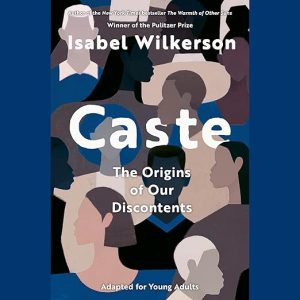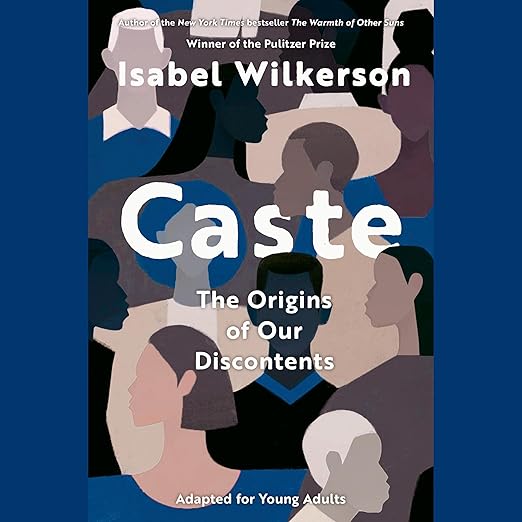
Isabel Wilkerson built Caste over years of systematic research comparing three social hierarchies, and this audiobook adaptation narrated by Robin Miles across ten hours and fifteen minutes brings her argument to audio listeners with all of its moral force intact and its analytical clarity meaningfully sharpened. Wilkerson is a Pulitzer Prize-winning author, and the young adult adaptation of her New York Times bestselling nonfiction work does not soften its core claim: the American experience of race is better understood through the framework of caste than through race alone. Caste is fundamentally about power, specifically which groups have it, which groups do not, and how the system perpetuates itself across generations without requiring the conscious prejudice of any individual actor to sustain it.
The comparative method is the book's most distinctive feature and its most intellectually demanding one. By placing Jim Crow alongside the Nuremberg Laws alongside India's treatment of Dalits, Wilkerson forces her reader to see the structural similarities between these systems that would be invisible if examined in isolation from each other. The Nazi legal scholars who drafted the Nuremberg Laws studied American Jim Crow legislation in considerable detail, incorporating some elements and explicitly rejecting others as too extreme for their purposes. That specific parallel is among the most disturbing and most important pieces of evidence in the entire audiobook, and Miles delivers it with the controlled gravity it fully deserves.
What Isabel Wilkerson Delivers
The young adult framing is less a simplification than a careful clarification. Wilkerson's original writing is not inaccessible to general readers, but the adaptation trims the most densely footnoted passages and sharpens the through-line between argument and evidence, making the logic of the comparative method easier to follow for listeners who have not already encountered the framework elsewhere. One parent reviewer noted that their twelve-year-old summarized the book's purpose as "a good book that spreads enlightenment, and everyone should read it." That the argument lands clearly with a twelve-year-old while remaining substantive enough for adult readers is a genuine accomplishment of the adaptation process rather than evidence of compromise or dilution of the core argument.
Another reviewer paired this with Ava DuVernay's film Origin, which dramatizes the circumstances under which Wilkerson wrote the original Caste and the personal losses she sustained during the research process. That pairing proves instructive in both directions: the film provides emotional context that makes the audiobook's analytical register feel more grounded and personal, while the audiobook provides intellectual scaffolding that makes the film's specific dramatized scenes legible within Wilkerson's larger structural argument about hierarchy and power. A third reviewer reported reading the book twice and creating a personal synopsis for ongoing reference, which speaks directly to how densely the material rewards sustained and repeated engagement rather than a single pass through.
Robin Miles is among the most consistently dependable narrators working in serious nonfiction, and her voice carries the specific combination of qualities this particular material demands. Intellectual authority that does not foreclose emotion, and emotional honesty that does not overwhelm argument: both are required throughout, and Miles maintains that difficult balance consistently. The passages where Wilkerson narrates specific incidents involving real people whose lives illustrate the mechanisms of caste require a narrator who can honor the individual human story without losing the structural argument they are meant to illuminate. Miles accomplishes this throughout the audiobook's full ten-hour runtime.
The India chapters, which some listeners find less immediately familiar than the American material, are among the strongest in audio format. Miles gives them the same weight as the American chapters, refusing to allow the comparative material to feel like mere backdrop for a primarily domestic argument about American race. Wilkerson's entire point depends on the comparative method working fully and symmetrically across all three case studies, and Miles' narration enforces that equal treatment without making it feel labored or artificially balanced.
Where Isabel Wilkerson Loses Some Ground
Pay attention to Wilkerson's deliberate use of the term "dominant caste" in preference to "white people" as a methodological choice she makes explicit in the text. The goal is to describe a structural position rather than a category of persons, and that distinction matters enormously for how the argument functions and how it is received by different readers. Miles delivers that distinction clearly enough that it registers as analytically significant rather than as rhetorical hedging. Also notice the passages where Wilkerson examines how the caste system operates on the bodies and psyches of those it ranks at its lowest tiers: the research on chronic stress, health outcomes, and the daily cognitive load of navigating an externally imposed hierarchy is some of the most quietly devastating evidence in the audiobook.
Who Should Pick Up Caste
This audiobook works for general readers interested in American history and the mechanics of racial hierarchy, for classroom use at the high school level and above, and for any listener who encountered the original adult Caste but found its length or density a barrier to completing it. The young adult adaptation is not a lesser version of Wilkerson's argument; it is a more accessible entry to the same intellectual terrain. Miles' narration makes the ten hours feel purposefully spent rather than simply passed through, and the audio format allows the comparative argument's cumulative weight to build across three separate case studies in a way that episodic or summary readings simply cannot replicate. Parents sharing this with teenagers will find the adaptation's clarity a genuine asset rather than a sign of reduced intellectual ambition.