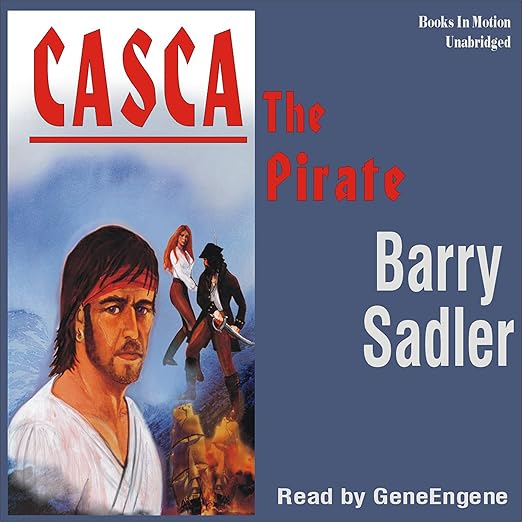
Barry Sadler's Casca series runs on one of pulp historical fiction's most reliably effective conceits: a Roman soldier cursed to immortality, thrust through time and across history, serving and fighting and surviving in whatever era the plot deposits him. Casca the Pirate audiobook is the fifteenth entry in that series and the final volume Sadler himself completed before his death in 1989. That distinction matters for readers who have followed the eternal mercenary from his Roman origins through the Crusades, the Hundred Years' War, and a dozen other theaters of human violence. This is the last chapter Sadler wrote himself, and it sends his character into one of pulp adventure's most irresistible settings: the early 1700s Caribbean, the golden age of piracy, Jamaica and Bluebeard and a rescue mission through waters full of cutthroats.
The premise is stripped down to its operational core, as Casca novels always are. Casca finds himself in Jamaica, pressed into service under the infamous pirate Bluebeard, tasked with leading a crew of assorted criminals in an attempt to rescue Michelle LeBeau from her captor. The series has never been about elaboration. It is about putting an immortal man who has seen everything into a new historical situation and watching the collision between his accumulated experience and the specific demands of the present moment. Two thousand years of warfare compressed into one body, navigating Caribbean piracy with the discipline of a Roman legionnaire and the patience of someone who knows he'll survive whatever happens next.
How Casca the Pirate Holds Up
Reviewer Kindle Customer offered an honest capsule assessment: a fresh if misogynistic look at pirates in the early 1700s. The modifier is important context. Sadler was writing pulp adventure fiction in a tradition with specific genre conventions about gender, women, and rescue narratives, and those conventions are present in the text. This is not a sanitized historical adventure. It is a product of its genre era, and readers who approach the series knowing what it is will find the pirate installment delivers what the series has always promised without disguising its origins.
What the series does well is historical flavor rendered efficiently. The early 1700s Caribbean has a specific texture, the island society of Jamaica, the social structure of pirate operations, the specific mixture of violence and mercantile interest that defined the period, and Sadler sketches that texture with the assurance of someone who did the research and then moved quickly to the action. Reviewer Timothy Clifford, describing the series as "the greatest serial ever," captures the specific kind of loyalty this franchise generates: the satisfaction of a consistent and reliable formula executed without pretension across a long run of installments.
Why Casca the Pirate Works as an Audiobook
Gene Engene's narration fits the material well. Casca novels operate in the register of adventure serials rather than literary fiction, and what the audio format requires is consistent pacing, clear action sequencing, and a tone that respects the pulp tradition without condescending to it. Engene delivers all three. The four hours and forty minutes of runtime move at the right pace for the material, and the period dialogue and Caribbean setting are handled with straightforward delivery that serves the story's forward momentum.
For the established Casca listener, the audio format offers something the print version cannot: the experience of a narrator carrying the eternal soldier's voice across a sustained performance. Casca's specific psychology, the accumulated weight of two thousand years of continuous warfare and loss carried in a body that cannot age out of combat, is best conveyed through a performance that maintains that baseline of exhausted capability throughout. Engene understands the register and maintains it.
Weak Spots in Casca the Pirate
This is a reissue, and the reissue status is relevant context for understanding the audiobook's place in the series history. Sadler completed fifteen novels himself, and Casca the Pirate marks the end of his direct authorial contribution to the eternal soldier's chronicle. The series continued under other authors in subsequent volumes, but this entry carries the specific authority of Sadler's own voice and vision for the character. For series completists, finishing Sadler's own run has a particular significance beyond the individual story's merits.
As with all Casca novels, this entry functions best within the series context rather than as an independent introduction to the character. The immortality premise, the specific nature of the curse that binds Casca to his endless martial existence, and the psychological texture that makes him more than a simple adventure protagonist are all established in earlier volumes. The pirate setting is accessible enough that a new reader could follow the events, but the weight of Casca's situation is most fully felt by listeners who have spent time with him across multiple historical periods.
The plot's brevity is a feature rather than a limitation. Sadler doesn't pad these novels, and the rescue mission structure of Casca the Pirate moves with the directness of a writer who knows his audience values momentum over elaboration. The historical color is present without dominating. The action is clear without being excessive. This is pulp adventure craft at a workmanlike level that has sustained reader affection across decades.
Who Should Listen to Casca the Pirate
Established Casca series followers who want to complete Sadler's own fifteen-volume run will find this a fitting final entry in the original sequence. The pirate period is one of the more naturally appealing settings the series has visited, and the rescue mission premise delivers the kind of focused adventure narrative the series executes reliably. Reviewer Jonathan W. Baker's note, "Got this to go with the rest," perfectly summarizes the completist mentality that drives much of the series' readership: each volume extends a chronicle, and completion is part of the appeal.
Fans of pulp historical adventure fiction who haven't encountered the Casca series and are drawn by the pirate setting specifically may want to start at the beginning to understand the foundational mythology before arriving at number fifteen. Those approaching with literary fiction expectations or sensitivity to dated pulp genre conventions regarding gender should know that both apply to this entry, and Sadler's work inhabits its genre without apology.
Key Details
- Narration: Gene Engene delivers Casca's 15th adventure with the straightforward performance the series requires, keeping the pirate-era action moving without theatrical excess.
- Themes: The eternal soldier and his immortality curse, Caribbean piracy, rescue and loyalty
- Mood: Pulpy and kinetic, with the historical adventure texture of a series built on one endlessly reinvented premise
- Verdict: A compact four-hour entry for established Casca fans that puts Barry Sadler's eternal soldier among Bluebeard's pirates in the early 1700s Caribbean, delivering exactly what the series promises.
Is this audiobook the last entry Barry Sadler himself wrote, or did the series continue under other authors after him?
Casca the Pirate is the fifteenth and final volume in Barry Sadler's own run of the series. Sadler died in 1989, and the Casca series has continued under other authors in subsequent volumes. This makes the audiobook the conclusion of Sadler's direct authorial contribution to the eternal soldier's chronicle.
How historically accurate is the Caribbean pirate setting in this audiobook?
The novel uses the early 1700s Caribbean as an adventure backdrop rather than a rigorously researched historical setting. The period flavor is present, with references to Jamaica and Bluebeard, and reviewer Kindle Customer noted the fresh if genre-conventional treatment of piracy. Casca novels are adventure serials, not historical fiction in the research-intensive mode, and the historical setting serves the action premise accordingly.
What is the runtime of this audiobook, and does the length suit the material?
At four hours and forty minutes, Casca the Pirate is a tight and appropriately paced adventure audiobook. Sadler writes economically, and the rescue mission structure keeps the runtime focused. The series has never been known for lengthy installments, and this entry delivers the complete story without padding.