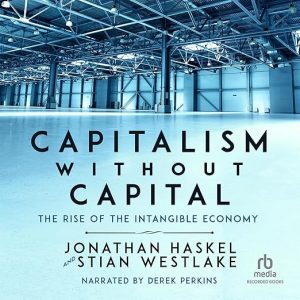
I came back to Capitalism Without Capital a second time in the context of trying to understand why a software company with almost no physical assets could be worth more than an industrial manufacturer with factories across three continents. The question sounds simple and the answer turns out to be genuinely complicated in ways that go beyond the usual hand-waving about network effects and disruption. Jonathan Haskel and Stian Westlake wrote the book that actually explains the mechanisms, and the first time I read it I realized I had underestimated how much of what I thought I understood about modern economics was built on assumptions that stopped being accurate sometime around the early 2000s.
The book's central claim is that the shift from tangible to intangible investment, from machines and buildings to software, design, branding, and organizational know-how, is not merely a sector story about tech companies but a structural change in how developed economies function. This matters because intangible assets behave differently from tangible ones in ways that have cascading effects: they scale without the limits that physical capital imposes, they spill over across industries in ways that create uneven winners, they are difficult to collateralize which changes the relationship between investment and credit, and they tend to be complementary to other intangibles in ways that concentrate value among firms that can combine them most effectively. The result is an economy that looks increasingly unfamiliar to anyone using frameworks built for a world of factories and machinery.
Scalability, Sunkenness, Spillovers and Synergies Explained
Haskel and Westlake organize intangible investment around four properties they describe as scalability, sunkenness (the fact that intangible investment is difficult to recover if it fails), spillovers (the tendency of intangible value to leak to competitors), and synergies (the way intangibles combine multiplicatively rather than additively). This framework is where the book earns its place as a serious contribution rather than a long magazine article. The four properties explain things that other accounts of the knowledge economy leave vague: why productivity growth has slowed even as technology investment has accelerated, why economic inequality between firms and between geographic regions has increased, and why small-business lending has become harder even in an era of abundant capital. The analysis applies equally to tech firms and pharma companies, to coffee chains and gyms, the breadth of industries covered is one of the book's genuine achievements.
Too Scholarly for Some, Prophetic Since 2017
The book does have a tone problem for general readers. Haskel is a professor of economics at Imperial College London and Westlake is a senior fellow at an innovation policy institute, and they write in the register of people who are primarily accountable to academic peers rather than to a general readership. One reviewer found the book too scholarly for personal taste, and I understand that response, there are chapters, particularly those dealing with measurement methodology for national accounts and the construction of intangible investment data across different countries, where the pace slows considerably and the prose assumes more patience than some listeners will bring. The scenarios presented in the final section for what an intangible-dominated future might look like are more suggestive than analytically developed, which is a missed opportunity at the close of an otherwise rigorous book.
The book's concluding section on policy implications is its most speculative and also its most interesting to revisit in light of what has happened since 2017. The authors suggest that intangible-heavy economies will tend toward greater concentration and inequality unless institutions are redesigned to account for the different behavior of intangible assets. The years since publication have largely confirmed that prediction. The dominance of a small number of technology platforms, the geographic concentration of high-skill employment, and the persistence of productivity puzzles in most developed economies all map cleanly onto the framework Haskel and Westlake developed. Reading the policy sections as a kind of forecast and then checking that forecast against current conditions is itself a useful exercise.
Perkins Keeps Academic Prose From Turning Tedious
Economic nonfiction is a genuinely difficult narration challenge because the material requires both intellectual clarity and enough vocal variation to keep listeners engaged across long stretches of abstract argument. Perkins is competent and consistent, maintaining a measured pace that suits the academic tenor of the writing. The book never becomes actively tedious to listen to, which is a real achievement given that some sections involve detailed discussion of national accounting methodologies. For listeners who are fully invested in the subject matter, the narration will feel appropriately matched to the content; for those who need more performance to stay engaged, the book might work better in print form, where you can pause and reread at will.
For Piketty Readers Wanting a Sharper Mechanism
Listen if you work in economics, business strategy, policy, or investment and want to understand the structural forces reshaping how value is created and distributed in modern economies. This is essential reading for anyone thinking seriously about why the firms winning today look so different from the firms that were winning thirty years ago. Also recommended for listeners who found Thomas Piketty's work on inequality interesting but wanted the mechanism explained more precisely, Haskel and Westlake provide that mechanism in rigorous and specific terms. Skip it if you are looking for accessible business narrative, this is rigorous economic analysis, and the rewards are commensurate with the patience and prior knowledge the material requires.
Common Questions
How technical is the economic content, and do I need a background in economics to follow it?
Moderately technical. The authors explain their framework clearly and avoid advanced mathematical notation, but the argument is built on economic concepts that benefit from some prior familiarity. Readers with a basic economics background will find it accessible; complete newcomers may find some sections challenging.
Does the book address the specific companies and industries driving the intangible economy, tech, pharma, finance?
Yes, extensively. The authors draw on case studies from technology firms, pharmaceutical companies, coffee chains, gyms, and financial institutions to ground the abstract argument in concrete examples. The range of industries covered is one of the book's genuine strengths.