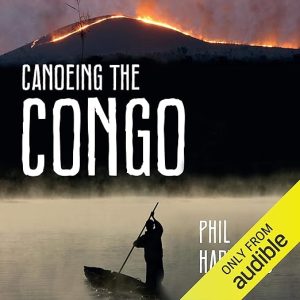
Just short of three thousand miles, the deepest river in the world, a flow rate second only to the Amazon: the numbers around the Congo do most of the intimidating before anybody gets into a boat. Phil Harwood spent five months attempting it alone, from the true source in the highlands of Zambia down to the sea, and the audiobook comes to seven hours and eighteen minutes. What stands out about this record, though, is how much of its description stops describing the journey and starts describing the man who made it.
A Closer Look at Canoeing The Congo
That closing stretch of copy repays attention before you buy, because it is jacket material wearing a synopsis's clothes. It tells you Harwood is an ex-Royal Marine Commando, a ski guide, an expedition leader, an outdoor instructor and a development trainer, then lists him as a qualified mountain leader, a level 4 canoe coach, a level 3 kayak coach, a rock climbing instructor, a wilderness emergency medical technician and a first aid instructor. It also names Ranulph Fiennes and Bill Bryson as writers he enjoys. All of that establishes competence and taste. None of it establishes whether he can write.
Significance arrives in a January 2017 response, which sets the book beside earlier Congo accounts by Jeffrey Tayler and Tim Butcher and names what separates this one: Harwood covered the entire river, from the headwaters in northern Zambia to the Atlantic, using only a canoe and doing better than half of it by himself. That is the claim to significance and it is structural rather than stylistic. Predecessors took sections, took boats, took company. Completeness is the argument here, and completeness is also why seven hours can feel like a compressed account of five months.
What Makes Canoeing The Congo Worth Hearing
Texture is where a March 2019 response beats the publisher's own copy: a first part abundant in evocative nature description, interspersed with the quirky experiences that find a person who ships a canoe to the Congo and paddles off down an enormous river alone. The same entry mentions having already handed its copy to a canoeist friend, which is a reminder that this written column is grading a printed book, and extends the recommendation past canoeists to African travelers, actual or armchair, and to open air adventurers generally.
Gareth Armstrong reads it, and that arrangement deserves a moment. This is a first-person expedition account voiced by somebody other than the man who made the trip, so the I in every sentence belongs to one person and the voice belongs to another. The material is thick with reported speech: immigration officials, fishermen, riverside encounters, all written by an outsider about people he mostly met once. Sample a passage of dialogue rather than a passage of landscape, because how those voices are handled is the difference between a record and a performance of one.
Things to Know Before Starting Canoeing The Congo
The star display is doing something impossible. Five people wrote responses here between April 2015 and December 2025, a full decade of readers, and the counter sitting above them claims a single rating. Then it prints 4.4. No rounding rule converts one vote into that figure, since the only averages a lone rating can display are the whole numbers themselves and 4.4 falls between two of them. The average was therefore computed somewhere else and married to a counter that mislaid its population. Use the decade of responses and ignore the number entirely.
The publisher's copy leans hard on menace, and the book underneath it appears to be more careful than its pitch. The description dwells on man-eating crocodiles, aggressive snakes, spiders' webs the size of houses, a stretch known as The Abattoir with a reputation for cannibalism and crime, and quotes local men asking why his throat has not been cut yet. A November 2022 response reports something rather different: nuanced insight into encounters with difficult immigration authorities, thieves and corrupt police, alongside kind and ethical people who shared humble shelters and supplied expert local knowledge. Buy on the second description.
Set your expectations for the hard material regardless. Harwood is arrested, intimidated, chased and threatened, and at one point he collapses with malaria. On a single stretch he hires four brothers with a shotgun and spends five days and nights on the water under their protection. All of that is the substance of several hours rather than a scene or two, and a listener who wants travel writing as pleasure rather than as endurance should know the proportion before starting. The wildlife is the least of the trouble here.
Who Phil Harwood Is Writing For
Expedition writing readers are the audience here, particularly those for whom completeness matters, since the source-to-sea claim is precisely what separates this from the Congo books that came before it. It rewards anyone who likes an account that stays practical about permits, logistics and the daily labor of moving a boat. An April 2015 response captures the listener it suits, wondering aloud how anyone could put themselves through such life-threatening events while noting that Harwood enjoyed and relished all of it.
Stay away if the register you want is literary rather than reportorial, because the pitch itself signals adventure writing rather than prose you will reread. Stay away too if an outsider moving through Central African communities under armed escort is a framing you would rather not spend an evening inside. One caution is particular to this format: three thousand miles of named tributaries and towns is hard to hold in your head without a map, and nothing supporting ships alongside the file.
At a Glance
- Narration: Gareth Armstrong reads seven hours in which the man telling the story is arrested, threatened and taken ill, so the question worth weighing is whether a hired voice suits an account this personal.
- Themes: a source-to-sea expedition, corruption and hospitality drawn from the same river, solitude as method
- Mood: gritty and forward-moving, closer to a logbook than to a travelogue
- Verdict: The completeness of the descent is what earns the seven hours, and the rating display on this record is worth nothing whatsoever.
Common Questions
Does this audiobook cover the whole river or only part of it?
The whole of it, which is the book's claim to significance. Harwood started at the river's true source in Zambia and finished at the Atlantic, close to three thousand miles later, across roughly five months and largely on his own. Earlier Congo accounts covered sections; this one takes the descent end to end.
How graphic is the danger in this audiobook?
Substantial without being gratuitous. Arrests, death threats, endemic corruption, a collapse from malaria and a stretch traveled under armed escort all feature, and the publisher's copy pushes the menace harder than the reading needs to. Expect sustained physical risk rather than horror, with the animals ranking well down the list.
Is it a problem that the author does not read his own story?
It alters the experience rather than damaging it. A hired reader puts a layer between you and a first-person account, which some listeners value for its steadiness and others feel as distance. Where it matters most is the reported speech, since the handling of local voices carries real weight in a book like this.
Do I need a map to follow this audiobook?
It genuinely helps. Seven hours of river geography, running from the headwaters down to the Atlantic, arrives as names and distances with nothing to look at, and the listing names no supporting material. Keeping a map open on a phone converts a sequence of place names into an actual route.