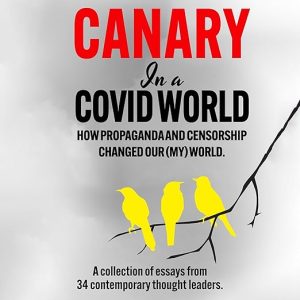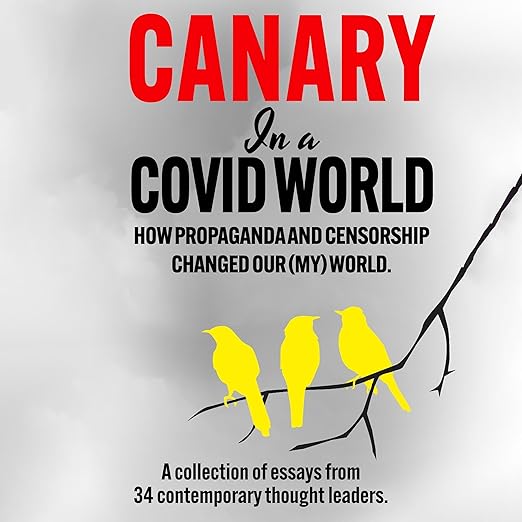
Collections like Canary in a Covid World present a particular challenge for a reviewer. The thirty-four contributors to this anthology, journalists, lawyers, scientists, academics, physicians, politicians, researchers, and people who describe themselves as vaccine-injured, are not speaking from a unified academic framework. They are speaking from a shared conviction: that the public narrative around COVID-19 was shaped by censorship and institutional power in ways that suppressed legitimate dissent, and that the damage from that suppression was real. Whether you approach this audiobook as essential counterprogramming or as misinformation depends almost entirely on where you already stand. But the audiobook itself, as a produced listening experience, is something I can address with more precision than the debates it describes.
The full-cast format is the collection's defining production choice, and it is the right one. These are essays written by the people who lived them, and hearing each contributor read their own words creates an intimacy that anthology readings often fail to achieve. Some voices are polished. The journalists and politicians among the contributors speak with the practiced confidence of people accustomed to public platforms. Others are rawer, more fragmented in their delivery, and those moments are often the most affecting. The effect of thirty-four distinct voices in sequence is not cacophony; it is, as editor C.H. Klotz suggests in framing the collection, a choir rather than a series of solos.
Thirty-Four Voices Build Arguments Rather Than Assertions
The audiobook runs just under twelve hours, which is a substantial listening commitment for an essay collection. The organization gives contributors enough space to build arguments rather than simply assert positions, and the range of professional backgrounds represented means the collection comes at its central questions from multiple angles simultaneously. A lawyer writing about mandates and legal rights sounds different from a scientist writing about data interpretation, and both sound different from a parent writing about what public health messaging did to their family. The breadth is intentional, and it succeeds in making the anthology feel like a community of shared concern rather than a single polemical voice amplified thirty-four times.
Reviewer A Very Concerned Educator described the collection as using logic and real data to make sense of the pandemic years, and credited the contributors with helping them avoid despair and panic during a difficult period. Reviewer R. Linnell applauded the willingness of people to speak against what they see as the mainstream narrative regardless of professional cost. These responses reflect the audiobook's primary audience: listeners who felt during the pandemic that their questions were unwelcome, and who are looking for a record confirming that their skepticism was shared by credentialed professionals willing to say so publicly.
Just Under Twelve Hours of Consistent Production
The production quality across the contributor recordings is notably consistent given that thirty-four different people are speaking. This is a technical achievement worth noting in a multi-contributor anthology. Some variation in room acoustics and recording environments is present, as you would expect when contributors record from different locations, but the editorial work holding the collection together is audible. The transitions between essays are handled cleanly, and the overall listening experience does not feel like a patchwork of disconnected recordings stitched together as an afterthought.
For listeners genuinely curious about what the dissident COVID scientific and policy community was arguing, not necessarily to validate or dismiss those arguments but to understand what was being said by people who felt they were sounding alarms that institutions refused to hear, this audiobook provides that record in a format far more engaging than reading through archived articles and independent newsletters. It functions as a primary source document of a particular moment in public discourse, which has its own historical value regardless of where any individual listener comes down on the underlying questions.
Editorial Framing Rejects Any Claim to Neutrality
The editorial framing does not claim neutrality. The collection's premise is that mainstream media and public health institutions became instruments of propaganda, as the synopsis states explicitly, and the selection of contributors reflects that premise rather than presenting a balanced spectrum of pandemic-era perspectives. Listeners who approach it expecting a fair accounting of the full range of COVID-era scientific debate will be disappointed; this is advocacy documentation, not journalism in the traditional sense, and it does not contextualize its claims against the mainstream scientific record within the audiobook itself.
Prospective listeners should also be aware that the subject of COVID remains among the most heated and contested topics in contemporary discourse. The audiobook makes strong claims about censorship, institutional dishonesty, and the suppression of evidence. Those claims are presented with conviction and specificity by credentialed contributors who staked their professional reputations on making them publicly. Weighing those claims against the broader public health record is work the audiobook does not do and does not intend to do.
Mainstream-Media Skeptics Are This Collection's Audience
Listeners who felt during the pandemic that their questions were marginalized, who distrust mainstream media accounts of COVID-19 policy, or who want to understand the specific arguments made by the dissident professional community during and after the pandemic will find this anthology a thorough and affecting document. Listeners who accept the mainstream institutional consensus on COVID and vaccines as sound and well-supported should know that this collection treats those institutions as the primary antagonists of its narrative. The emotional weight of thirty-four contributors speaking in personal terms over nearly twelve hours will be difficult to engage with critically throughout, and the audiobook does not invite that kind of engagement.
In Brief
- Narrator: Full cast of thirty-four contributors reading their own essays gives the collection an authenticity and vocal range that a single narrator could not replicate.
- Subjects: COVID-19 policy dissent, censorship and media criticism, individual voices against institutional consensus
- Tone: Urgent and confrontational
- Bottom line: A full-cast anthology of dissident COVID-era voices that will resonate deeply with listeners already skeptical of mainstream pandemic narratives, and strongly challenge those who are not.
Frequently Asked Questions
Who are the thirty-four contributors to Canary in a Covid World, and what professional backgrounds do they represent?
The contributors include journalists, lawyers, judges, scientists, physicians, academics, politicians, researchers, data analysts, and people who identify as vaccine-injured. The breadth of professional backgrounds is one of the collection's deliberate features, presenting dissent from multiple disciplines rather than from a single ideological corner.
Does the full-cast audiobook format work for an essay anthology of this length?
Yes, the full-cast format is well-suited to this material. Each contributor reading their own essay preserves the individual voice and perspective in a way that single-narrator audiobooks of anthology collections cannot. The production quality across thirty-four different recordings is more consistent than you might expect.
Is this audiobook presenting a balanced view of COVID-19, or is it explicitly one-sided?
The collection is explicitly positioned as counter-narrative. It does not present a balanced review of pandemic-era evidence; it documents the arguments made by people who dissented from mainstream institutional guidance. Listeners expecting journalistic balance will not find it here.
At nearly twelve hours, is the audiobook structured so individual essays can be listened to separately, or does it need to be heard in sequence?
Essay collections generally allow for selective listening, and a multi-contributor anthology like this is designed with individual pieces that can stand alone. However, listening in sequence gives you the cumulative effect of diverse voices building a collective argument, which is clearly what the editor intended.