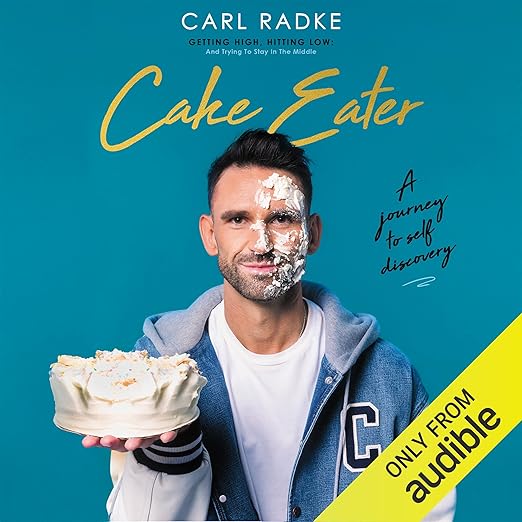
Carl Radke's reputation on Bravo's Summer House was built on a specific character: the life of every party, the person who made the summer feel worth having, the man whose presence guaranteed fun would happen. Cake Eater is the audiobook that arrives after that version of himself became impossible to sustain. Running just under five hours and self-narrated, this memoir covers Radke's journey from that public persona to a sober life built on different foundations: grief actually processed rather than numbed, relationships measured by authenticity rather than entertainment value, and a fundamental redefinition of what fun actually means when alcohol is no longer the currency everyone is trading in.
The celebrity memoir audiobook format in self-narration is a gamble with a clear outcome distribution. Done poorly, it produces a promotional document that sounds like an extended press release. Done with genuine commitment, it creates an intimacy that professional narrators cannot manufacture regardless of skill. Lori Gottlieb, the bestselling author of Maybe You Should Talk to Someone and a New York Times therapist columnist, described Radke's memoir as "deeply personal" and "an honest, heartfelt reminder that healing takes time and self-compassion." Gottlieb is not a person given to cover-quote hyperbole, and her specific framing, healing, time, and self-compassion, is accurate to what this audiobook delivers across its four hours and fifty minutes.
The First Audiobook One Reviewer Ever Finished
The memoir's most significant emotional center is Radke's account of his brother's death and the long shadow that loss cast over his relationship with alcohol and with his own sense of what his life was for. Addiction memoirs often use a single precipitating crisis as a turning-point narrative device, but Radke is honest that sobriety was not a single decision following a single moment. The grief from his brother's loss, the toxic masculinity patterns he absorbed and perpetuated in the Summer House environment, and the particular pressures of being a reality TV figure conducting private battles under public scrutiny: these are treated as a system of interacting pressures rather than a clean causal sequence with a redemptive arc. Reviewer Kelley, who described herself as someone who had never finished an audiobook before, said this one made her rethink her own relationships with her coping mechanisms. That response is the measure of memoir that earns its subject matter.
Reviewer Mariah offered the most substantive critical assessment: honest but holding back. She noted that Radke's visible evolution across Summer House seasons was remarkable but that the memoir felt like it was not surfacing the full weight of what it was working through. That observation is fair and worth sitting with. Self-narrated celebrity memoirs have real constraints around what can be said about living people and ongoing relationships, and Radke navigates those constraints with evident care. Reviewer Lauren was specifically glad the audiobook did not focus heavily on the public breakup, and that choice was clearly intentional rather than evasive.
Redefining Fun Without Alcohol as Currency
Radke's account of redefining fun without alcohol is the memoir's most broadly applicable and under-discussed contribution. "Sober Carl isn't fun" is the implicit accusation he confronts throughout, and his response is both personal and cultural. He is arguing from direct and sustained experience that the version of fun which requires substance is a kind of poverty dressed as abundance, a performance of pleasure rather than the real thing. Listeners who have quit drinking, who are considering it, or who know someone in that position will find his account of navigating social spaces, professional contexts, and relationships without alcohol practically useful rather than just emotionally resonant. The specificity of his experience makes the general principle landing harder.
The audiobook's four hours and fifty minutes is well-proportioned for memoir. The chapters move with enough forward momentum that the introspective sections, which could become self-indulgent in a longer format, feel earned rather than indulgent. Radke's voice throughout has the quality of someone who has done enough therapy to have genuine vocabulary for what he went through, without that vocabulary flattening the rawness of the experience itself.
Richer With Summer House Already Watched
Without some prior context from Summer House, certain sections of this audiobook will land with less dimensional weight. Radke references his arc across multiple seasons, his public sobriety journey, and the ways his behavior changed visibly on camera over time, and for listeners without that reference frame some of the before-and-after comparison requires imagination rather than recognition. The audiobook is not impenetrable without that context, but it is more textured and resonant for listeners who have watched at least part of his reality television arc and remember who he was before.
The repetitive sections that reviewer Lauren flagged are present in a way that is worth noting. Some of the introspective observations about the relationship between masculinity and alcohol, or between professional achievement and personal emptiness, restate themselves in slightly different terms across separate chapters. At this memoir's length it is not a serious problem, but listeners wanting the tightest possible economy of expression will notice it across the runtime.
For Sobriety Journeys, Not Reality TV Gossip
This audiobook is a natural choice for Summer House viewers who followed Radke's transformation on screen and want the private account behind the public evolution. It is also a worthwhile listen for anyone navigating sobriety, considering sobriety, or trying to understand the psychological mechanics of addiction and recovery in a personal and honest register rather than a clinical one. Readers drawn to Lori Gottlieb's recommendation will find the therapeutic framing accurate: this is memoir that takes psychological honesty seriously, even and especially when that honesty is uncomfortable. Those looking for celebrity memoir that covers industry drama, relationship gossip, or behind-the-scenes production stories will find this audiobook focused quite differently than that expectation.
Common Questions
Do you need to have watched Summer House on Bravo to get full value from this audiobook?
Some familiarity with Radke's arc across the show adds context to his before-and-after framing and gives his account of public sobriety additional dimension. But the memoir functions without it. His account of addiction, grief, and recovery does not depend on knowing the television narrative, and the core emotional work stands on its own.
Does Carl Radke's self-narration work for this audiobook, or does it feel too unpolished for the memoir format?
Self-narration is a clear advantage here rather than a limitation. Radke's direct, unfiltered delivery gives the memoir an intimacy that a professional narrator could not manufacture. The rawness of some passages lands harder because it is his actual voice speaking them, and Gottlieb's description of the audiobook as heartfelt reflects that quality directly.
How does this audiobook handle the emotional weight of Radke's brother's death without feeling exploitative?
With considerable care. Radke does not use his brother's death as a narrative pivot point or a clean before-and-after marker. He treats the grief as one thread in a complex system of pressures that shaped his relationship with alcohol and identity, which feels more honest than a simpler causal story would be. Several reviewers found this handling emotionally resonant rather than manipulative.
Is this audiobook primarily about sobriety, or does it cover broader themes that might interest listeners without personal recovery experience?
Sobriety is the organizing context but not the exclusive subject. Radke covers toxic masculinity and how it shaped his public persona, grief processing and the loss of a sibling, the relationship between performance and authenticity, and what fun actually looks like when it no longer requires a performance. Listeners without personal sobriety contexts will find those threads substantive and engaging on their own terms.