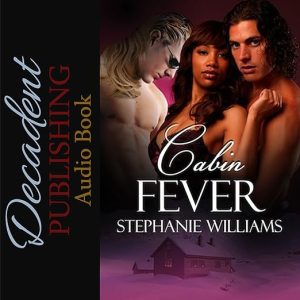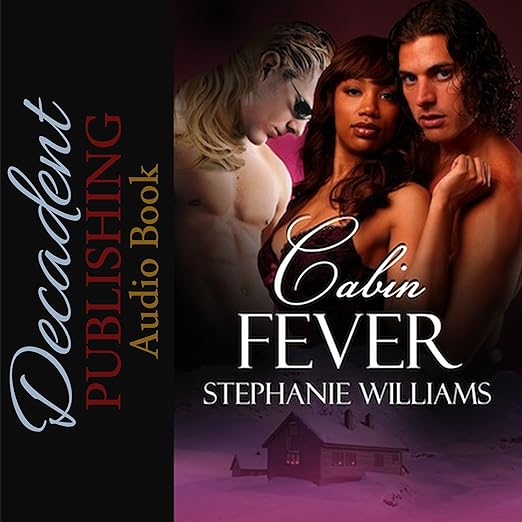
The title of William L. Sullivan's Cabin Fever does real work setting up this audiobook's premise. Sandra, Sean, and Patrick have built a friendship around Boot Camp, their shared gym, and a comfortable professional dynamic that barely contains the feelings running beneath it. When Sean's uncle offers a cabin near the Rockies as a pretext to step away from their routines, the remote location becomes both setting and catalyst. Adrienne Scott's narration navigates the transition from workplace camaraderie to something considerably more complicated with a grounded delivery that keeps the emotional stakes legible even when the material heats up significantly in the cabin sequences.
What distinguishes this from simpler erotic novellas is the attention Sullivan gives to Sandra's interior conflict. She is not passive in her desire but actively managing the implications: the rumors already circulating at Boot Camp, her private fantasies about Sean and Patrick, the fear that testing what the three of them might be to each other could undo the friendship that currently holds everything together. That tension between wanting something and protecting what you already have is the engine of the narrative, and it gives the audiobook more emotional texture than the premise might suggest at first encounter. Sullivan earns the central question by making the friendship feel genuinely valuable before it becomes something more.
A Closer Look at Cabin Fever
The audiobook runs at five hours and seven minutes, which situates it firmly in novella territory. Sullivan uses that length wisely through most of the story, moving between workplace banter, the cabin's enforced proximity, and the gradual dismantling of the professional boundaries Sandra has maintained for years. Scott's narration is particularly effective in the early sections, where the friendship dynamic needs to feel genuinely warm for the stakes of the central question to land properly. A ménage story where the friendship does not feel real before it becomes something else is just logistics. Cabin Fever earns its central turn by building the relationship context first.
Listeners familiar with this genre subtype will recognize the beats: the moment of honest conversation that opens the door, the discovery that desire has been mutual all along, the logistical and emotional challenges of three people navigating something that does not fit conventional frameworks. Sullivan works through those beats without lingering on any single one long enough to let the momentum drop, which is a genuine craft achievement for a novella that has to manage three sets of feelings simultaneously. Scott's differentiation between Sandra's two dynamics with Sean and Patrick respectively adds useful texture to what could otherwise feel symmetric.
The case for audio with this material is partly atmospheric. The cabin setting, with its enforced intimacy and distance from everyday obligations, is exactly the kind of enclosed space that audio brings to life through narration. Scott's delivery of Sandra's uncertainty is more immediate in spoken form than on a page, particularly in the scenes where the three friends are circling the conversation they have been avoiding for what feels like years. Reviewer Brownsugar described Sandra as blessed to live most women's fantasy, which captures the wish-fulfillment dimension Sullivan is consciously working with, but the stronger pull is the question of whether a friendship survives becoming something more, and whether love between three people can be sustained rather than disrupted.
At its runtime, Cabin Fever fits comfortably into an afternoon or a long listening session, which suits listeners who want a contained, emotionally engaging romantic story without committing to an extended series. The Boot Camp setting grounds the characters in a shared professional world with its own pressures and office dynamics, which gives the retreat to the Rockies more weight than it would have with less established context. Scott's voice work sustains the domestic-turned-romantic register throughout without losing either quality.
Things to Know Before Starting Cabin Fever
The most consistent criticism across reader responses concerns the ending, and it is worth naming plainly. Multiple reviewers describe it as arriving too abruptly, before the full relational consequences of the cabin weeks are worked through. Susalina noted it is a good start that just needs more instead of ending where it did, and Mrs. Stephanie Jynelle Imhoff described wanting to see how family and friends come into it after the central relationship has formed. The rating of 3.6 reflects this mixed response: the central romance works, but the resolution does not feel proportionate to the setup invested in the characters.
Reviewers also note that the ménage dynamic involves more sequential intimacy between Sandra and each of the men than fully simultaneous involvement, which may matter to listeners with specific expectations for the subgenre. This is not a spoiler so much as useful framing: the emotional content is genuinely a three-person story, but the physical dynamic has more structure to it than the premise might initially imply. The audiobook's overall experience rewards listeners who prioritize the emotional journey over the explicit content ratio.
Who It's For
This audiobook suits listeners drawn to friends-to-lovers romance with a consensual ménage element and some heat, who are comfortable with a shorter, novella-format narrative. Those who need full narrative resolution and a clear future for the trio should know the ending leaves substantial threads open. Listeners seeking a slow-burn with high emotional payoff will find more here than a purely explicit premise would suggest, though the abrupt close is a genuine limitation. Adrienne Scott's performance makes the audio version the preferred format for engaging with Sullivan's material over the print edition.
- Read by: Adrienne Scott handles the ménage premise with confidence, giving Sandra a grounded voice that keeps the romantic and erotic material from tipping into parody.
- At its heart: Friends-to-lovers, polyamory, trust and emotional risk
- Vibe: Warm and sensual, with an abrupt ending that leaves listeners wanting more
- Short version: William L. Sullivan's novella-length audiobook delivers exactly what the premise promises for readers drawn to consensual friends-to-lovers ménage, though listeners should know the ending arrives before the relationship dynamics fully resolve.
Before You Listen
Is this audiobook explicit, and does the heat level stay consistent throughout?
The content has genuine erotic elements consistent with adult romance novellas. The heat level builds across the runtime rather than appearing immediately, with the first sections establishing the friendship before the cabin setting changes the dynamic. Listeners should expect adult content.
Is this audiobook narrated entirely from Sandra's point of view, or do we get all three perspectives?
The narration centers Sandra's perspective, which is standard for this subgenre. Her interior conflict, desires, and emotional processing drive the story. Sean and Patrick are rendered primarily through their dialogue and behavior rather than their own interiority.