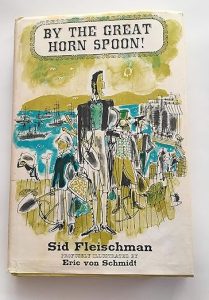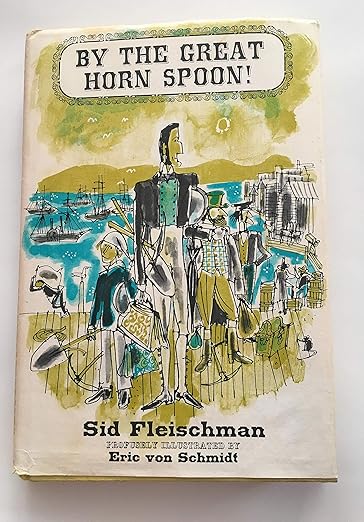
Quick Take
- Narrator: Willard E. Lape leads what the listing credits as a Full Cast Family production, a fitting choice for Fleischman's dialogue-heavy comic adventure.
- Subjects: Gold Rush adventure, unlikely friendship across class lines, reinvention on the frontier
- Tone: Brisk, comic, and warm-hearted
- Bottom line: A short, well-crafted classic adventure that holds up decades after its Disney adaptation, ideal for introducing younger listeners to audiobooks.
Why would two Boston stowaways risk an entire ocean voyage just to chase gold in San Francisco? Sid Fleischman's 1963 adventure novel answers that question with the kind of brisk, comic energy that made him one of the most durable American children's authors of the twentieth century, and this four-hour-and-thirty-two-minute audiobook carries that energy directly into audio. The premise is simple by design: two stowaways, headed for the California Gold Rush, encounter exactly the kind of escalating trouble that made Fleischman's other adventure novels required reading for generations of young listeners.
Fleischman went on to win the 1987 Newbery Medal for The Whipping Boy, and he and his son Paul Fleischman remain the only parent and child to both win Newbery Medals in the award's history, a detail that speaks to just how thoroughly craft and comic timing ran in the family. By the Great Horn Spoon! predates that Newbery win by more than two decades but already shows the same instinct for zesty plotting and genuine historical texture that would define his whole career. That inherited sense of craft is easy to hear in how precisely the novel's comic setpieces are timed and paid off.
The plot itself carries far more specific incident than the bare listing description suggests. Twelve-year-old Jack Flagg and his aunt's unflappable butler Praiseworthy stow away aboard the ship Lady Wilma when it departs Boston on January 27, 1849, after a criminal named Cut-Eye Higgins steals their legitimate tickets; caught and forced to work off their passage in the coal bunkers, they eventually expose Higgins and reclaim their berths. Once in the goldfields, the ever-proper Praiseworthy becomes locally famous under the nickname Bullwhip for his surprising fighting skill, which is exactly where Disney's film adaptation title comes from.
Aunt Arabella's own arc deserves mention alongside her nephew's adventure: having lost her fortune, she eventually travels west herself, and the novel resolves her story with Praiseworthy's marriage proposal once he has given up butlering for good, planning instead to become the first lawyer in the new mining territory. That closing image, a formerly proper English servant reinventing himself entirely on the frontier, gives the comic adventure plot a genuine, earned emotional landing rather than simply stopping once the gold is found.
Why It Works in Audio
This particular novel has a production pedigree worth knowing about: Disney adapted it into the 1967 feature film The Adventures of Bullwhip Griffin, starring Roddy McDowall, which introduced Fleischman's Gold Rush stowaways to an entire generation of moviegoers who may never have picked up the original book. That adaptation history is a useful signal of the story's durability on its own terms, well before streaming-era franchise logic made adapting children's adventure novels into a routine studio strategy.
The listing itself credits narrator Willard E. Lape alongside a Full Cast Family production credit, suggesting this specific edition may be a dramatized, multi-voice recording rather than a single narrator reading straight through, which fits Fleischman's dialogue-heavy, comedic style particularly well; a book built around fast verbal sparring between two mismatched stowaways and the various Gold Rush characters they encounter benefits from a cast able to differentiate those voices clearly rather than one reader carrying every part alone.
Fleischman worked professionally as a stage magician before he became a full-time writer, and that background in misdirection and comic timing is genuinely traceable in how deliberately he plants and then pays off small details across the novel, the same instinct for a well-timed reveal that a magic act depends on, just redirected into prose plotting instead of stagecraft.
Weak Spots in By The Great Horn Spoon!
This specific listing has attracted very little outside feedback so far: no written listener reviews are attached, and the rating sits at a modest 3.6 across only three ratings, numbers that reflect how thinly this specific audiobook edition has been reviewed rather than any independent judgment on the underlying novel, which has remained continuously in print and taught in classrooms for over sixty years. Treat the numeric rating with real caution given how few data points it rests on. Sampling the first chapter before committing is a reasonable way to confirm the cast's comic timing lands for a given household before buying.
At four and a half hours, this is a brisk listen even by children's-adventure standards, appropriate for the source novel's own tight, episodic pacing but worth knowing upfront if a listener is expecting something closer to a modern middle-grade fantasy epic's runtime. The comedic, tall-tale register Fleischman is known for also means the historical Gold Rush setting functions more as colorful backdrop than as rigorously researched period detail, which is the right trade for the audience this book is written for.
The historical backdrop is the real 1849 California Gold Rush, the same wave of prospectors that swelled San Francisco's population and reshaped the American West within a few short years, though Fleischman treats that history with a light, comic touch rather than documentary weight, which is exactly the right register for the audience this book was written for.
This belongs to a specific, durable strand of mid-century American children's literature built around a young protagonist thrown into real historical upheaval and surviving it through wit rather than force, a tradition that runs alongside contemporaries like the Great Brain books and forward into much of the historical-adventure fiction still being published for this age group today.
Who Will Get the Most From It
This audiobook is well suited to families looking for a classic American adventure story with genuine comic timing, listeners specifically drawn to Gold Rush-era historical fiction pitched at a younger audience, and anyone revisiting a childhood favorite that may be more familiar through its Disney adaptation than through the original page. Fleischman's Newbery pedigree, even though it arrived on a different book, is a reasonable signal of quality for parents unfamiliar with this specific earlier title. It also makes a genuinely good pick for a family car trip specifically, short enough to finish over a single long drive and structured in brisk enough episodes that younger listeners can follow it without losing the thread if attention wanders for a stretch.
Skip it if you are looking for a lengthy, immersive listen or a historically rigorous account of the California Gold Rush; this is a tight, funny, character-driven adventure built for readers around middle-grade age rather than a sweeping historical epic. Everyone else looking for a short, well-regarded classic to introduce younger listeners to audiobooks should find this a low-risk, high-reward pick.
How long is the By The Great Horn Spoon! audiobook?
This edition runs four hours and thirty-two minutes, a brisk listen even for a children's adventure novel.
Are there many listener reviews for this audiobook edition?
No, this specific listing has no written reviews attached and only three ratings, so treat the numeric score as a small, early sample rather than a strong signal either way.