Before You Press Play
- Narrator: Kailey Bray reads with clear authority and keeps the financial content accessible without oversimplifying the distinctions between insurance products.
- Subjects: Consumer financial literacy, the gap between common knowledge and professional advice, whole life insurance rehabilitation
- Tone: Methodical and reassuringly systematic
- Bottom line: A useful corrective for anyone who has received contradictory advice about life insurance, though the authors' whole-life preference is a viewpoint to evaluate rather than accept uncritically.
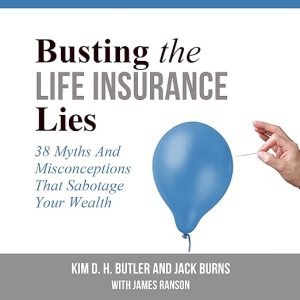
I picked up Busting the Life Insurance Lies at the recommendation of a friend who works in financial planning and wanted a counterargument to deliver to clients who came in having watched too many YouTube videos about term insurance. That is a fairly specific use case, but it illustrates something important about this book: it is designed as a corrective to specific, common misconceptions rather than as a comprehensive introduction to personal finance. At under four hours, it achieves that corrective function efficiently.
Kim Butler and Jack Burns bring a combined fifty-plus years of industry experience to the project, and it shows in how precisely they identify which myths actually circulate and why. The 38 myths the book addresses include everything from the assumption that you lose all your cash value when you die to the belief that life insurance is categorically a bad investment to the more nuanced question of whether borrowing from a policy means borrowing against it or from it. These are the actual confusions that come up in financial planning conversations, not strawman positions invented for easy refutation. Kailey Bray narrates with a professional steadiness that keeps the myth-and-response structure from becoming repetitive. The format is sequential and systematic: you know exactly where you are in the argument at all times.
The authors are frank about their position: they believe in whole life insurance and the infinite banking concept, and the book is written from within that framework. One reviewer with a fair summary of the limitation notes that whole life is one option, not the only option, and that the authors consistently steer toward it as the preferred instrument. That is not a disqualifying bias as long as you know it is there, but it means this is an argument from a specific perspective within the financial advisory world rather than a neutral taxonomy of insurance products. Butler and Burns acknowledge this, and they include a section addressing what they call pro-whole-life lies, which demonstrates a degree of intellectual honesty about the limits of their own preferred approach.
Bray Voices Stephen and Kara's Myth-Busting
The book's narrative device, a fictional couple named Stephen and Kara working through the 38 myths with an advisor, keeps what would otherwise be dry definitional content from losing momentum entirely. One reviewer specifically praised this framing for making a normally boring subject interesting. That is a modest achievement but a real one: Butler and Burns could have written a reference manual and did not. The audio format works better than you might expect for this material because the myth-and-response rhythm is inherently suited to being heard rather than read. Bray maintains the distinction between the Stephen and Kara dialogue sections and the direct-address explanatory passages without heavy dramatization, which is the right approach for content that needs to stay clear rather than entertaining.
Understating a Case That Deserved More Force
One reviewer who gave the book five stars offered a specific and honest critique: the authors understate their case to the point where readers may fail to grasp the significance of what is being argued. That is an unusual complaint for a clarity-focused book, but it tracks. Butler and Burns are careful and methodical in a way that can blunt the force of arguments that genuinely deserve emphasis. The three-hour-fifty-minute runtime is efficient but means some of the 38 myths receive fairly brief treatment. Listeners who want to fully evaluate the whole-life arguments against alternatives like buy-term-and-invest-the-difference will need to do supplementary reading. This book is excellent at identifying and correcting misunderstandings; it is less comprehensive at adjudicating between competing financial strategies.
For Readers Confused by Contradictory Advice
This is well-suited for people who have received contradictory advice about life insurance from different sources and want a systematic way to evaluate what they have been told. Insurance professionals looking for a tool to share with clients who arrive with misconceptions will find it useful for exactly that purpose. Listeners who already have a strong view that term insurance is always preferable to whole life will find the book argues against that position from the first chapter and should know that going in. Those who want a fully neutral comparison of insurance product types will need a different resource.
Are the authors of Busting the Life Insurance Lies neutral between whole life and term insurance?
No. Kim Butler and Jack Burns are advocates for whole life insurance and the infinite banking concept, and the book is written from within that framework. They do acknowledge limitations of their own position and include a section on pro-whole-life myths, but listeners should know the authors have a clear preference before starting.
Does Kailey Bray's narration make the financial content accessible for listeners without a financial background?
Yes. Bray reads clearly and does not rush through definitions or technical distinctions. The authors also use a fictional couple to walk through each myth in narrative form, which keeps the content accessible without requiring prior financial knowledge.
How does the book handle the advice that term insurance is always better than whole life?
This is one of the central myths the authors address directly and at length. They argue that the term-versus-whole debate is often framed in ways that misrepresent how whole life cash value works and what benefits it provides while the policyholder is still alive, not just at death.
At under four hours, does the book cover all 38 myths adequately?
It covers them efficiently rather than exhaustively. Each myth receives sufficient treatment to identify the misunderstanding and present the authors' correction, but some of the more complex arguments are necessarily compressed. Listeners who want a deep dive into any particular myth will find the book a good starting point for further research rather than a complete treatment.