- Performance: Mike Terry reads with the steady authority the material requires, projecting competence without veering into the self-congratulatory register that some business memoir narration falls into.
- What it covers: Risk calibration in entrepreneurship, going against conventional business wisdom, succession and exit strategy
- Feel: Direct and practical, with the earned confidence of someone recounting what actually worked
- Our call: Golisano's specificity about Paychex's growth is what separates this from generic entrepreneur advice, and Terry's narration respects the intelligence of the listener.
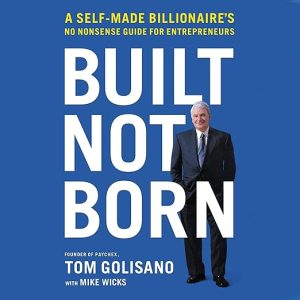
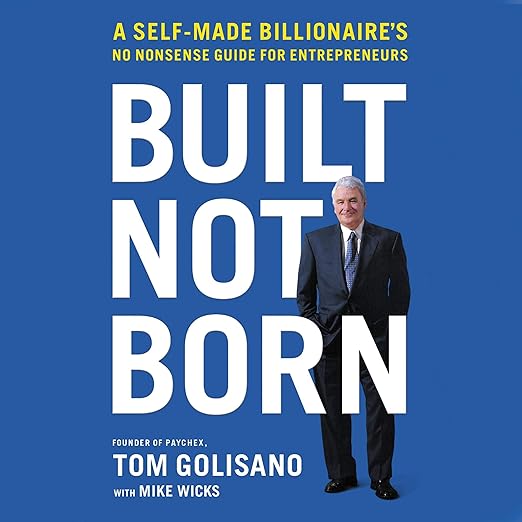
Tom Golisano built Paychex from a $3,000 startup into a $28 billion company, and Built, Not Born is the audiobook version of what that actually required, told without the inspirational softening that makes most business memoirs feel like corporate mythology. The title is the thesis: entrepreneurial success is not a function of personality or innate talent but of specific decisions made repeatedly under specific pressures. Golisano is interested in the decisions, not the mythology, and that distinction makes the listening experience considerably more useful than most titles in the genre.
The framing from the start is practical. Golisano acknowledges directly that aspiring business owners are nervous about risk, and his response is not to minimize that fear but to give it specific content. What risks are actually dangerous versus what risks look dangerous from the outside but are manageable with the right preparation? That question runs through the entire six-hour runtime, and the answers are grounded in Paychex's actual history rather than abstracted into principles that could apply to anyone doing anything.
The sections on negotiation and hiring are where Golisano's specificity is most valuable. The discussion of the pregnant pause as a negotiating tool, a deliberate beat of silence after an offer that most people rush to fill, is the kind of tactical detail that business books often promise but rarely deliver at the level of actual instruction. Similarly, the discussion of what potential buyers and funding sources look for when evaluating a business plan is grounded in what Golisano has seen in practice, both as a founder and as a mentor to other entrepreneurs, rather than in generic template advice. The exit strategy discussion deserves particular attention. Most entrepreneur memoirs treat the decision to sell or pass on a business as a personal and emotional crisis rather than a strategic one. Golisano addresses it as both, which is more accurate, and his account of what buyers are actually evaluating when they look at a business is specific enough to be genuinely useful for owners who are not yet thinking about exit but should be. The guidance on prenuptial agreements for business owners follows the same pattern: uncomfortable subject, clear-eyed treatment, practical framework.
One reviewer who is a former Paychex employee noted the accuracy of Golisano's account of his management skills and the culture he built. That kind of insider confirmation is worth noting because business memoirs often suffer from a gap between the founder's self-presentation and the reality experienced by people who worked inside the company. In this case, at least one person with direct knowledge found the account credible. Another reviewer described it as "one of the best books I have listened to on running a small business," specifically calling out the case studies and examples as well-researched.
Terry's Measured Delivery Softens Golisano's Bluntness
The audiobook format works in Built, Not Born's favor for a specific reason: Golisano's prose style is direct and occasionally blunt in a way that reads differently when heard than when read. On the page, directness can sometimes register as abrasiveness. In audio, delivered by Mike Terry with the measured confidence of someone who has nothing to prove, the same content sounds like hard-won advice from someone who respects the listener enough to tell them the truth. Several reviewers noted that Golisano might "come off as someone who is" demanding or exacting at first encounter but that the practical content justifies the tone.
At just over six hours, Built, Not Born is also sized correctly for its content. Golisano does not pad. Each chapter addresses a specific challenge: how to find opportunities by going against the grain, why a prenuptial or postnuptial agreement is critical for any business owner, how to structure a business plan for outside funding, what growth and leadership strategies have sustained Paychex's profitability across decades. These are not rhetorical questions. They are answered.
Payroll and Prenups Under One Roof
Built, Not Born is most directly applicable to founders building service businesses with significant employee infrastructure, which is the model Paychex represents. The advice around payroll processing, workforce management, and business-to-business relationships reflects that specific context. Entrepreneurs building product companies, tech startups, or direct-to-consumer brands will find some sections more applicable than others, though the core principles around negotiation, hiring, and financial discipline translate broadly.
The prenuptial agreement discussion is a section that surprises some listeners. Golisano treats this with the same matter-of-fact approach he brings to everything else, framing it as standard business protection rather than a personal statement, but listeners approaching the book without that expectation may find the detour into personal legal strategy unexpected. It is, however, consistent with his overall philosophy: eliminate avoidable risks before they become crises, including the risks that polite company does not usually discuss.
Practical Advice for an Actual Business
Current and aspiring small-business owners who want specific, tested advice from someone who built a billion-dollar company from a very small start will find this audiobook genuinely useful. Golisano's willingness to discuss specific decisions rather than generalizing into evergreen principles sets it apart from most entries in the entrepreneur-memoir genre. Listeners who prefer academic frameworks, startup-culture narratives, or motivational pacing will find this too direct for their taste. Built, Not Born is not trying to inspire you. It is trying to inform you, which is a more useful thing for anyone who has actual decisions to make about an actual business.
Frequently Asked Questions
Is this audiobook relevant for first-time entrepreneurs or only for established business owners?
Golisano explicitly addresses both audiences. The book covers the startup phase, including how to identify opportunities and structure a business plan, as well as growth and exit strategy. Reviewers with businesses at various stages have found different sections most applicable to their current situation.
How does the audiobook handle the technical financial content around business valuation and funding?
Golisano keeps the financial discussion grounded in practical decision-making rather than technical accounting. The focus is on what buyers and investors actually look for and how to present a business plan effectively, not on modeling or formulaic valuation methodology.
Does Mike Terry's narration match the tone of Golisano's content?
Yes. Terry reads with the kind of measured authority that suits a business advisor rather than a motivational speaker, which is the register Golisano's content demands. The narration does not dramatize or inflate the material.
How does Built, Not Born compare to other founder-memoir audiobooks in terms of practical content versus personal storytelling?
Golisano leans more heavily toward practical instruction than personal narrative compared to most business memoirs. The Paychex story is present throughout as illustration, but the book is structured around transferable principles rather than biography.