I have a slightly unusual relationship with the Berkshire Hathaway annual meeting recordings. I started watching them sporadically in my late twenties, drawn in by a colleague who insisted they were better than any business school class she had taken. She was not wrong. There is something about the format, unscripted questions from shareholders, answered without preparation by two of the most lucid business minds of the twentieth century, that produces a quality of insight that polished presentations simply cannot replicate. The problem was always discoverability. Finding the exact exchange where Munger explained what he meant by a moat, or where Buffett laid out his thinking on management compensation, required either meticulous note-taking or a very good memory.
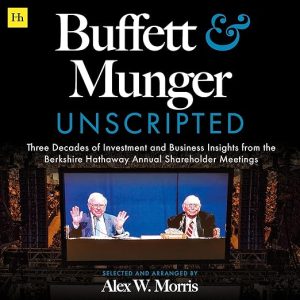
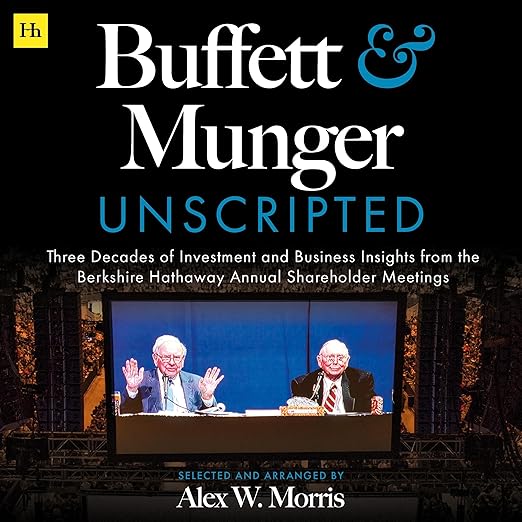
Buffett and Munger Unscripted solves that problem. Alex Morris, an equities analyst and financial writer, watched hundreds of hours of video from Berkshire meetings covering 1994 through the final meeting before Munger's death, organized more than 1,700 questions and answers by theme, and produced the most systematically useful primary-source resource in value investing outside the actual letters and the Charlie's Almanack compilation. Adam Sims narrates with appropriate clarity and economy - the material generates its own gravity, and Sims wisely does not add interpretive flourishes it does not need.
Morris Keeps the Questions Behind the Answers
The organizational architecture is the book's primary contribution. Buffett and Munger are extensively quoted elsewhere, their aphorisms are ubiquitous in business literature, but the context in which those ideas were expressed, the specific questions that prompted them, the back-and-forth that preceded and followed a memorable formulation, is routinely stripped away in other compilations. Morris preserves that context, which changes the quality of the wisdom considerably. An insight explained in response to a shareholder's confused question about Berkshire's insurance operations reads differently than the same insight presented as a standalone epigram.
The range of themes is genuinely comprehensive. Capital allocation principles, management evaluation criteria, the nature of durable competitive advantages, book recommendations, the importance of admitting error and recovering from it, the right time horizon for investment decisions, and the specific mechanisms through which Buffett and Munger thought about business quality versus price all receive substantial treatment. This is not a book of highlights. It is a primary source document with editorial architecture.
Twenty-One Hours You Can Navigate by Theme
One reviewer who had been watching the CNBC Berkshire releases independently described the book as taking that educational experience a step further, organized perfectly for listeners who want to learn about investing and business in a systematic way. That captures the value proposition precisely. The video archive is freely available and excellent, but it requires an enormous time investment to extract organized knowledge from it. Morris has done that work.
At twenty-one hours, this is a substantial listen, but the thematic organization means it also works well as a reference text you return to by section rather than listening through linearly. The audio format is somewhat less well-suited to reference use than a physical book, but Sims's clear narration and the logical chapter structure make navigation manageable.
Munger's Voice Goes Missing in the Final Years
This is a book for people who already care about investing and business. It is not written as an introduction to value investing. Listeners without some prior exposure to Buffett and Munger's frameworks, at minimum a familiarity with The Essays of Warren Buffett or Poor Charlie's Almanack, will find the organizational logic harder to follow and the insights less coherent without the background to place them in context. Morris himself describes the book as the perfect companion to those texts, which is the right framing.
The lack of Munger's voice in the final years of the archive is an absence the book cannot fix. The meetings after Munger's death are included, and Buffett alone is always worth hearing, but some of the most intellectually electric material in the archive comes from the interplay between the two men, and that dynamic is necessarily incomplete in the most recent material.
Best for Serious Students of Value Investing
Serious investors and business analysts who want the most comprehensive organized access to Berkshire AGM wisdom in audio form will find this the best available option. Students of value investing who have read the primary texts and want primary-source reinforcement across a wide range of topics will get significant value. Financial professionals who advise clients on long-term equity investing will find the material on management evaluation and capital allocation particularly useful. Casual readers who are primarily curious about Buffett as a cultural phenomenon will find it denser and more technically focused than they may have expected. Those looking for a narrative biography of either man should look elsewhere: this is organized wisdom, not storytelling.