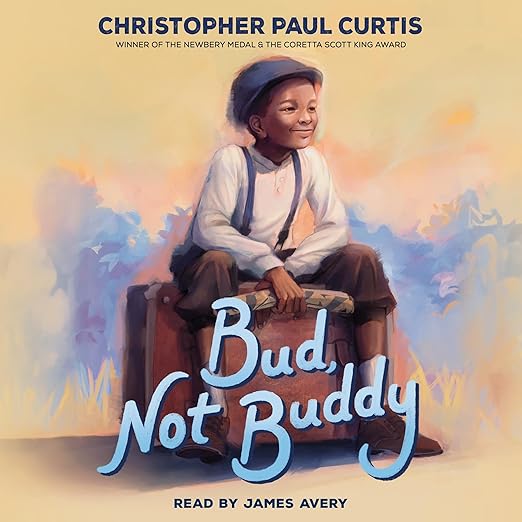
Every review under this audiobook is, in one way or another, about homework. Required reading for my 6th grader, says the first. Part of my 4th grade son's assigned reading material, says the second. A third opens with the words My 10 year old review and then hands over the keyboard. Five entries, and the nearest any of them gets to arriving voluntarily is a parent buying a second copy once the assignment was finished. That is what a Newbery winner's afterlife looks like twenty-six years in, and it shapes what this column can and cannot tell you.
What We Made of It
Bud is ten years old in 1936 in Flint Michigan, motherless and on the run, and the description lists his assets the way a case file would. He has a suitcase full of special things. He is the author of Bud Caldwell's Rules and Things for Having a Funner Life and Making a Better Liar Out of Yourself. And his mother, who never told him who his father was, left behind flyers advertising Herman E. Calloway and his famous band, the Dusky Devastators of the Depression. A boy, a rulebook, and a handbill amount to a whole novel's worth of equipment.
Vampires turn up in the list of things that will not stop him, and that single word establishes the register. Not hunger, not fear, not vampires, not even Herman E. Calloway himself, the copy says, running a Depression-era quest straight through the imagination of the ten-year-old telling it. The joke is structural rather than decorative. A child who ranks vampires alongside hunger as obstacles has not yet finished sorting the world into real and unreal, and both the comedy and the grief in this book come from that sorting happening in front of you.
Carolina's entry is the most specific piece of criticism anywhere in view, and a ten-year-old wrote it. The characters seemed to fit the era because of how they acted and talked, it says, and the setting made you feel like you were in Grand Rapids or Flint watching it all happen. The favorite moment named is Bud drinking a red pop in Lefty Lewis's car, described as so detailed it felt like watching a movie. Period voice, a sense of place, and one sensory scene: that is a better account of what the novel does than the jacket copy manages anywhere.
One dissent exists, and it is a four rather than a one. S Mc Elroy calls the book heartwarming and nice, praises a brave young boy in a big world, and notes that it shows life in the 1930's through the eyes of a young boy, before filing all of it under a headline complaining that the story does not pick up fast enough. The response arrives with no spaces after its periods, sentences shunted into one another, which is either a keyboard problem or a young writer in a hurry. Either way it stands as the sole pacing warning available and it earns its attention.
James Avery is credited with all five hours and fourteen minutes, published by Listening Library and dated August 10, 2000. That runtime is short for a Newbery winner and exactly right for this book, which is told start to finish by a boy explaining things as he goes. The whole novel is Bud talking, so a recording of it is a recording of one sustained performance, not a cast, and the credit reflects that honestly. It is also, at twenty-six years old, among the more venerable readings still on sale without anybody flagging the age on the page.
What to Watch For in Bud, Not Buddy
Jacket copy and recording date do not come from the same decade. The description calls the book a classic, a word that requires time to have passed, and credits the author with a Virginia Hamilton Award for Lifetime Achievement. The recording is dated August 10, 2000. Marketing text on this listing has plainly been refreshed since then; the audio has not been, and nothing says so. Meanwhile the badges field sits empty, even though the description names a Newbery Medal and a Coretta Scott King Award in its opening line.
School is the engine of this review column, and it bends what you can learn from it. Three of the five responses name a grade level or a child. One reports loving the story enough to buy a second copy in another format for rereading, which is a text purchase logged underneath an audio listing and a reminder that these responses were not gathered from listeners. Another consists of the single word Good. What the column establishes is that the novel works in classrooms. What it cannot establish is whether this particular recording works in headphones.
Thirty-three points sit behind a 4.7 badge across seven votes, and the two invisible ones can be identified exactly. Seven votes averaging 4.7 fix the total at thirty-three out of a possible thirty-five. Written responses cover twenty-four of them, four fives plus the single four already discussed. That leaves nine points for the two who voted and said nothing, and nine spread over two whole-star votes has exactly one solution: a five and a four. Two silent readers are out there, one delighted and one mildly reserved, and the arithmetic identifies them both.
Best Suited For
Assigned reading is where most of this listening will happen, and five hours and fourteen minutes is a genuinely useful length for the purpose. A child working through a set text can finish the recording across two sittings, and an adult can keep pace alongside them in a single evening. Beyond the classroom, the audience is anybody who wants a Depression-era road story told by a child carrying a rulebook, which is a narrower and considerably more accurate description of the thing than award-winning classic manages.
Grown listeners with no child in the room should know what they are getting: a middle-grade novel that is funny well before it is sad, pitched squarely at ten-year-olds, and short enough that the emotional turn arrives quickly. Anybody expecting a historical novel about the Depression will find the Depression working as weather: a condition of the story, never its topic. And anybody who wants a recent recording should read the date on this one and decide accordingly. Nobody needs a permission slip for it, but on the evidence of the column most listeners will turn up holding one.
- Read by: James Avery is credited with the whole five hours, which suits a novel that is one boy talking from beginning to end
- At its heart: A search for a father across Depression-era Michigan, invented rules as armor, kindness from strangers
- Vibe: Funny first and sad later, pitched at a child's eye level
- Short version: A short, durable classroom staple on a recording that has been in service since 2000.
Questions Listeners Ask
How old does a listener need to be for this audiobook?
The review column answers that better than any published guideline. Respondents name a fourth grader, a sixth grader, and a ten-year-old who wrote a paragraph of their own. Bud is ten and speaks in his own voice throughout, so listeners around that age get a narrator their own size. Adults will find it short without finding it simple.
Does a 2000 recording still hold up on an audiobook shelf?
The date field reads August 10, 2000, and Listening Library has not replaced it since. The jacket copy has moved on, calling the book a classic and crediting the author with a lifetime achievement award, so the marketing is newer than the audio it sits above. Nothing flags the gap, so the sample is your only check.
Why do so many of the reviews mention school?
Because the novel has become a set text. Most of the column names a grade level, an assignment, or somebody's child; one respondent reports buying a second copy in another format afterward for rereading; another runs to a single word. All that establishes is that the book works in classrooms, which is not the same thing as knowing how this reading sounds.