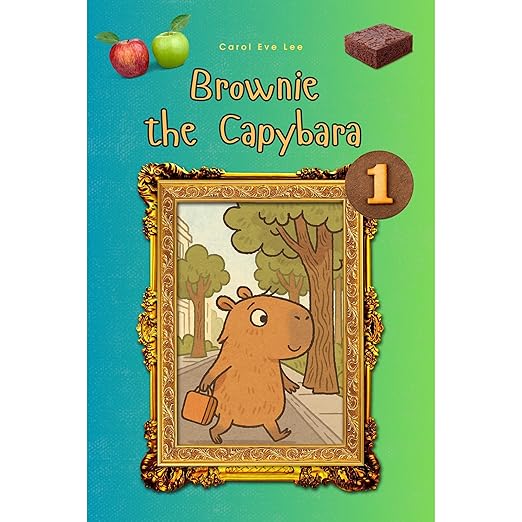
Brownie, the amnesiac capybara at the center of Carol Eve Lee's debut chapter book, is precisely the kind of animal protagonist that hits differently in audio than on the page. Brownie the Capybara, narrated by Virtual Voice and serving as the first entry in the Brownie the Capybara series, is a short audiobook at just over an hour, aimed squarely at readers aged six through twelve who have already discovered the internet's collective capybara obsession and want to spend more time with the world's friendliest large rodent. Lee's premise is both simple and emotionally intelligent: a capybara with no memory of where he came from wanders into a small town and stumbles onto a family that may or may not be exactly what he needs.
A Family Sketched Through Reactions to a Capybara
Lee writes the amnesia premise with a light touch that keeps it from becoming heavy. Brownie's memory loss is not played for pathos so much as for comic and emotional duality - he simultaneously wants to stay with the family he has found and wants to run, a tension that children in the eight-to-twelve range tend to recognize intuitively, even if they couldn't name why. The "not-so-ordinary family of four" is sketched efficiently: individual members come into focus mainly through their reactions to a large, gentle, and somewhat confused capybara appearing in their lives, which is a serviceable way to reveal character quickly in a short format. The humor is gentle and consistent rather than punchline-driven, and the chaos that Brownie periodically generates feels proportionate to his size and his personality.
A Brazilian reviewer notes that she read it with her goddaughter and that both found it genuinely funny and attention-holding - a useful data point, since the international capybara following means this series is being discovered by non-English-speaking audiences as well. The Virtual Voice narration does the job without distinguishing itself; it reads the text accurately and paces the adventure sequences reasonably, but it flattens the comedy in ways that a human narrator comfortable with children's material would not. For a one-hour runtime at this price point, this is not a fatal flaw, but it is a real limitation for the funniest sequences.
The Capybara Internet Subculture Crosses Language Barriers
The audiobook format suits early independent listeners well. At just over an hour, this sits in the range that eight-year-olds can manage in a single session - long enough to feel like a complete story, short enough that concentration holds. The chapter book structure, as opposed to a picture book, means the narrative has room to develop Brownie's emotional dilemma beyond the purely episodic, which makes the listening arc more satisfying than a collection of unconnected scenes would be. Children who have been listening to longer series audiobooks and want something they can finish in one go will find this a satisfying format.
The subject matter is also self-selecting in a useful way. Capybaras have a specific, devoted fan base among children currently, driven largely by social media content about the animals' famously relaxed demeanor. Lee's Brownie shares that temperament - gentle, adaptable, more puzzled than aggressive when things go sideways - and the book leans into it without making it the only joke. For a child who has been asking for a capybara of their own, this is a reasonable substitute that gives the animal genuine personality rather than just using the species as a cute visual hook.
The Brazilian reviewer who read it alongside her goddaughter noted that both generations found the comedy and adventure genuinely engaging, which is a useful data point about the book's international reach. The capybara internet subculture crosses language barriers more thoroughly than most children's character IP does, which means Lee is writing into an already-formed affection rather than trying to create one. That is a structural advantage for an independently published debut series, and it shows in how specifically the book characterizes Brownie's personality rather than relying on generic cute-animal appeal to carry the premise.
Virtual Voice Offers No Cast Differentiation
As a series opener, this audiobook prioritizes setup over resolution. The memory loss arc is the central engine of the book and its series, and it does not resolve here. Lee closes the first volume with Brownie in a more settled situation than where he started, but the past he cannot remember is not recovered, and the question of whether this ordinary family is his true home remains open. This is appropriate series architecture, but parents previewing for children who find open-ended stories frustrating should note that this is explicitly designed to make you want the next book.
The Virtual Voice narration also means there is no cast differentiation beyond the text's own character tags. The family members are distinguishable in the prose, but not via distinct vocal performances. For children who have been raised on the full-cast audiobook productions that Disney and major publishers produce, the single-voice AI narration will feel noticeably sparse. The story's strengths are sufficient to carry the experience, but the production ceiling is low compared to commercial children's audiobooks with human narrators.
An Adult Reading Aloud Upgrades the Experience
Children ages six through twelve who are already invested in capybaras as a species will find this immediately appealing. The book works especially well for newer chapter-book listeners who want animal-centered adventure with emotional stakes that feel manageable rather than threatening. Adults reading aloud to children would significantly upgrade the experience over the Virtual Voice version - the humor and warmth benefit from human delivery. As an independent listen for children in the seven-to-ten range, the audiobook holds up. The series setup also makes it a reasonable investment if you have a child whose reading habit you want to nurture with follow-on volumes.
Key Details
- Voice: Virtual Voice handles the chapter book format adequately for older children who read independently, though the warmth a human narrator would bring to Brownie's comedic confusion is noticeably absent.
- Big ideas: Memory and identity, friendship and belonging, courage to stay
- Atmosphere: Cheerful and gently adventurous, with some emotional tenderness beneath the comedy
- Worth it?: A charming debut chapter book for the capybara-obsessed middle-grade set, with a genuinely sweet emotional core beneath the comedic adventure setup.
Common Questions
Is this audiobook appropriate for very young children, or is it aimed older?
Lee's listed age range is six to twelve, and the material suits that window well. The themes of memory, belonging, and courage to stay read differently at different ages within that range; younger children will enjoy the comedy and the capybara, older children will recognize the emotional undertow.
Does the audiobook work as a standalone or do you need to plan to continue the series?
It works as a standalone introduction, but the central mystery of Brownie's past is not resolved here. Think of it as a series opener that is satisfying as a first episode rather than a complete story - you will want the next book.
Is there any educational content about capybaras in this audiobook, or is it purely fiction?
It is purely fiction. Brownie behaves in capybara-consistent ways - gentle, water-loving, socially adaptable - but the book does not include natural history information. For factual content about the species, a different title would serve better.