
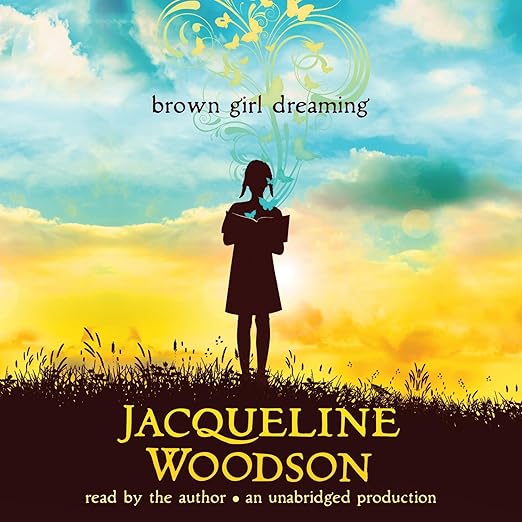
A verse memoir read by the poet who lived it is about as close as an audiobook gets to its ideal form, and Brown Girl Dreaming is exactly that. Jacqueline Woodson wrote her childhood into poems and then recorded them herself for Listening Library, just short of four hours of it, and the book she is reading tells you plainly that she struggled with reading as a child. Whatever else this recording is, it is a woman speaking aloud the words that took her the longest to reach.
A Closer Look at Brown Girl Dreaming
The structure is deceptively plain. Woodson was raised between South Carolina and New York and felt, as the copy puts it, halfway home in each place, and the poems move across that split without ever announcing a thesis about it. What accumulates instead is a child's-eye record of the 1960s and 1970s: the remnants of Jim Crow, a growing awareness of the Civil Rights Movement, and the slow discovery that stories are something a person can make. Each poem stands alone and each one leans on the ones before it, which is a difficult trick to pull off across a whole childhood.
A reader who traced the family history in July 2017 credits an aunt named Ada, a genealogist and family historian, with supplying the material the book opens on, and describes a contrast between north and south running through the whole book like a current. That is a sharp reading of the shape. The same response places the family's early movements in Ohio, and so does a second one, which is notable because the description never mentions Ohio at all.
The awards do a lot of the selling here and they are worth taking seriously: a National Book Award, a Newbery Honor, a Coretta Scott King Award. What the copy does not offer is a single line of critical assessment of this book. The only quotation on the page sits under a heading praising Jacqueline Woodson generally, and the newspaper notice it reproduces praises her understanding of young people's thoughts without naming any title.
What Works
Verse in audio lives or dies on where the silences fall, and only the person who wrote the line breaks knows where they belong. Woodson does not perform these poems so much as place them, and the difference matters on a text where a stanza break can carry the weight a paragraph of prose would need. A hired reader would have to guess at the pauses; the author simply knows. In a form this compressed, that removes an entire layer of interpretation between the listener and the page.
A second argument is autobiographical rather than technical. This is a book about a child who could not read easily, and who found her way to language through stories told out loud before she could get them down on paper. Hearing the adult version of that child speak the poems returns the material to the medium it started in. Almost four hours is short enough to take in two or three sittings, and the poems are self-contained enough to survive being picked up mid-sequence.
Students find it too. A reader who came to it through a young adult literature class left five stars in November 2017 with the most useful practical note in the pool: the writing is simple enough for an eight-year-old to read and rich enough for an adult to enjoy alone. That double register is real, and it is easier to hear than to see, because a reading pitched for a child never talks down to the adult in the room.
Things to Know Before Starting Brown Girl Dreaming
Arithmetic on this record settles into something unusually neat. A posted 4.7 across six ratings pins the total to exactly twenty-eight stars, since twenty-seven would display 4.5 and twenty-nine would display 4.8, and the five grades you can read total twenty-four. The one vote nobody can see is therefore a four, which is about as much certainty as a product page ever hands over.
Series metadata is a different story. It reads Newbery Honor Book, which is an award rather than a series, and the number beside it is blank. That will file this title alongside nothing and mislead anyone browsing for a sequence. The genre placement is loose in the same way, sitting under children's audiobooks with a biographies tag while the responses beneath it span an eight-year-old, a university course and a recommendation pitched at pre-teens.
The form confuses people too, which is worth knowing before you buy for a young reader. A reader who mapped the route from Ohio through the rural south and back to Brooklyn in December 2025 called it a collection of poem-stories, which is accurate. Other responses reach instead for the words novel and prose. Nothing in the listing states outright that the whole book is poetry, and every visible response is written in the language of reading rather than of listening.
Who Jacqueline Woodson Is Writing For
Families are the natural audience, and the age band is wider than the shelf suggests. A five-star from India in February 2021 recommends it to pre-teens with an interest in memoir and history, which is fair, though the book reaches a good deal further up the age range than that. Anyone teaching the Civil Rights era to young listeners will find a text that conveys the period through daily detail rather than through summary.
Poetry-shy listeners should also consider it, because the poems are narrative and cumulative rather than difficult. The four-star response from July 2020 puts its finger on why the book carries beyond its category: children understand more of the nuance around them than adults credit, and Woodson writes from inside that awareness rather than looking back down at it.
A conventional life story with chapters and dates is not what arrives here, since the book proceeds by image and moment and will feel elliptical to anyone waiting for a narrative spine. The printed page has a claim as well, because line breaks, white space and the shape of a stanza on paper are part of what the poems do, and a recording can only translate them into breath. The ideal arrangement is to own both, text and reading together.
The Short Version
- Narrator: Jacqueline Woodson reads her own poems, so every line break and silence arrives as the author placed it rather than as a performer's guess.
- Subjects: Growing up African American in the 1960s and 1970s, the split between South and North, finding a voice through story, family memory.
- Tone: Tender, unhurried, quietly historical.
- Bottom line: A verse memoir that gains real weight from being spoken by the poet, at under four hours.







