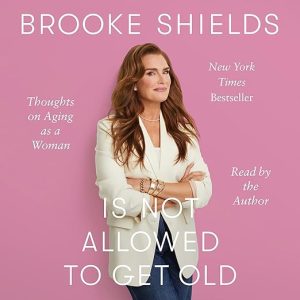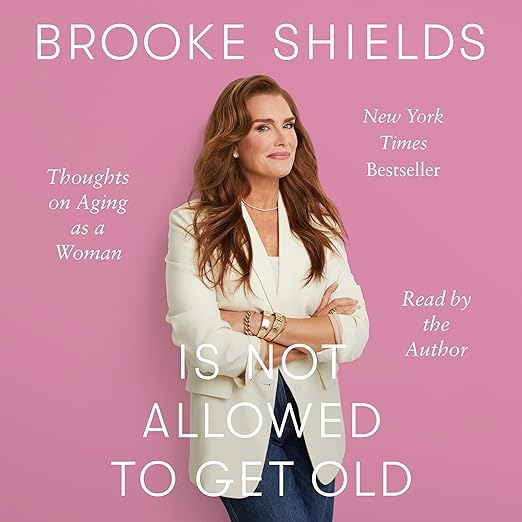
What the craft of this audiobook gets right immediately is the gap between persona and person. Brooke Shields has spent decades as a face, a brand, a shorthand for a particular kind of American beauty. Here, narrating Brooke Shields Is Not Allowed to Get Old herself, she refuses that version of herself with considerable skill. The audiobook opens not with polished reflection but with the low-grade friction of being a woman in her late fifties who is still, somehow, expected to apologize for existing visibly. The tension between what she was told aging would look like and what it actually feels like drives the whole listening experience. This is an audiobook about the difference between living up to an image and living inside your own life, and Shields knows the difference personally in ways that most writers of this genre do not.
The audiobook runs just over nine hours, and Shields earns that runtime. Library Journal noted she maintains a balance between lightheartedness and sincerity, which is accurate but understates how difficult that balance is to hold in practice. What could easily tip into celebrity platitudes stays grounded because Shields keeps pulling the narrative back to specificity: real health scares, real moments of humiliation, real reckonings with a body that has been public property since childhood.
Wondering What Might Still Be Ahead
The title is doing serious rhetorical work. It is not an affirmation or a marketing hook. It is an accusation leveled at a culture that treats women's aging as a kind of failure. Shields knows this, and she builds her argument around that accusation without ever letting it become a lecture. She weaves together personal memoir, cultural observation, and research reporting in a structure that feels genuinely essayistic rather than ghost-written and smoothed down. AudioFile's observation that the book suits those who enjoy celebrity-narrated memoirs slightly underestimates what Shields is doing: this is memoir with a specific cultural argument about systemic age-related bias, not simply personal disclosure about what it feels like to get older in the public eye.
One reviewer, Baltic Mermaid, pulled out this line: I can spend time wondering what could have been, but these days I find myself, far more often, wondering what might still be. That is the emotional core of the audiobook. Shields is not interested in elegizing her younger self. She is interested in what becomes possible when you stop performing compliance with other people's timelines. At fifty-nine, she argues, the years ahead look more genuinely hers than the years behind. That is a harder and more interesting claim than simple resilience messaging, and the audiobook format gives it room to breathe and develop over multiple chapters in ways a shorter work could not.
Shields's Timing Carries a Calvin Klein Joke
The self-narration is the primary reason to choose the audio format over print. Shields's voice carries a quality that no professional narrator could replicate: the slight hesitation before a difficult disclosure, the dry comic timing on a punchline about Calvin Klein ads, the genuine emotion when she discusses health issues that, as reviewer Carey Newcastle noted, were not widely known. There is a particular authenticity that comes from hearing someone wrestle with their own story in real time, and Shields delivers that throughout the nine-hour runtime. She is funny when she needs to be, and the humor is earned rather than deployed as deflection from the harder material.
The research and reporting sections are handled well within the audio format. Shields brings in external material on ageism and gender without it feeling grafted on. The transitions between personal anecdote and broader cultural analysis are smooth, which suggests both careful writing and a narrator who genuinely understands what she is saying rather than reading it cold off a page. For listeners who want both emotional resonance and substantive engagement with questions of gender and aging, the balance here is real and sustained across the full runtime.
Health Admissions Land Without Self-Pity
The audiobook is most powerful in its specific admissions, particularly around health challenges that Shields had not previously discussed publicly. These passages have genuine vulnerability without self-pity, and they reframe what the rest of the audiobook is actually about. Shields is not arguing that aging is painless or that confidence solves everything. She is arguing that even the hard parts are more navigable when you stop measuring yourself against a standard that was always designed to make women feel insufficient. That is a more complicated and more honest version of the usual midlife empowerment narrative, and hearing Shields articulate it in her own voice gives it a credibility that a third-person treatment could not match.
Listeners who prefer pure memoir over cultural argument may find the research-driven passages slower going. The book is genuinely hybrid in its approach, and the reporting sections occasionally interrupt the narrative momentum. But Shields recovers quickly, and the argument she is building requires the evidence she marshals. Those willing to sit with both modes will find them reinforcing each other by the final third in ways that make the overall listening experience feel complete and purposeful.
Company for Midlife Questions, Beyond Pure Memoir
This audiobook is well-suited to women in or approaching midlife who want company for the questions they are already asking, particularly those who have grown up watching Shields and carry their own complicated relationship to the cultural beauty standards she helped define. It also works for anyone interested in how public figures reckon with the distance between their public image and their interior life, especially when the reckoning is done with this degree of candor. Listeners who prefer memoir that stays purely personal rather than making a cultural argument should know this book reaches beyond autobiography into advocacy, and the combination is deliberate and sustained. At nine hours and one minute, it asks for genuine attention and rewards that attention with a perspective on midlife and female agency that is more nuanced than the genre usually delivers.
Before You Listen
Does Brooke Shields narrating her own audiobook add something a professional narrator could not?
Yes, meaningfully so. The self-narration carries the kind of micro-hesitations, dry pauses, and real emotion that come only from someone living inside the material. Library Journal and AudioFile both called it out specifically as a strength, and the moments where Shields discusses previously undisclosed health challenges hit harder in her own voice.
Is this audiobook more memoir or more self-help?
It sits firmly in the memoir-with-argument category. The personal stories dominate, but Shields is building a case about systemic ageism and female agency throughout. Listeners expecting a pure life-story format will encounter reporting and cultural analysis woven in, which is deliberate rather than a detour.
How does this audiobook handle serious health content given its lighthearted title?
With more directness than the title implies. Shields does not soften her health disclosures or rush past them. The humor she brings elsewhere gives those sections more weight rather than undercutting them. The tonal balance is the book's main craft skill.