- Voice: Frances Mayes narrates her own work with a warmth and intimacy that transforms the audiobook into something closer to a private conversation over a very good bottle of wine.
- Big ideas: Tuscan lifestyle transposed to American life, sensory abundance, the art of hospitality
- Atmosphere: Leisurely, evocative, and warmly aspirational
- Worth it?: At under four hours, this audiobook works best as an immersive companion to Mayes's longer Tuscany memoirs rather than a standalone listening experience.
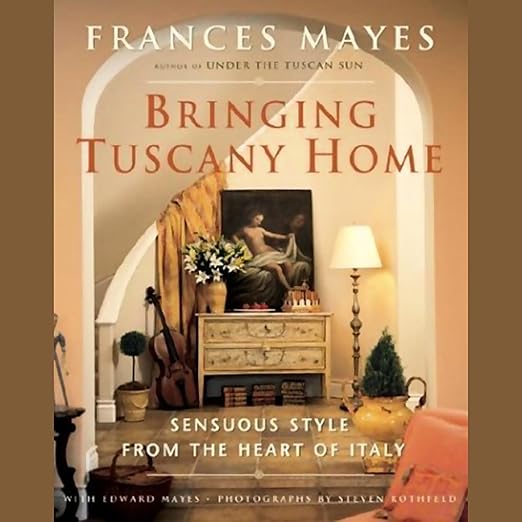
Frances Mayes narrating her own audiobook is not a neutral fact. Bringing Tuscany Home, read by Mayes herself, carries the accumulated weight of Under the Tuscan Sun and its follow-up volumes: the particular cadence of someone who has spent decades describing light on stone, oil on bread, the specific quality of an afternoon in a Tuscan hill town. At 3 hours and 35 minutes, this is the shortest entry point in the Mayes Tuscany catalog, and the self-narration functions almost like a personal tour of a sensibility rather than a conventional guide to home decor and Italian cooking.
The book's conceit is elegant: Mayes and her husband Edward have spent enough time at Bramasole that Tuscany has traveled back with them to California, and they want to show readers how to make that transfer in their own lives. Color palettes for rooms, antique market advice, wine pairing notes, garden design rooted in terra-cotta and pergola, menus anchored in olive oil and vino santo. These aren't vague inspirations. They're specific enough to act on. The New York Times called Mayes the bard of Tuscany, and Bringing Tuscany Home is the most practical expression of that bardship, the place where the lyrical sensibility of the memoirs meets actionable advice about terra-cotta urns and majolica table settings.
The Verdict, Briefly
Mayes's prose in this audiobook has a quality that resists hurry. The passage about imagining the signoras who lived in the house, shelling peas and rocking grandchildren, is a characteristic move: grounding the abstract idea of Tuscan style in a concrete, embodied female presence. That's her way in. Not architecture first, not design theory, but the human life that the space has held. When she then describes how Bramasole traveled to California and took root, with doors open to the San Pablo Bay breeze and Mount Tamalpais visible in the distance, the reader understands that bringing Tuscany home isn't about sourcing particular furniture. It's about carrying forward a particular relationship with time, hospitality, and sensory pleasure.
For audio specifically, Mayes's narration earns the self-narrator decision. She knows which phrases want lingering. The wine passages, the descriptions of market finds, the garden advice about vine-covered pergolas and terra-cotta urns, all of it sounds better in her voice than it would in a professional narrator's rendering of her voice. The intimacy is the point, and it's an intimacy that print cannot quite replicate. Reviewers who came to this book through prior Mayes familiarity consistently report a strong emotional response to hearing her describe bringing Bramasole to America.
The caveat worth naming directly: the print edition of this book includes more than 100 photographs by Steven Rothfeld, and that visual dimension is entirely absent from the audiobook. One reviewer described the photographs as beautiful and inspiring, and those images, including shots of the Mayes's California home with its Tuscan accents, are genuinely load-bearing for a book about visual aesthetics and design. The audiobook gives you the prose, the 25 new recipes, and the resources for Tuscany travelers. It does not give you the full design experience the print edition offers.
Listeners who know and love the Tuscany memoirs will get the most from this format. The narration adds layers of emotional texture that the page can't supply, but the listening experience is most rewarding when it supplements rather than replaces the print version. Reviewers who came to this book through prior Mayes familiarity report a strong emotional response, while readers expecting a complete standalone experience may find the 3-hour-35-minute runtime leaves them wanting more of the visual material the audio cannot provide.
Weak Spots in Bringing Tuscany Home
The book covers an exceptionally wide range: room decoration, garden cultivation, wine selection, market sourcing, recipe collection, hospitality philosophy, and travel logistics for visitors to Tuscany including shipping advice and market days for several towns. This breadth means no single section receives exhaustive treatment. The antique market guidance is practical but broad; the recipe section provides 25 new dishes but not a complete Tuscan culinary education. Listeners who want depth on any one element will need to seek supplementary resources alongside this audiobook.
What Mayes delivers instead is something rarer: coherent aesthetic vision. Every element in the book, the colors, the linens, the garden urns, the lunch at the vineyard, connects back to the same underlying sensibility. The Tuscan way of living she describes isn't a checklist of decor choices. It's a relationship with abundance, slowness, and the pleasures of the table that she has spent decades articulating. Even in 3 hours and 35 minutes, that sensibility comes through with the clarity of a person who has genuinely built their life around it and wants to share not the things themselves but the principles behind them.
Who Will Get the Most From It
Listen if: you are already a fan of Frances Mayes's Tuscany memoirs and want more time in her company, you enjoy audiobooks that function as extended sensory experiences rather than information-delivery systems, or you have the print edition open alongside the audio for the photographs. Mayes narrating her own work is a specific pleasure for readers already in her register.
Skip if: you haven't read any of the Tuscany books and are coming to this as a cold introduction to the author, or if you primarily want practical home design instruction and need the visual component to make that instruction work. The print edition is the more complete object; the audiobook is the more intimate one, and knowing which you need before purchasing will save disappointment.