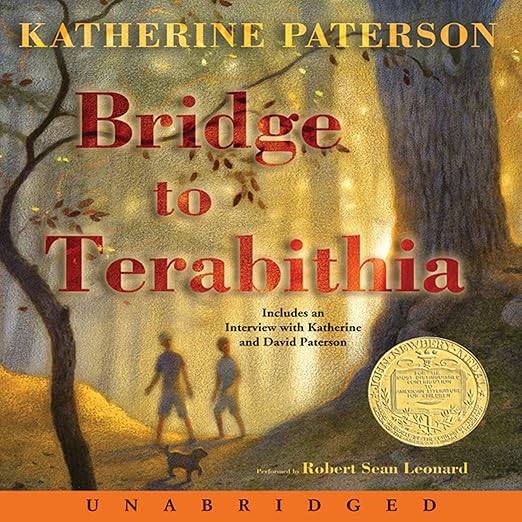
- Voice: Robert Sean Leonard is the sole name on a three and a half hour Newbery winner told from one boy's shoulder throughout.
- Big ideas: An invented kingdom, an unequal friendship, sudden loss, a family with no language for it.
- Atmosphere: Sunlit, then very quiet.
- Worth it?: Still one of the finest short novels about childhood, provided nobody reads you the description first.
Take the children's filing on this one loosely. Bridge to Terabithia runs three hours and thirty minutes as an audiobook, read by Robert Sean Leonard for HarperCollins, and the top response on its page carries five stars under a headline arguing that children do not have enough life experience to relate to it. That is a strange thing to find at the head of a Newbery winner shelved for young listeners, and it is also the most useful warning the page contains about what these three and a half hours actually do.
What We Made of It
Jess Aarons has spent an entire summer training to be the fastest runner in the fifth grade, and the new girl at school beats him. Paterson lets that sting properly before turning it into a friendship, which is the first sign the book will not take any of the easy routes. The woods behind Leslie Burke's house become Terabithia, a kingdom the two of them rule and defend, and the novel treats that invented country with precisely as much seriousness as the two children give it.
What makes Terabithia convincing is that it is unmistakably a child's construction: a rope swing, a kingdom mapped onto a stand of trees behind a house, rules invented on the spot and then obeyed absolutely. One respondent describes doing exactly the same thing with a sister, swinging off a tree and down a hill into a country they had borrowed the name Narnia for. That is the novel's real subject before it becomes anything else, and it explains why the loss, when it arrives, never turns sentimental.
Paterson's handling of that loss is the reason the book has outlasted almost everything shelved beside it. It arrives with no preparation, offstage, in a sentence that does not raise its voice. What follows is not a lesson about death but a portrait of a fifth grader performing normality while something has quietly come apart underneath, and of a family with no vocabulary for helping him. One respondent puts it as well as a critic could: the characters are brought to life in a realistic way, which is exactly what makes losing one of them cost something.
Robert Sean Leonard is the only name on the credit, holding three hours and thirty minutes of close third person that sits almost entirely inside Jess. That is a demanding assignment in a quiet way, because the novel's most important moments are the ones where nobody says anything, and a reading either finds those pauses or flattens them out. HarperCollins issued this in August 2009, and the listing names no second performer, no full cast and no supplementary material of any kind.
Length is what the format quietly contributes here. Three and a half hours means you will almost certainly finish in one sitting, and one sitting is the right way to take it. Bridge to Terabithia is built as a long sunlit accumulation followed by a short brutal descent, and a reader who sets the paperback down for a week after the turn loses the shape of the whole thing. The recording makes stopping there considerably harder: a kindness wearing the wrong face.
The responses agree on the effect and split on the audience. One calls it a timeless story for kids and adults together. Another argues that Paterson does to the reader what Leslie does to Jess, pushing back the walls of a mind, and quotes the line from the novel to prove the point. A third reports that the invented-country chapters brought back a sister, a tree swing and a hill they used to jump down. None of them describes a child meeting this book alone, which may be the situation worth avoiding.
Before You Commit to Bridge to Terabithia
Read the jacket text yourself before you hand this recording to anybody, because it gives the ending away. It names the morning Leslie goes to Terabithia without Jess, states plainly that a tragedy occurs, and then explains that Jess will need his family and the strength Leslie gave him in order to deal with his grief. Whoever reads that blurb has been handed the entire second half of the novel before a single minute of audio has played.
Weigh the argument in that leading response seriously, too. Its author awards five stars and simultaneously doubts that children carry enough life experience to meet the loss at the center. The awards were given for very nearly the opposite reason. Still, a listener under ten who has never lost anybody may find the final half hour bewildering where an older one finds it devastating, and the page offers no guidance whatsoever: no age band, no content note, nothing but the shelf it sits on.
Grief here is not tidy either. Jess reacts badly, then selfishly, then guiltily, and the adults around him mostly get it wrong before they get it right. That refusal to manage a child's feelings on the child's behalf is the book's great virtue, and it also makes the recording a poor candidate for background listening on a family drive. Nothing on this listing flags any of it, so the decision belongs entirely to whoever presses play.
Best Suited For
Ten and up is the honest floor, for listeners who can take an ending that does not soften itself. Adults who somehow missed this at school should treat three and a half hours as an unusually good return on an afternoon. Teachers and parents planning a conversation about loss will find that the novel does the difficult opening work for them and then leaves the conversation genuinely open, which is rarer in children's fiction than it sounds. Listeners who love the friendship half and dread the rest should know that Terabithia itself gets far more of the running time than the grieving does.
Hold off if the child you have in mind is grieving right now, because this is a book for afterward and not for during. The same goes for anyone who needs a story to explain its own ending; this one flatly declines. Anybody who has been avoiding it on the strength of a half-remembered fifth grade assignment should know the novel is quieter and considerably better than the memory of it. Leonard reads it in one unbroken three and a half hours, and the last thirty minutes are the reason to be by yourself when you reach them.