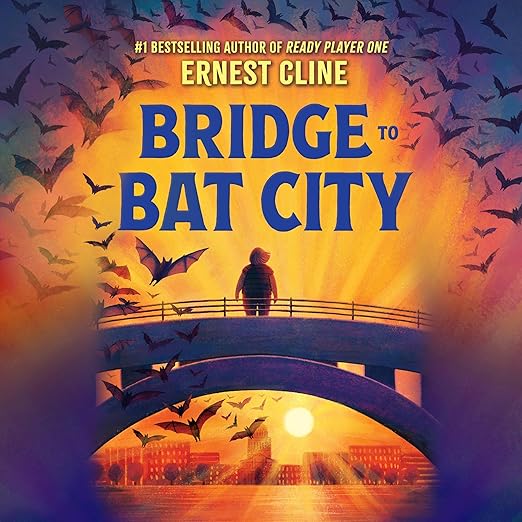
Opal arrives in Bridge to Bat City carrying the specific grief of a thirteen-year-old who has lost her mother and been relocated to a place that is not home. Ernest Cline's debut children's audiobook, narrated by Felicia Day, announces itself as a mostly true tall tale in the subtitle, and that framing does important work: it signals that the real bats of Austin are present here, the Mexican free-tailed bats that live beneath the Congress Avenue Bridge, and that the fantastical elements of the story are layered over a foundation of genuine natural history. For middle-grade fiction, that grounding in the real world is often what separates emotionally resonant stories from whimsical ones that evaporate after the listen.
The premise is efficient and well-constructed: Opal moves to her uncle Roscoe's farm after her mother's death, finds connection through music with both her uncle and an orphaned colony of bats, and then faces the threat of a mining company that wants to destroy the bats' cave and the farmland. The conflict structure is clear and age-appropriate without being simplified. Cline introduces the villain and the threat early enough that the reader understands the stakes, and then spends the middle of the book developing the relationships and the world that give those stakes emotional weight.
Opal Bonds With Roscoe Through Shared Listening
Cline's most successful move in Bridge to Bat City is using music as the connective tissue between characters who would otherwise have no reason to understand each other. Opal's bond with Uncle Roscoe develops through shared listening and musical knowledge before it develops through conversation, which is a psychologically accurate depiction of how grief-shielded adolescents sometimes form connections. The bats' musical responsiveness, while fantastical, is rooted in the real observation that bats navigate through sound and are acutely sensitive to the acoustic environment. Cline does not strain this real foundation past the breaking point; the science is there as a permission structure for the magic rather than an attempt to make the magic scientifically credible.
One reviewer noted that the middle-grade audience may struggle with some of the musical references, and that observation is fair. The Austin music scene that Cline draws on has a generational texture that will mean more to adult readers than to the ten-to-twelve age range the book nominally targets. This is not a fatal problem, because the emotional beats of the story do not depend on recognizing the specific references. But it does create an occasional double audience quality, moments where the book is clearly speaking past the child to an adult reader who will catch the allusions. Whether that is a feature or a flaw depends on who is doing the listening.
Felicia Day Plays Opal's Wonder as Genuine
Felicia Day is the audiobook's most significant production asset. Her voice carries a warmth and a slight eccentricity of inflection that matches Opal's character precisely: a girl who does not quite fit the expected mold, who connects more easily with bats and music than with social convention, who is carrying grief too large for her frame. Day does not play these qualities for cuteness; she plays them as the genuine personality markers they are. Her narration in the sections where Opal first encounters the bats has a quality of genuine wonder that is difficult to manufacture and easy to lose to over-performance. Day finds it and holds it throughout.
The book runs five hours and eight minutes, which is appropriate for its target age range and for reading aloud as a shared experience. Parent-child or classroom listening is well-served by this length, which creates natural stopping points without the episodic fragmentation that shorter children's audio sometimes produces. The sci-fi element one reviewer mentioned feeling clumsily inserted is present but minimal; listeners should not approach this expecting significant speculative content. Bridge to Bat City is primarily a realist middle-grade story with fantastical inflections rather than a science fiction novel with a child protagonist.
Ready Player One Fans Should Adjust Expectations
The novel's rating of 3.7 across 116 reviews reflects the reality of a book that works very well for the listeners it suits and less well for those expecting something different. The review calling it mostly okay and noting the sci-fi element as underdeveloped speaks to a segment of the audience that wanted a different book than Cline delivered. Bridge to Bat City is first and foremost a grief and belonging story that uses music and bats as its vehicles; it is not a plot-driven adventure or a speculative fiction exploration. Listeners who arrive with that understanding will find the book more satisfying than those expecting the author of Ready Player One to apply his science fiction instincts to children's adventure.
The environmental theme is present but not heavy-handed. Cline does not lecture; he demonstrates. The mining company's threat to the bats' habitat is made real through Opal's attachment rather than through ecological statistics, which is the right approach for middle-grade fiction where argument rarely lands with the force that story does. Adult listeners reading this to younger audiences can let the environmental stakes speak for themselves without needing to supplement them with discussion points.
Felicia Day Makes This a Shared Family Listen
This audiobook is best suited to middle-grade listeners dealing with themes of loss, belonging, and the challenge of feeling out of place in a new environment, and to the adults reading with them. Felicia Day's narration makes it an excellent shared listening experience for families. Those who loved Ready Player One and are hoping for something in that vein from Cline will find Bridge to Bat City a gentler, more emotionally immediate work than its predecessor; the two books share an enthusiasm for specific cultural knowledge and an outsider protagonist, but the register and scale are entirely different. Listeners drawn to environmental stories with heart and animal characters with distinct personality will find this one of the more affecting entries in recent middle-grade fiction.
Questions Listeners Ask
Does the Bridge to Bat City audiobook require any background knowledge of Austin, Texas or its music scene?
No prior knowledge is required. Cline introduces Austin through Opal's discovering eyes, and the city's music culture is built into the story rather than assumed. Younger listeners without that cultural context will follow the story without difficulty; the musical references add texture for adults but are not load-bearing for the central emotional plot.
How does Felicia Day's narration suit the Bridge to Bat City audiobook for young listeners?
Day brings a genuine warmth and slight eccentricity to the narration that matches Opal's character. Her voice is expressive without being cartoonish, which makes it accessible for young listeners while keeping the emotional honesty of the grief storyline intact. She is an ideal choice for a book that needs to operate on both a whimsical and a heartfelt register simultaneously.