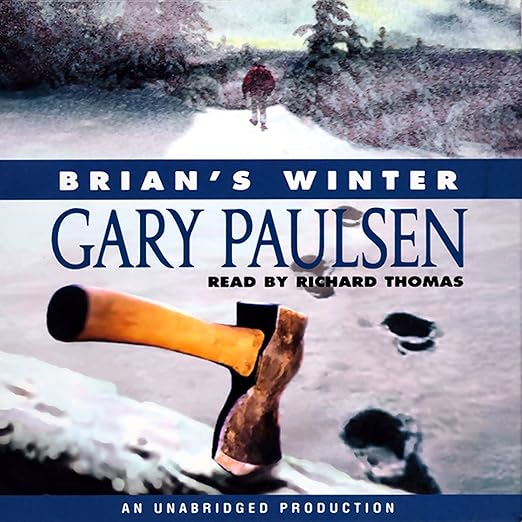
Gary Paulsen's premise for Brian's Winter, the third entry in the Brian's Saga series, is the kind of thought experiment that haunts readers of Hatchet long after the original rescue: what if Brian Robeson had not been found? What if the Canadian wilderness had kept him through the cold months, the killing months, when survival shifts from difficult to genuinely mortal? This audiobook, read by Richard Thomas with a precision that matches Paulsen's spare prose, runs just over three hours and answers that question with the same disciplined attention to physical reality that made Hatchet essential reading for a generation of young adventurers.
How Brian's Winter Holds Up
Paulsen's achievement across the Brian's Saga books is the relentless specificity of the wilderness detail. Brian does not survive on vague resourcefulness - he survives on exact knowledge: the right way to insulate a shelter, the particular behavior of prey animals in cold conditions, the management of fire when wet wood is all that's available. Brian's Winter extends that specificity into the season that makes all of those challenges orders of magnitude harder. Temperature is the enemy here in a way that summer never fully presented, and Paulsen renders the physical reality of deep-cold survival with the authority of someone who has spent time in those conditions himself.
For listeners coming from Hatchet and The River, Brian's Winter works as both continuation and standalone. Paulsen addresses the alternate-timeline premise directly and efficiently, allowing listeners who may not have read the earlier books to orient themselves without backstory dumps. The book assumes Brian's competence - he has already spent a summer in the wilderness - and builds on that foundation rather than re-establishing it. That decision gives the narrative a different texture than Hatchet, which was partly about the shock of incompetence meeting necessity. Brian's Winter is a story about competence confronting a new and harder test.
Richard Thomas's narration makes a set of choices that reward attention. His Brian is not a performing hero - there's no swagger in the voice, no theatrical suffering. Thomas reads Paulsen's prose with a quiet watchfulness that suits a boy who has learned to observe his environment carefully because his life depends on accurate observation. The pacing is unhurried in a way that could feel slow in a different context but here creates the sense of real time passing - the long stretches of cold and silence that define winter in the Canadian wilderness, punctuated by moments of acute physical crisis that Thomas handles with controlled urgency rather than melodrama.
One reviewer noted that her son, not previously a committed reader, latched onto this series with particular intensity at Brian's Winter specifically, and that tracks with what the book does structurally. The stakes are unambiguous and physical. The antagonist is the season itself, which is more implacable than any human villain. And Paulsen never rescues Brian from consequences - mistakes are expensive in ways that keep the narrative tension real rather than manufactured. For younger listeners especially, the audiobook format allows the wilderness immersion to work on them directly, without the mediation of reading effort.
Weak Spots in Brian's Winter
The introduction of the Smallhorn family, the Cree family Brian encounters during the winter, is one of the most carefully handled passages in Paulsen's entire saga. Brian's interaction with indigenous knowledge keepers - people whose relationship to the wilderness is built across generations rather than improvised from necessity - shifts the story's frame in a way that resists the classic lone-survivor fantasy. Brian is not the cleverest person in the wilderness; he is a newcomer who has learned a fraction of what the people who have lived there for centuries carry as basic competence. Paulsen makes that point without editorializing, simply by showing Brian watching and learning from people whose winter skills dwarf his own.
Thomas's reading of these scenes has a different texture than the isolation passages - more attentive, Brian slightly younger-sounding in the presence of others - and that tonal shift is worth noticing. It's one of the more subtle craft decisions in the performance.
The cold itself functions as a character in the audiobook in a way that survival fiction sometimes forgets to honor. Brian's Winter is not simply a story in which winter is backdrop - the cold is the antagonist in the same sense that the Canadian wilderness was the antagonist of Hatchet's summer. Paulsen tracks the way cold changes everything: the available food, the structural integrity of Brian's shelter, the risk calculus attached to every physical task. Richard Thomas conveys that transformation in register - his Brian in the winter sections sounds more deliberate, more careful, less given to the improvised energy that carried the earlier books. That is the right performance choice for a season that punishes improvisation.
Paulsen's research for the Brian's Saga books is evident throughout Brian's Winter in ways that distinguish this series from adventure fiction that treats wilderness as scenery. The survival techniques Brian employs - the specific construction of winter shelter, the particular approach to cold-weather hunting, the management of body heat in conditions that punish every miscalculation - are drawn from real winter survival practice. That accuracy is part of what keeps the narrative honest: readers who have any experience with cold-weather camping or outdoor work will recognize the specific challenges Paulsen describes, and that recognition deepens the stakes in a way that more fantastical wilderness fiction cannot achieve.
Should You Listen to Brian's Winter?
Listeners who finished Hatchet and want more of Brian belong here without qualification. Reluctant readers in middle grades who engage with physical, action-oriented narrative - and whose adults are willing to try the audiobook as a gateway - will find this a strong entry point even if they haven't read the earlier books. Parents looking for wilderness-adventure content that takes physical reality seriously rather than offering sanitized adventure will find Paulsen's attention to consequence genuinely valuable. Listeners hoping for a more complex emotional arc or character interiority beyond the immediate demands of survival should calibrate their expectations: Brian's Winter is about staying alive, and everything else is secondary to that focus.
- Performance: Richard Thomas brings a quiet intensity to Brian's isolated voice that suits Paulsen's spare, observational prose - the performance feels appropriately stripped down for survival fiction.
- What it covers: Wilderness survival, resilience under extreme conditions, the education that comes from necessity
- Feel: Taut and immersive, cold in the best sense
- Our call: Richard Thomas's reading gives this third Brian's Saga entry the focused, unsentimental voice the material earns.