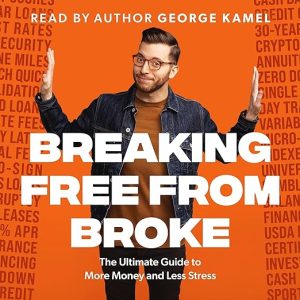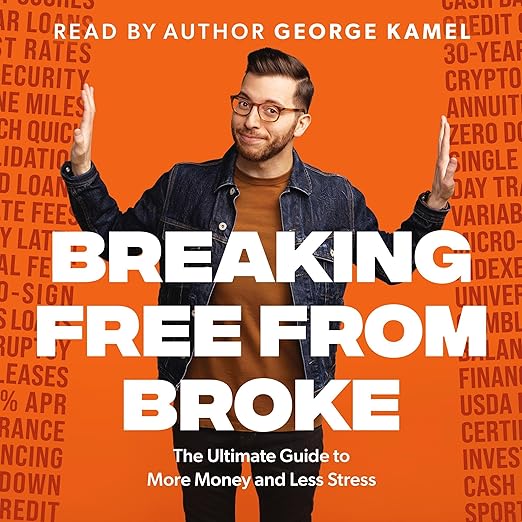
George Kamel begins Breaking Free from Broke from a specific biographical position: a negative net worth at the start of his adult financial life, and millionaire status in under ten years by following Dave Ramsey's Baby Steps. That trajectory is not background material; it is this audiobook's central argument made manifest in a single person's documented experience. Kamel, a Ramsey Personality and personal finance expert, narrates his own six-hour-and-forty-two-minute book, and the self-narration is one of its genuine assets. His snarky sense of humor, advertised in the synopsis as a deliberate feature, requires his own voice to land with the timing it needs.
A Credit Score Measures Debt, Not Health
The book's central claim is structural rather than behavioral: American consumer culture is not a neutral environment in which people happen to make poor financial decisions. It is a system specifically designed to keep people in debt, and the tools it deploys, credit cards, student loans, car payment culture, credit scores as proxy for financial character, are not neutral instruments but profit-generating mechanisms that function at maximum efficiency when consumers believe they are necessary. Kamel works through this argument with more specificity than the framing usually gets. His deconstruction of the credit score as a metric that measures your relationship with debt rather than your actual financial health is the kind of point that sounds obvious after you hear it and never seemed obvious before. The section on student loans is particularly pointed: Kamel argues that the framing of college debt as an investment with guaranteed returns is a marketing claim rather than a financial reality, and he does it with specific examples rather than abstract warnings. That specificity is what distinguishes this from standard anti-debt rhetoric.
The millennial point of view is explicitly part of the value proposition and is not simply a marketing frame. Kamel is not approaching this as a professor of finance or a generational elder dispensing timeless wisdom; he is a person who came of age during the period in which student debt became a default expectation, car payments were presented as inevitable, and the credit card was framed as essential infrastructure for adult life. His specific generation's experience with these products gives the critique texture and personal authority that a more academic treatment would lack. Reviewer Joshua Clobes called it a one stop shop for all the money myths and noted it as perfect for teens and young adults, which is accurate to the intended audience even if the prescriptions apply broadly.
Kamel's Jokes Land Better Than on the Page
Kamel's narration is the primary reason to choose the audiobook format over the print edition. His snarky sense of humor is a tonal register that benefits from vocal delivery. The jokes and asides that punctuate the financial instruction work in audio in a way that reads more flatly on a page. The pacing of the six-hour-forty-two-minute runtime is brisk enough to maintain engagement without sacrificing the explanatory depth that makes individual sections actionable. One reviewer described the experience as comical and informative simultaneously, which is the intended effect and the one Kamel consistently delivers across the full runtime. The audio format also benefits from the way Kamel uses comedic asides to reset listener attention between denser sections of financial data. Personal finance audiobooks can become monotonous when the instruction is delivered without modulation, and Kamel avoids that entirely.
The Baby Steps framework, which Kamel attributes throughout to Dave Ramsey, provides the structural spine of the prescriptive content. The audiobook is not agnostic about method: it advocates specifically for the debt snowball approach, for eliminating credit products as quickly as possible, and for a particular sequence of financial moves that Kamel traces from his own experience. Listeners already inside the Ramsey ecosystem will find this a natural companion, and the generational framing gives it a voice that Ramsey's own work, written for a broader demographic, does not always provide. The chapters on investing traps and mortgage mistakes are the most practically valuable sections beyond the core debt critique.
Advertising as the Vector That Sustains Debt
The book's prescriptive confidence is both its strength and its limitation. Kamel presents the Baby Steps framework as the definitive path out of the broken system he describes, and that commitment to a single methodology means the audiobook does not meaningfully engage with competing approaches, such as those that treat credit strategically rather than categorically. For listeners already aligned with the Ramsey worldview, this is a feature: the clarity and consistency of the prescription is what makes it actionable rather than paralyzing. For listeners who want their financial advice to acknowledge trade-offs and complexity, the certainty of tone will feel like an oversimplification.
The section on marketing and consumerism is the most culturally ambitious part of the audiobook, and the argument there, that the advertising industry is a specific vector through which the debt system sustains itself in the lives of people who believe they are making free choices, is made with enough specificity to hold up as more than rhetoric. Kamel is at his sharpest when connecting the individual debt experience to the systemic incentives that produce and sustain it, and that thread runs most clearly through this section of the book.
Young Adults Weighing Their First Loan Decisions
Young adults at the beginning of their financial lives who are weighing whether to take on student loans, carry a credit card balance, or sign a car loan are the clearest target audience. Listeners already carrying consumer debt who want a framework for prioritizing elimination will find the Baby Steps prescription useful and the humor makes the medicine go down. Anyone who has absorbed the Ramsey financial philosophy and wants a generationally-inflected, comedy-adjacent restatement of it will find Kamel's voice a welcome addition to that tradition. Listeners seeking nuanced analysis of when debt can be a legitimate financial tool should look elsewhere.
- Voice: George Kamel narrating his own book is an asset here; his snarky delivery and comedic timing translate directly from the page to audio, and the self-deprecating personal finance humor lands considerably better in his own voice than it would through a hired performer.
- Big ideas: Consumer debt mythology, credit score culture, millennial financial reinvention
- Atmosphere: Punchy and irreverent, with a clear prescriptive undercurrent
- Worth it?: George Kamel dismantles the financial products marketed to keep people indebted with specific, example-driven critique that makes abstract debt culture feel personal and urgent.
Frequently Asked Questions
How does George Kamel's self-narration affect the audiobook listening experience?
It is one of the audiobook's genuine strengths. Kamel's comedic timing and conversational delivery are integral to the book's voice, and they translate more effectively in audio than in print. The humor that punctuates the financial instruction lands in a way that requires his own vocal register.
Does this audiobook take a balanced approach to financial products like credit cards, or does it advocate a specific position?
It advocates a specific position. Kamel argues categorically against credit cards, credit score optimization, and debt-as-tool strategies, drawing directly on the Ramsey Baby Steps framework. This is advocacy with a clear methodology, not a balanced survey of personal finance philosophies.