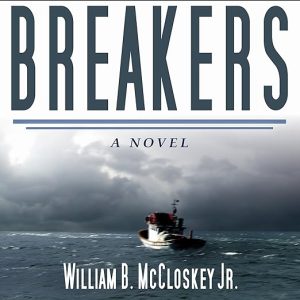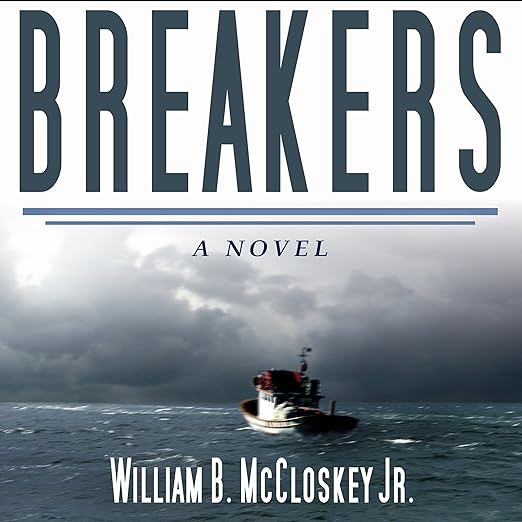
I grew up reading fiction set near water, but coastal Alaska fishing is a world I had never encountered in any depth before McCloskey's Highliners series found me a few years ago. I listened to Breakers on a week when work was particularly grinding, and there was something clarifying about spending my commutes deep inside a world where the physical stakes are absolute and the decisions are immediate. When your crab season collapses and your loan payments do not, you make choices. Hank Crawford makes several of them in this book, and not all of them are comfortable.
Breakers is the third book in the Highliners series, a sequel to McCloskey's bestselling debut about the commercial fishing industry off Kodiak, Alaska. The author is not writing from a distance. Reviewers with direct ties to the Alaskan fishing industry have verified his detail, and one reader who grew up in that world described the research as thorough in a way that comes only from someone who has been present in the industry himself. That kind of authority is rare in adventure fiction and it shows on every page.
Where This One Lands
Skipper Hank Crawford is the organizing consciousness of the Highliners world. He is respected, capable, and deeply in debt. McCloskey gives him a new baby, a new boat with an attached mortgage, and a crab season that yields the worst results in memory. When salmon prices collapse alongside the crab shortfall, Crawford's situation becomes genuinely desperate. The journey to Japan to meet his business partners, where he must decide whether to compromise his ethics or absorb a potentially ruinous loss, is the moral spine of the book. McCloskey is too honest a writer to make that choice simple or to let Crawford off easily either way.
The series has been praised for capturing the excitement, danger, and unending anxiety that define the commercial fisherman's life, and Breakers delivers on all three counts. The sea itself is a presence in the narrative, not backdrop. McCloskey understands that commercial fishing is simultaneously a livelihood, a community, and a relationship with something fundamentally indifferent to human plans.
Why Breakers Works as an Audiobook
Aaron Abano's narration fits the material well. He is not a showy narrator; he reads with a steadiness that mirrors the world McCloskey builds, where physical endurance and emotional restraint are intertwined virtues. At fourteen hours, the book has room to develop its characters and its setting without feeling stretched, and Abano sustains the tone throughout without flagging. Several dedicated rereaders of the series have described the audiobook as their third or fourth visit to the same material, which says something about how the story holds up under repeat exposure.
For listeners who appreciate fiction that treats labor and economics as subjects with the same seriousness as human relationships, Breakers is particularly satisfying. McCloskey does not romanticize the fishing life. The work is brutal, the margins are thin, and the industry is at the mercy of forces no individual can control. That unsentimental clarity gives the emotional moments in the book considerably more weight.
What Gives Us Pause
This is a series entry, and listeners who come to it without having read or heard Highliners will miss some of the accumulated emotional weight that makes the Crawford saga compelling. The book can be followed as a standalone in terms of plot, but the investment in the characters depends partly on the earlier volumes. Readers who have been through the complete series multiple times describe Breakers as the entry that rewards the most with repeated exposure, suggesting its depth becomes more apparent in context.
The pacing is deliberate in the way that serious literary fiction often is. McCloskey is not writing thriller-paced adventure. He is building a world and trusting his readers to stay with it. Listeners who want escalating tension and rapid plot movement may find the rhythm slow; those who like their fiction earned and specific will settle in easily.
Who Should Listen to Breakers
Fans of the Highliners series who have not yet continued into the sequels should not wait. Readers who appreciate literary fiction grounded in specific working worlds, comparable in that sense to writers like Patrick O'Brian or Annie Proulx in her Newfoundland work, will find McCloskey a worthwhile discovery. New listeners are better served starting with Highliners, though this book is strong enough to function on its own for the patient reader.
Good to Know
Do I need to read Highliners first, or can I start with Breakers?
Breakers is the third book in the series. While it functions as a standalone narrative in terms of plot, the emotional investment in Hank Crawford and the recurring characters is significantly deeper for those who have followed the series from the beginning. Starting with Highliners is strongly recommended.
How accurate is McCloskey's portrayal of the Alaskan commercial fishing industry?
Reviewers who grew up in or worked within the Alaskan fishing industry consistently praise his accuracy. The detail is documentary in quality and comes from genuine immersion in the world he describes.
Is Aaron Abano's narration consistent with the tone of the book?
Yes. Abano's understated, steady delivery suits McCloskey's unsentimental prose. He does not impose drama on material that generates its own, which is the right instinct for this kind of fiction.
Is this a series worth completing, or does it tail off after Highliners?
Dedicated series readers consistently recommend completing all four books in order and describe Breakers as one of the strongest entries. Reviewers who have been through the complete series multiple times find it rewarding each time.