Quick Take
- Narrator: Raya Kane handles the ensemble cast with clear differentiation, keeping the political and action-heavy sequences equally readable.
- Subjects: unexpected inheritance of power, political scheming and rival houses, loyalty under pressure
- Tone: Energetic and escalating, with genuine political texture alongside the action
- Bottom line: A second book that earns the investment of the first and adds enough complexity to make the third genuinely anticipated.
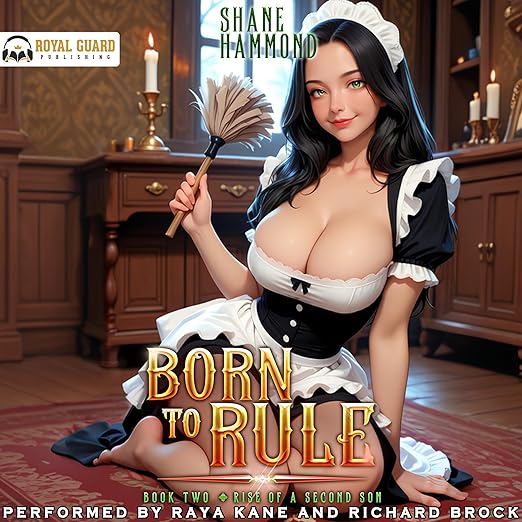
I've been reading progression fantasy long enough to know that the second book is where most series reveal whether they have structural depth or whether the first installment was using beginner's luck. Born to Rule, the second entry in Shane Hammond's Rise of a Second Son saga, is not a beginner's luck book. It does something harder: it takes a protagonist whose first-book circumstances were defined by crisis and survival and begins the work of building something out of those ashes.
Jason, the second son of the King of Sevona, opens this installment in a position he never anticipated. His older brother Julian, the crown prince, has been killed in battle during a campaign against orcs. The road home from a diplomatic mission is anything but simple: a hidden dwarf city is under siege, a knight in black armor with unclear allegiances is watching Jason's every movement, and a rival noble house is actively scheming to fracture the kingdom for another's favor. He has earned the loyalty of Princess Adriana after the events of book one, and his allies are beside him, but the political landscape he's returning to has shifted under everything he thought he knew about his own future.
Our Take on Born to Rule
The subgenre label kingdom-building progression fantasy carries specific reader expectations: the protagonist will accumulate power, influence, and allies in ways that feel structured and rewarding, and the world-building will expand to accommodate the increasing stakes. Hammond delivers on both without letting either element overwhelm the other. The political machinations of the rival noble house are specific enough to feel real rather than decorative, and the siege of the hidden dwarf city adds a tactical dimension that keeps the action moving alongside the courtly maneuvering that the setting requires.
One reviewer noted that the political parts weren't their personal favorite while acknowledging that the action and excitement more than compensated. That's a fair calibration: the political texture here is more developed than in many genre entries, and readers who came purely for combat progression may find themselves doing more navigation of alliances than anticipated. Readers who want their fantasy world-building to include actual governing complexity will find this among the more thoughtful entries in the progression fantasy space. The two things coexist without either dominating the other entirely.
A reviewer raised a specific concern about the romance between Jason and Adriana, who is an elf with a longer lifespan than her human partner. This is a genuine tension in high fantasy romance and one that different authors handle very differently across the genre. Hammond doesn't resolve it in this volume, which is either a feature or a problem depending on your tolerance for romantic uncertainty across a series. For readers who find the immortality gap immediately disqualifying, it will remain an ongoing source of friction. For readers who engage with it as one of the series' genuine complications, it adds a dimension to the relationship that simple human-human romance wouldn't carry.
The broader ensemble, the allies Jason travels with, the new additions joining the fight, and the existing political relationships he is navigating, is handled with enough care that the cast feels populated rather than crowded. A reviewer who called the first book one of their favorites in a while noted that this second installment somehow managed to top it, which is high praise and consistent with the 4.7 rating across 692 reviews for a book released in February 2026. Another reviewer called it an incredible series with lovable characters, which speaks to how much the character work is carrying the engagement alongside the plot mechanics.
What to Watch For in Born to Rule
Progression fantasy narration has its own specific demands. The action sequences need to move with urgency, but the political and planning sequences need enough patience that the stakes are legible rather than rushed past. Raya Kane handles both registers without the kind of performance lurching that can undermine a narrative built on tonal variety. The black-armored knight is given enough atmospheric weight in the narration to function as the sustained menace Hammond intends, which is a specific accomplishment: ominous figures delivered without portentous narration are harder to sustain in audio than on the page where the reader's imagination does more of the work.
At 14 hours and 21 minutes, this is a satisfying runtime for a series installment that needs to both resolve the immediate crises and set up the next volume. Hammond doesn't pad and doesn't rush. The book ends at a point where the larger stakes are clear enough that readers will want book three, which is exactly where a second installment should leave you: satisfied with what you got and genuinely curious about what comes next.
The title of this book, Born to Rule, functions as both a literal description of Jason's situation and an ironic commentary on it. He was the second son, the one not expected to rule, and his path to the crown involves proving fitness for a role that was never designed for him. That framing, the underdog forced into the top position by circumstances beyond anyone's control, gives the kingdom-building premise an emotional engine that pure power-progression fantasy often lacks. You want Jason to succeed not just because he's the protagonist but because the odds against him feel real.
The Right Listener for Born to Rule
Listen if you finished book one and want to see what Hammond does with an actual kingdom-building brief, if political fantasy with combat stakes is your preferred mode, or if you want progression fantasy that takes its world seriously beyond the power leveling mechanics. Start with the first book. Skip if you want pure power progression without political texture, or if you find an immortality-gap romance dynamic a dealbreaker from the start.
Frequently Asked Questions
Can I start with Born to Rule book two, or is book one required reading?
Book one is required. The character relationships, Jason's earned alliances, and the political context of the crown prince's death are all load-bearing for what happens in book two.
How does the progression fantasy element work here? Is it system-based power leveling or something more narrative?
The progression is more narrative-based than system-based. Jason accumulates political power, allies, and capabilities through events rather than through formalized leveling mechanics, which makes this closer to epic fantasy than LitRPG.
Is the romance with Princess Adriana a central focus or secondary to the action and politics?
It's one element in an ensemble of concerns rather than the central plot driver. The romance has genuine stakes, including the elf lifespan question some reviewers find challenging, but the political and action plots operate with equal weight.
Does book two end on a satisfying note or on a hard cliffhanger requiring book three immediately?
The immediate crises introduced in book two are resolved, but the larger political conflict and Jason's path to the crown remain ongoing. It's a satisfying stopping point that sets up the next installment rather than a hard cliffhanger.