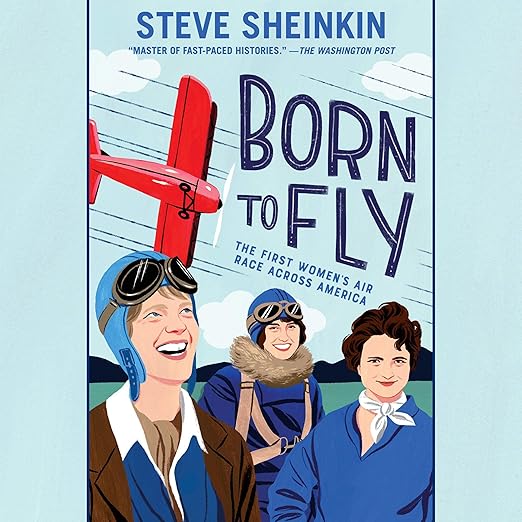
Amelia Earhart and three other women pilots took off from Santa Monica in August 1929 at the start of the first Women's Air Derby, a cross-country race that the press promptly nicknamed the Powder Puff Derby, a condescension that the competitors spent the entire route systematically dismantling. Steve Sheinkin's audiobook covers that race and the four extraordinary lives that led to it, and Kim Mai Guest's narration makes the whole thing feel like it is happening in real time. I listened to this one with a twelve-year-old niece on a long drive, and her silence in the passages where the planes got into genuine trouble was one of the more satisfying responses I have had to a children's audiobook in years.
Elinor Smith Flew Under the Brooklyn Bridge
Sheinkin is a National Book Award finalist with a gift for structural nonfiction that respects young readers' intelligence without losing their attention, and Born to Fly might be his most elegantly constructed title. He braids four biographical threads: Earhart, whose fame preceded the race and whose charisma drove media coverage; Marvel Crosson, who built a plane before she knew how to fly one and who died in the Arizona desert during the Derby; Louise Thaden, who had shattered altitude records in an era when altitude records could kill you; and Elinor Smith, who at seventeen became internationally known for flying under the Brooklyn Bridge. These four lives, separately remarkable and collectively extraordinary, come together in the Derby's final leg in ways that feel like a thriller's structure rather than a history lesson.
The book was read for academic pentathlon preparation at the middle school level, and that context is telling. Sheinkin's nonfiction requires genuine engagement. He does not reduce his subjects to inspirational archetypes. Earhart, in particular, gets a more rounded portrait than the sentimental version often taught in schools: she is formidably skilled and also a careful manager of her own public image, someone who understood that celebrity was an instrument that could fund more flying. That complexity is handled matter-of-factly rather than as a revisionist expose.
The 1929 Air Derby itself is astonishing as an event. The planes were genuinely unreliable by any modern standard. Forced landings were not rare; they were expected. At least one competitor died during the race. The mechanical contingency of early aviation meant that skill was necessary but not sufficient, and Sheinkin renders that uncertainty with enough specificity that listeners feel the fragility of the machines even when the prose is celebrating the audacity of the women flying them.
Competitors Fought to Remove the Co-Pilot Rule
Kim Mai Guest's narration is calibrated precisely to the material's demands. She handles the biographical sections with warmth and momentum, giving each of the four women a distinct vocal presence without resorting to caricature. In the race sequences, her pacing accelerates naturally with the narrative, and the moments of crisis, forced landings, equipment failures, the terrible news from Arizona, land with appropriate weight. Guest is a narrator who trusts the story rather than performing it, and that restraint is exactly right for Sheinkin's prose.
The book's feminist context is handled with the same matter-of-fact quality as everything else Sheinkin writes. The women of the Air Derby were operating in a world that had given them the vote nine years earlier and that was still actively debating whether women should fly competitively at all. The race organizer initially required each woman to carry a male co-pilot for safety reasons, a requirement the competitors successfully fought to remove. Sheinkin presents this resistance as practical and strategic rather than ideological, which is historically appropriate and makes the narrative more vivid. These were women solving problems, not embodying symbols.
At six hours and twenty-four minutes, the production is appropriately paced for middle grade listeners and accessible for younger children with adult accompaniment. The content is substantive without being overwhelming. Marvel Crosson's death is handled with honesty and respect rather than glossed over. That choice reflects Sheinkin's consistent respect for his young reader audience: they can handle the reality that early aviation was dangerous, and the story is stronger for including it.
Four Lives Mean No Exhaustive Treatment
Adult listeners should know that the book is written for a middle grade audience, which shapes Sheinkin's vocabulary choices and the depth of historical context. For adults interested in the history of women in aviation, Born to Fly is an excellent entry point, but the detail level will prompt further reading rather than fully satisfying specialist curiosity. The story is compelling at every reading level; the scholarly apparatus, footnotes, extended source analysis, is not part of what this production offers.
The interweaving of four biographical threads means no single life gets exhaustive treatment. Each woman receives enough detail to feel fully human and specific, but listeners who come specifically for a deep-dive on Earhart or who want extended coverage of Smith's Brooklyn Bridge flight may find the multi-protagonist structure parcels out attention more broadly than they want. That structure is a feature rather than a flaw for readers coming to all four women with equal curiosity.
One reviewer observed that early aviation was so dramatically different from modern flight that it can be hard for contemporary readers to viscerally register the risk. Sheinkin addresses this partly through mechanical detail and partly through the accumulated testimony of what actually went wrong during the Derby. Guest's narration delivers those passages with enough specificity that the danger registers rather than becoming abstraction.
Guest Delivers Outstanding Narration for This Story
Young listeners from around age ten through high school who respond to biography that treats its subjects as complete human beings rather than inspirational symbols will find this audiobook among the best in the genre. It is suitable for classroom use, family listening, and independent listening for confident middle grade readers. Kim Mai Guest's narration is outstanding, and the structure delivers genuine narrative tension in the final stretch of the race.
Adult listeners with a casual interest in aviation history or women's history will also enjoy this audiobook without feeling it is too simplified for them. Skip it if you need specialist depth on any of the four subjects. Come to it if you want a structurally elegant, humanly specific nonfiction narrative delivered with excellent audio craft.
- Narrator: Kim Mai Guest calibrates between warmth and urgency with precision; each of the four women has a distinct vocal presence without caricature.
- Subjects: Pioneering women in aviation, resilience under institutional exclusion, the mechanics and danger of early flight
- Tone: Propulsive and historically vivid, emotionally honest about danger and loss
- Bottom line: Steve Sheinkin's braided biography of four 1929 Air Derby pilots is a structurally elegant nonfiction audiobook that trusts its young audience completely.
Questions Listeners Ask
Is this audiobook appropriate for listening as a family with younger children?
Yes, with the note that Marvel Crosson's death during the race is handled honestly rather than softened. The content is appropriate for ages ten and up as independent listening, and younger children will follow the story easily with adult accompaniment. The six-hour runtime works well broken across multiple sessions.
How does this audiobook cover Amelia Earhart differently from standard accounts?
Sheinkin presents Earhart as both a genuinely exceptional pilot and a strategic manager of her own celebrity, someone who understood that fame could fund more flying. This more rounded portrait is handled matter-of-factly rather than as revisionism. Listeners familiar only with the inspirational archetype version will find this framing more interesting and historically accurate.