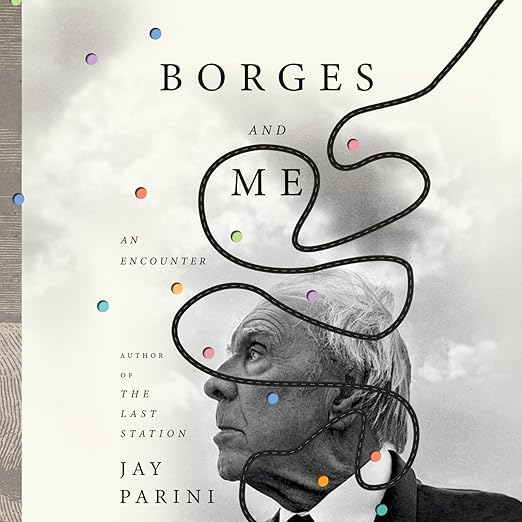
I first encountered Jorge Luis Borges properly in graduate school, in a seminar on postcolonial literature where his story Borges and I appeared as a reading on identity and authorship. The piece is one page long and manages to be more philosophically dense than most novels. So when Jay Parini wrote a memoir about a road trip through the Scottish Highlands with a blind, elderly Borges in the early 1970s, my skepticism was considerable. You do not easily write about a writer of that magnitude without the subject swallowing the book entire.
Parini more or less pulls it off, which is its own form of achievement. Borges and Me is described by the author in his afterword as a kind of novelistic memoir, meaning it is based on true events but shaped with the techniques of fiction. That framing matters and sets appropriate expectations. Parini is not claiming verbatim accuracy. He is claiming emotional truth and the right to shape his experience into something narratively coherent, and on those terms the book mostly succeeds in ways that pure memoir rarely does.
A Closer Look at Borges and Me
The setup is straightforwardly improbable: a 22-year-old American graduate student, in Scotland fleeing the Vietnam War and genuinely in search of his adult life, owns a 1957 Morris Minor. Borges, visiting his translator and in his seventies, is blind and frail and harbors a specific wish to drive to Inverness and meet a man there who is interested in Anglo-Saxon riddles. The pairing has been compared by one reviewer to Don Quixote and Sancho Panza, which is not wrong. The grand but impractical elder and the willing but bewildered young companion is an old structure, and Parini knows it and uses that knowingness consciously.
What prevents the book from becoming a simple discipleship narrative is that Parini does not idealize the experience or the man. Borges is charming and maddening in roughly equal measure. He talks at great length about literature and ideas with genuine brilliance, and he is also, at certain moments, simply an eccentric old man endlessly talking in ways that exhaust his companion. One dissenting reviewer put this with blunt Scottish directness, describing Borges as a scruffy, smelly old man endlessly talking mostly drivel. That response is too harsh, but it captures something real about the book's honesty. Both versions of Borges, the luminous and the tedious, coexist in the narrative, and that duality gives it the texture that hagiography lacks.
What Makes Borges and Me Worth Hearing
The Highland journey gives the book its physical and tonal backbone. Parini uses the landscape with the skill of a novelist rather than a memoirist, grounding Borges's more labyrinthine intellectual flights in specific places and weather and the particular unreliability of a 1957 Morris Minor trying to navigate Scottish roads. One reviewer who approached the book primarily as a fiction reader noted that it took time to get on board, but that once in the Scottish Highlands with Borges as the Delphic passenger, she found herself attached to the pair of them, two unlike characters bonding over poetry, imagination, and beauty. That delayed attachment is accurate to the experience. The book rewards the patience it asks for in its opening chapters.
Fred Sanders's narration serves the material without overwhelming it. He reads young Parini's voice with a literary quality that reflects the older writer looking back on his younger self, which is the appropriate register for memoir-as-craft. His Borges, while inevitably a construction, captures the combination of erudition and unexpected directness that characterizes the historical figure in other accounts and other testimonies.
Things to Know Before Starting Borges and Me
The genius of Parini's structural choice is that Borges's actual ideas permeate the road trip narrative without being explained didactically. His interest in labyrinths and mirrors and doubles, his work on Anglo-Saxon riddles, his famous essay on how every writer creates their own precursors through their work, all of this surfaces in conversation and observation rather than in expository passages. Listeners who come to the book already familiar with Borges's writing will find resonances everywhere. Listeners who come without that familiarity will still enjoy the book, but they will enjoy it differently and with less of the pleasure of recognition that Parini has built in for readers of his subject.
The surreal turn the narrative takes in its later sections is either the book's most successful moment or its most frustrating depending on what the listener came for. Those expecting straightforward memoir will feel the ground shifting in ways they may not welcome. Those who come expecting something novelistic and strange will feel precisely at home. The book announces its intentions early enough that this surprise should not ambush anyone who was paying attention.
Who Jay Parini Is Writing For
Literary fiction readers with some prior knowledge of Borges, travel memoir enthusiasts, and listeners interested in coming-of-age stories built around intellectual mentorship will find Borges and Me genuinely rewarding. The book is not long at under nine hours, and it earns its strangeness through accumulated character detail rather than performing it through stylistic flourish.
Listeners expecting a straightforward road-trip narrative or a biographical account of Borges will be disoriented. This is neither. It is a novelistic meditation on influence, identity, and what it means to be a young writer in proximity to a great one. That is a specific appetite, and the book serves it specifically and without apology.
Questions Listeners Ask
Do I need to know Borges's work to appreciate Borges and Me?
Prior knowledge enriches the experience considerably. Parini weaves Borges's actual ideas about labyrinths, mirrors, identity, and literary influence into the narrative without explaining them from scratch, which rewards readers who are already familiar. Complete newcomers will still enjoy the road-trip and mentorship dimensions, but the deeper resonances will be inaccessible. Listening after reading even one Borges story is worth the preparation.
Is Borges and Me a memoir or a novel?
Parini calls it a novelistic memoir in his afterword: based on true events but shaped with fictional techniques. The road trip and the encounter with Borges are grounded in real experience, but the dialogue, structure, and certain events have been shaped by a novelist's hand. Readers expecting strict memoir accuracy should adjust expectations; readers comfortable with the blurred form will find it one of the book's pleasures.
How does Fred Sanders handle the challenge of voicing Borges as a character?
Sanders gives Borges a quality that combines genuine erudition with unexpected bluntness, which aligns with how Parini describes the historical figure. His version is inevitably a construction rather than a portrait, but it is consistent throughout and avoids both reverent impersonation and comic reduction. Listeners familiar with Borges's documented speaking style will have their own response to this rendering.
At what point does the narrative take its more surreal or novelistic turn?
The book maintains a predominantly realistic register through most of the Highland journey before becoming more openly strange in its later sections. Listeners who are patient with the early chapters, which some reviewers found slow to engage them, generally find the later payoff worth the wait. The surreal dimensions are grounded in Borges's actual aesthetic concerns rather than arbitrary strangeness.