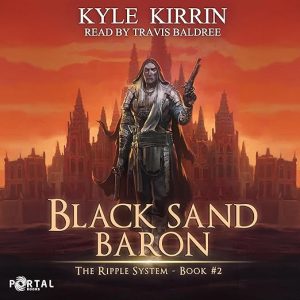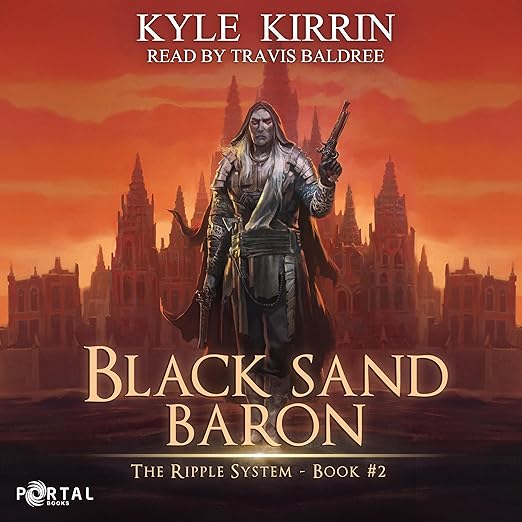
Black Sand Baron picks up where Shadeslinger left off, and the audiobook version benefits from the same asset that made the first Ripple System entry a standout: Travis Baldree in the narrator's chair. This is not a casual pairing. Baldree, best known to many readers as the author of Legends and Lattes, is also one of the most technically gifted audiobook narrators working in fantasy and LitRPG, with a particular strength for ensemble casts where comedic timing and character differentiation are load-bearing elements of the experience. In Black Sand Baron, Kyle Kirrin gives him a lot to work with, and the twenty-hour runtime gives him room to develop what he builds.
Ned is now the target of a game-wide Holy War, which is a significant escalation from the problems he was managing in book one. Tyrann, his antagonist, commands tens of thousands of followers and a divine power preparing to step into the world of EBO within days. Against this, Ned has allies that include a squirrel-exploding bard, a repurposed home security system that follows instructions with uncomfortable literalness, and a talking axe named Frank who is dissatisfied with most levels of violence. On paper, the comedic imbalance is the point. In practice, Kirrin uses the absurdity to build genuine tension: the humor keeps you from noticing how serious the stakes have become until you are already invested in the outcome.
The Verdict, Briefly
The reviewer who called this a really stunning follow-up captured something real about the book's relationship to its predecessor. Shadeslinger established the world and the character dynamics; Black Sand Baron uses that foundation to scale up the conflict while deepening the relationships between Ned and his increasingly unlikely companions. Frank the Axe in particular becomes more interesting as a character when the narrative puts him under sustained pressure. The talking axe who wants more violence than any battle provides is a comedy bit in isolation; across twenty hours of audio, he becomes something closer to a genuine character study in motivation and limitation, and Baldree's delivery of him shifts accordingly.
The LitRPG mechanics are integrated rather than foregrounded. Kirrin writes in a tradition that treats the game-world as a place people actually live rather than a system to be optimized, which means the stat-checks and level-up moments serve the story rather than interrupting it. This positions Black Sand Baron closer to the fantasy-adjacent end of the LitRPG spectrum, which suits readers who appreciate the genre's narrative possibilities without wanting the book to stop for mechanical exposition. The old power stirring in EBO, which introduces strange new enemies and contested rewards, adds a second strand of conflict that keeps the story from becoming purely reactive on Ned's part.
The twenty-hour runtime is significant, and it is worth knowing that the book earns that length rather than inflating it. Kirrin's pacing is consistent, and the Holy War escalation creates sustained tension that prevents any section from feeling like padding. Baldree handles the ensemble with the specificity it requires. Each of Ned's companions has a distinct voice and comic register, and Baldree differentiates them clearly enough that even in rapid exchanges you always know who is speaking. The home security system character, described as taking instructions far too literally, requires particular care in audio: the joke depends on a specific deadpan quality that Baldree maintains without overselling it. The bard's energy is appropriately different. Frank gets a register that is simultaneously menacing and comedically self-aware. This is skilled ensemble performance work.
Listeners who completed Shadeslinger and moved immediately to this audiobook will find the transition seamless. The world is the same, the character relationships have the continuity the sequel assumes, and Baldree's narration maintains the tonal consistency that makes the series feel like a unified project rather than isolated entries. That consistency across a long series is harder than it looks, and it is worth acknowledging as a specific asset of this audiobook production.
Before You Commit to Black Sand Baron
Black Sand Baron is the second book in The Ripple System, and it requires book one as context. Kirrin does not spend time re-explaining the world, the character relationships, or the circumstances that put Ned in the position he is in at the opening chapter. Listeners who enter here without Shadeslinger will find themselves at a disadvantage, not necessarily confused about plot mechanics, but missing the emotional grounding that makes the stakes feel earned rather than abstract. This is a series where reading order matters and the sequel is not designed to function as a standalone.
The book also runs to twenty hours, which is a genuine commitment. Listeners who found Shadeslinger's length satisfying will have no problem here. Those who were on the fence about whether the first book merited the investment should finish it before starting Black Sand Baron, because the sequel is longer and assumes you are already committed to following Ned wherever Kirrin takes him.
Who Will Get the Most From It
Listeners who completed Shadeslinger and want to know what happens next should not wait. The escalation in scope is matched by improvement in execution, and Baldree's narration makes the ensemble dynamics more vivid than they already were on the page. Fans of comedic LitRPG that takes its world-building seriously, who enjoy series like B.V. Larson's Undying Mercenary or Ryk Brown's novels, will find the tonal balance familiar and the execution strong.
Listeners new to The Ripple System should start with Shadeslinger rather than entering here. And anyone who found the first book's humor too dominant at the expense of emotional depth should know that Black Sand Baron adjusts that balance, giving the ensemble more room to develop into characters rather than comic functions. The audiobook rewards the full investment of the series.
Quick Take
- Read by: Travis Baldree is one of the best narrators working in LitRPG, and Black Sand Baron confirms that: the bard, Frank the Axe, and the home-security-system-turned-companion all land distinctly.
- At its heart: Underdog vs. overwhelming odds, humor as survival strategy, community built from chaos
- Vibe: Propulsive and funny, with genuine stakes underneath the comedy
- Short version: The Ripple System's second entry is a more confident book than its predecessor, and Baldree's narration makes the comedic ensemble work in ways the page alone might not.
Common Questions
Is Black Sand Baron a good entry point for The Ripple System, or do I need Shadeslinger first?
Black Sand Baron is the second book in the series and requires Shadeslinger as context. Kirrin does not re-establish the world or character relationships, so new listeners should start with book one to get the full emotional and narrative foundation the sequel builds on.
How does Travis Baldree's narration handle the comedic ensemble cast in this audiobook?
Baldree differentiates clearly between the bard, Frank the Axe, and the home-security-system-turned-companion, maintaining distinct voices and comic registers for each. His delivery of the home security system's deadpan literalness is particularly effective, and the ensemble exchanges land cleanly throughout the twenty-hour runtime.
Does the audiobook require familiarity with LitRPG genre conventions?
Kirrin integrates the LitRPG mechanics into the story rather than foregrounding them, so readers without deep genre familiarity can follow without difficulty. The game-world feels like a setting people inhabit rather than a system to be explained, which lowers the barrier for listeners coming from adjacent fantasy rather than dedicated LitRPG.
How does Black Sand Baron compare to the first book in this audiobook series?
Most readers and existing reviews describe it as a stronger entry than Shadeslinger, with escalated stakes and more developed character dynamics. The comedic tone is maintained but balanced by more sustained narrative tension. At twenty hours, it is also a longer commitment than book one.