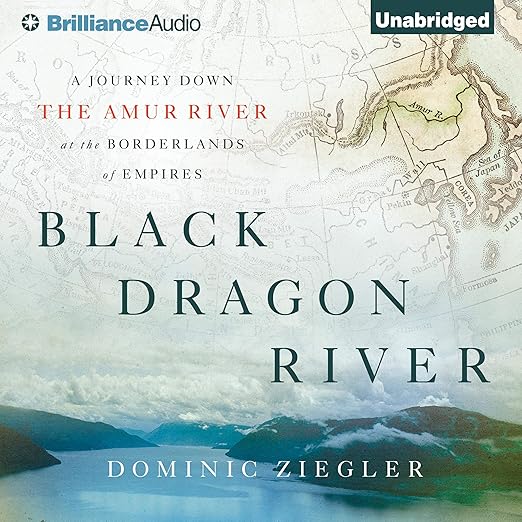
The Amur River runs for nearly three thousand miles along the border between Russia and China, and most people cannot place it on a map. That geographical obscurity is itself part of Dominic Ziegler's argument in Black Dragon River, an audiobook that treats a largely unknown river system as a lens for examining one of the most consequential bilateral relationships in the contemporary world. Ziegler's book uses physical movement through space as a method for moving through time, and at fourteen hours the audiobook rewards the kind of sustained attention that this layered approach requires. This is not casual travel writing. It is a serious examination of a serious place, delivered with the prose quality of a writer who understands that the listener's geography lesson depends on their wanting to stay in the room.
Where This One Lands
Ziegler, a journalist who has covered Asia extensively, approaches the Amur from multiple scales simultaneously: the specific texture of a horseback crossing from the Mongolian steppe into the taiga, the long historical view from Genghis Khan's empire through Russia's nineteenth-century expansion to the Pacific, and the contemporary political analysis of what this border means now, in a moment when Russia and China's relationship is being renegotiated in real time. The tension identified by one reviewer, who found considerably more Russian imperial history than anticipated and less attention to the smaller peoples of the Amur region, is real and worth acknowledging. Ziegler's handling of the Tungusic peoples and other indigenous communities of the river valley is briefer than some listeners will want, while the Russian imperial narrative receives extensive and often brilliant treatment.
For China, Ziegler explains, the Amur is a symbol of national humiliation and Western imperial land seizure. For Russia, it is a symbol of national regeneration, the route to a Pacific identity that would replace the oppressive European one. Those competing meanings, embedded in the same river, are the book's central metaphor, and Ziegler develops it with historical depth that rewards the patient listener. The imbalance in coverage of Russian versus indigenous history is a genuine limitation of the book's proportions, but it does not undermine the central achievement: making a region that reads as blank space on most Western mental maps feel rich, contested, and urgently relevant to understanding the present. One reviewer describes the river as one of the world's most contested regions, and that assessment has only grown more accurate since the book's publication.
The Best Parts of Black Dragon River
Steve West's narration suits Ziegler's measured, literary prose. Ziegler writes with the careful authority of someone who has spent years in the region, and West does not over-dramatize the material. The river crossings, the forced detour onto the Trans-Siberian Railway when the Amur becomes impassable, and the layered historical episodes are handled with even authority throughout. For listeners drawn to narrative nonfiction that functions as literature, the quality of the prose is one of the audiobook's primary attractions. One reviewer describes it as the kind of book you want to read slowly because of the excellent prose and the dangerous and beautiful places it visits, and West's pacing honors that impulse without extending the runtime unnecessarily. The geopolitical material, written before the most recent significant shifts in Russia-China relations, has aged well because Ziegler is analyzing structural dynamics rather than current events.
What Gives Us Pause
Listeners who come expecting adventure travel in the mode of Paul Theroux or Tim Cahill may find Ziegler's historical density and journalistic sobriety less immediately gratifying than they anticipated. The book's strongest passages are often its most historically saturated, and readers who want the physical journey consistently foregrounded over archival and analytical material may find the proportion occasionally frustrating. The narrative also requires holding Russian and Chinese history in simultaneous focus, moving between them without always providing explicit transition signals. That structural ambition is one of the book's genuine strengths for readers ready for it, but it demands active rather than passive listening. Ziegler's framing of the Amur region as a key to understanding the Russia-China relationship has only grown more relevant since publication, giving the analysis a contemporary urgency that justifies the historical depth it took to establish.
Who Should Listen to Black Dragon River
Listeners who value long-form travel writing that uses physical geography as a vehicle for political and historical analysis will find this audiobook a strong entry in that tradition. Readers of Peter Hopkirk's Central Asian histories or of Robert Kaplan's geopolitical travel writing will recognize the methodological sensibility immediately. Those interested in the Russia-China relationship from a cultural and historical angle rather than current affairs journalism will find Ziegler's approach distinctively rewarding. Pure adventure travel listeners who want narrative forward momentum over historical depth should look elsewhere. Listeners interested in the indigenous peoples of the Amur region as a primary focus should supplement this book with more specifically anthropological sources. The fourteen-hour runtime is proportionate to the book's ambitions, and listeners who commit to the pace will find they can no longer treat this part of the world as empty space on their mental map of Asia.
Steve West's reading also serves the book well in the sections where Ziegler moves into more lyrical descriptive passages about the landscape itself. The Amur River valley, particularly in its upper reaches, is a place of genuine physical drama, and Ziegler's prose at its best captures that drama with the kind of economy that marks serious travel writing. West does not over-emphasize these passages, which is the right choice; Ziegler's descriptions earn their own weight without needing additional performance. For listeners who come to this audiobook prepared to work with its layered approach, those passages are among the most rewarding in the genre's recent output.
Steve West's reading also serves the book well in the sections where Ziegler moves into more lyrical descriptive passages about the landscape itself. The Amur River valley, particularly in its upper reaches, is a place of genuine physical drama, and Ziegler's prose at its best captures that drama with the kind of economy that marks serious travel writing. West does not over-emphasize these passages, which is the right choice; Ziegler's descriptions earn their own weight without needing additional performance. For listeners who come to this audiobook prepared to work with its layered approach, those passages are among the most rewarding in the genre's recent output.