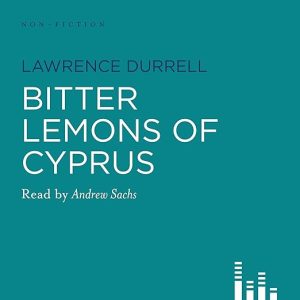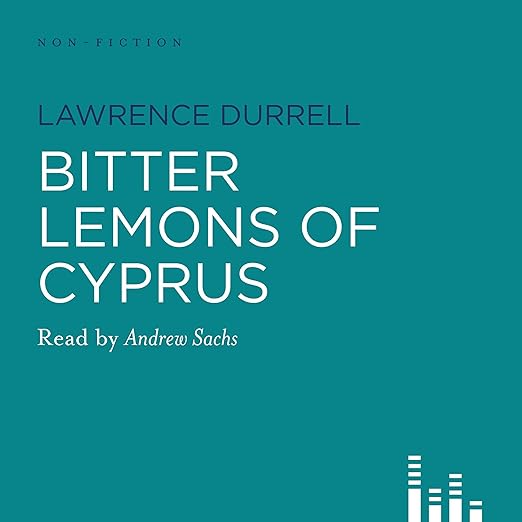
British-ruled Cyprus in the mid-1950s was a place of genuine beauty sliding slowly toward armed uprising, and Lawrence Durrell's memoir of the years he spent living there captures both halves of that reality without collapsing one into the other. Bitter Lemons of Cyprus is the third of Durrell's island memoirs, following Prospero's Cell on Corfu and Reflections on a Marine Venus on Rhodes, and this audiobook edition, narrated by veteran character actor Andrew Sachs, brings real dramatic range to a book that is as much about people as it is about place.
Durrell settles in the village of Bellapaix and writes with what Cecelia Critchley Oler's review calls a poet's sensibility, deeply sensitive, full of humility and humanity, applied to a genuinely complicated political moment: the gradual rise of Greek Cypriot demands for enosis, union with Greece, during the years 1953 to 1956. Durrell states his own intentions plainly in the book's preface, describing it as 'not a political book but simply a somewhat impressionistic study of the moods and atmospheres of Cyprus during the troubled years,' and that framing holds up: this reads far closer to a love letter interrupted by history than to a political tract.
Marina Richards' review adds a layer of personal poignancy worth noting: reading this while actually in Cyprus, she found the places Durrell describes have changed almost beyond recognition, which speaks to how specifically and vividly Durrell renders Bellapaix and its surrounding villages. MontanaSail's review, from someone who lived through this exact period in Cyprus as a child, calls the book very reminiscent of her own family's stories, a strong signal of the memoir's accuracy and texture beyond just its literary polish.
Bellapaix itself is not a fictional or generic village backdrop; it is built around a real, centuries-old Gothic abbey, the Abbey of Bellapaix, whose ruins Durrell writes about as a constant physical presence in the village's daily rhythm. Anchoring the memoir's village life around a genuine historic landmark gives Durrell's prose a layered sense of time, ancient stone alongside mid-century political upheaval, that a more anonymous fictional setting could not have provided, and it is part of why this specific island memoir has outlasted so much travel writing from the same period.
The synopsis itself describes this as a longtime bestseller, and that durability is worth sitting with: most travel writing about a specific, time-bound political moment ages into a historical curiosity within a decade or two, yet Bitter Lemons of Cyprus has stayed in print and in conversation for nearly seven decades. That staying power has less to do with the politics, which did resolve, eventually, in ways Durrell could not have foreseen, and everything to do with the quality of the sentences themselves.
Highlights
The synopsis itself makes a specific claim worth testing against the audio: that Andrew Sachs 'inhabits the voices of both Turkish and Greek Cypriots with authenticity and compassion.' That is a real narration challenge for a memoir built around dozens of village characters across two distinct linguistic communities, and Sachs, a character actor with genuine range well beyond his best-known comic roles, is well suited to differentiate that cast without ever slipping into caricature, which this kind of material specifically needs to keep its compassion intact.
Durrell's prose itself rewards being read aloud in a way plainer travel writing does not. Cecelia Critchley Oler's description of him as a poet, both in his expository writing and his actual poetry, points to prose built on rhythm and cadence, qualities that land with more immediacy spoken than silently read. At just over three hours, this is also a genuinely manageable listen for material this rich, a single long sitting or a few shorter ones rather than a multi-week commitment.
Durrell's reputation rests most famously on The Alexandria Quartet, his sprawling experimental novel sequence, but the island memoirs, this one included, show a different, more intimate register: a writer capable of grand modernist structure choosing instead to write small, specific, deeply personal nonfiction about the actual places he called home. That range is worth knowing going in, since listeners expecting the Quartet's dense, fragmented style will instead find something considerably warmer and more linear here.
Things to Know Before Starting Bitter Lemons of Cyprus
This is not light travel writing in the modern armchair-tourism sense, and listeners expecting a breezy vacation memoir should recalibrate. Cecelia Critchley Oler's review says plainly that 'it's not an easy read, but it's really worth it,' and that assessment holds for the audio version too: the political tension underneath the beauty is real, and Durrell does not resolve it neatly, because history had not resolved it neatly either by the time he finished writing.
The book is also nearly seven decades old at this point, and its portrait of a British colonial Cyprus caught between competing nationalist movements reflects the perspective and blind spots of its era honestly rather than through a corrective modern lens. Listeners wanting a fully contemporary political analysis of Cyprus's later partition should treat this as a period document, a specific witness to one moment, rather than a comprehensive history of the island's subsequent decades.
The political backdrop Durrell describes has a specific historical name, the Cyprus Emergency, the period of unrest as the EOKA movement pushed for union with Greece against continued British rule. Durrell himself worked for a time within the British colonial government's public relations office during part of this period, a detail that adds real texture to his perspective without necessarily compromising the compassion his prose extends to Greek and Turkish Cypriots alike; readers interested in that specific tension between his official role and his personal sympathies will find it a genuinely rich undercurrent.
Is This One for You?
This is an excellent pick for readers of literary travel writing who already admire Durrell's island trilogy or want an entry point into it, and for anyone with a personal connection to Cyprus specifically, the way MontanaSail's review describes recognizing her own family's history in these pages. Fans of mid-century British expatriate memoir generally, the kind that treats a place's people as seriously as its scenery, will find this a rewarding, relatively short listen.
Skip this one if you want a straightforward historical or political account of the Cyprus conflict rather than a personal, impressionistic memoir, since Durrell's own stated aim was never comprehensive political analysis. Listeners after modern travel content with practical destination advice should also look elsewhere, since this reflects a Cyprus that, as marina richards notes, has changed almost beyond recognition since Durrell lived there.