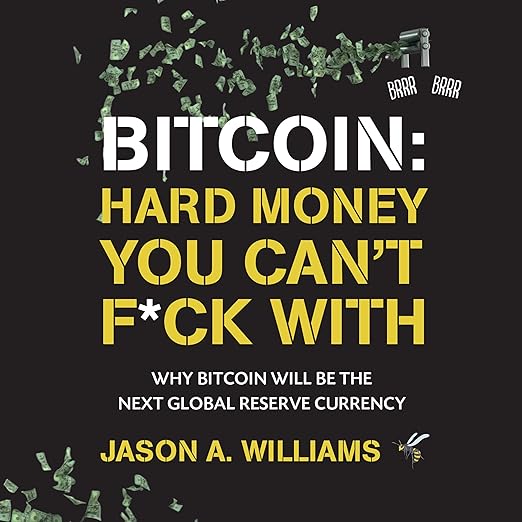
A colleague introduced me to this book by asking whether I would rather start with something that explains Bitcoin the way a textbook does or the way someone who has already been converted explains it. This is definitively the second type. Jason A. Williams is a Bitcoin advocate first and an author second, and the book does not hide that. I found myself thinking of it less as journalism and more as an extended argument made by someone who genuinely believes what he is saying. On those terms, it is more honest than a lot of financial writing that pretends to neutrality it does not actually have.
The title alone signals the register. Bitcoin: Hard Money You Can't F*ck With is not trying to sound measured. Williams is writing for people who are either already curious about Bitcoin or willing to be persuaded, and the energy of the book reflects that. What the six-hour audiobook does well is move efficiently through the foundational ideas before building to the argument about what Bitcoin's structural properties mean in a world of expanding monetary supply.
First, the Big Picture
Williams frames this book around the 2020 financial crisis and the pandemic-era money creation that followed it, which gave him a concrete contemporary anchor for the argument that fiat currency systems are structurally prone to debasement. The money printer go brrr reference in the synopsis is not just a meme citation. It anchors the book in a specific moment when central bank interventions were visible and controversial in ways that made the Bitcoin argument feel newly urgent to people who had previously dismissed it.
One reviewer writing in 2024 notes that the book holds up well even years after publication, with Bitcoin having established itself as a globally accepted store of value roughly in line with what Williams projected. That is a fair observation. The core argument about Bitcoin's scarcity and resistance to manipulation did not age out, even if specific price projections and timeline claims have been superseded by actual events.
The Best Parts of Bitcoin: Hard Money You Can't F*ck With
Williams organizes the book into three sections: what Bitcoin is and why it matters, a compressed history of money and monetary failure, and the argument for Bitcoin as the next global reserve currency. This is a sensible scaffold for someone approaching the subject fresh. The history of money section, covering how fiat currencies have consistently failed when governments needed to spend more than they taxed, is actually the strongest part of the book regardless of whether you ultimately accept the Bitcoin conclusion. The historical precedents Williams draws on are documented and the argument is coherent.
Jessica Walker's narration handles the three-section structure cleanly. She keeps the energy up through the more explanatory passages without pushing into territory that would make the advocacy sound like a sales pitch.
A Few Reservations
Williams does not engage with serious critiques of Bitcoin, including energy consumption, regulatory risk, volatility as a medium of exchange, or the genuine uncertainty about whether it will function as a reserve currency rather than a speculative asset. This is a book about why Bitcoin matters written by someone who is convinced it matters. Readers wanting the counter-case alongside it will need to look elsewhere. One reviewer specifically recommended it as a starting point rather than a definitive text, and that framing is accurate.
Who Should Listen to Bitcoin: Hard Money You Can't F*ck With
This is best for listeners who know little about Bitcoin and want an enthusiastic, clear-language introduction to the foundational ideas. At six hours, it does not overstay its welcome, and the three-part structure means you can pause between sections without losing the thread. It also works for anyone who has been following Bitcoin broadly and wants a coherent framework for the monetary argument specifically.
Skip it if you are looking for a balanced, multi-perspective analysis of cryptocurrency. Williams is making a case, not conducting an inquiry. That does not make the book less worth listening to, but going in with accurate expectations about what it is will make the experience more useful.
The Short Version
- Performance: Jessica Walker keeps the material accessible without losing the book's energy, handling both the polemical sections and the more explanatory passages at a steady pace.
- What it covers: Bitcoin as monetary system, history of fiat currency failure, macroeconomic disruption
- Feel: Evangelical and urgent, written from inside a conviction rather than outside it
- Our call: An enthusiastic and readable Bitcoin introduction that holds up well for newcomers, with the caveat that it reads as advocacy rather than analysis.
Before You Listen
Does this book explain the technical mechanics of how Bitcoin works?
Only at a surface level. Williams focuses on Bitcoin's monetary properties, its fixed supply and resistance to manipulation, rather than blockchain architecture or cryptographic specifics. This is a financial and historical argument rather than a technical primer.
How well has the book's argument held up given that it was published in 2021?
The core monetary argument has held up. Bitcoin's position as a recognized store of value has strengthened since publication. Specific predictions about timeline and adoption have been a mixed record, but the framework the book offers remains coherent.
Is this appropriate for someone with no background in economics?
Yes. Williams writes for a general audience and defines his terms throughout. The history of money section in particular is accessible to anyone willing to follow a simple historical argument about what money is and how governments have abused it.
Does Jessica Walker's narration suit the book's tone?
Walker keeps the energy appropriately engaged without pushing into infomercial territory, which is the risk with advocacy material. The pacing is comfortable across the full six hours, and she handles the more technical terminology without stumbling.