Quick Take
- Voice: Mattoo reads her own essays with the offhand precision of a natural storyteller, her timing sharpening the humor and earning the grief.
- Big ideas: Displacement and belonging, immigrant identity, the unreliability of home
- Atmosphere: Warm and wry, with unexpected emotional depth
- Worth it?: Mattoo's self-narrated essay collection is one of those listening experiences where the format and the material are perfectly matched.
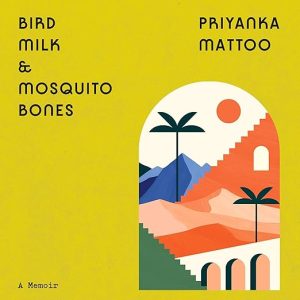
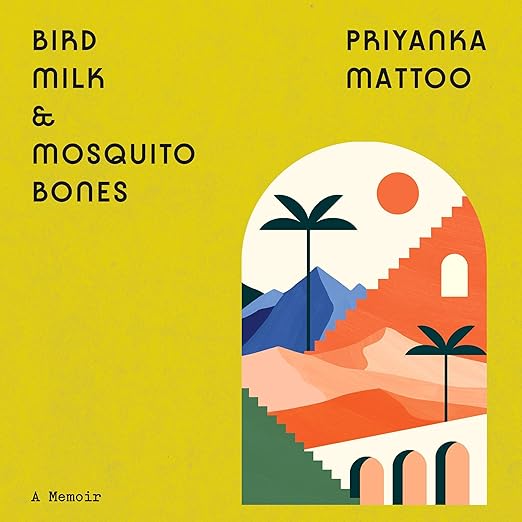
I listened to Bird Milk and Mosquito Bones over two commutes and one long walk, and I kept stopping to replay paragraphs not because I had missed something but because the writing was precise enough that I wanted to hear certain sentences again. That is a particular quality in essay collections delivered in audio: the prose either rewards that kind of attention or it evaporates. Priyanka Mattoo's does not evaporate.
The book covers thirty-two addresses across four decades, from a wooden house in the Himalayas to Srinagar, Saudi Arabia, England, Michigan, Rome, and Los Angeles. The 1989 violence in Kashmir that forced her community out is the event at the center of everything, the hole in the geography that every subsequent address is partly an attempt to fill. Mattoo does not approach this material sentimentally. She approaches it with wit, a keen eye for the absurd detail, and a willingness to be honest about the costs of perpetual motion.
Is Bird Milk & Mosquito Bones Worth Your Time?
What distinguishes this collection from the crowded field of diaspora memoirs is Mattoo's sense of comedic timing and her refusal to make any single location or period into a defining wound. The essays are standalone pieces that accumulate into something larger: a portrait of a life in constant renegotiation with the idea of home. Reviewer Kimberly described it as essays that span geography without becoming a simple travelogue, and that is accurate. These are interior essays that use place as lens rather than subject.
The Saudi Arabia section is particularly strong. Mattoo captures the specific texture of life inside a foreigners' compound, the way friendships form and collapse behind sandstone walls, with the kind of specificity that only comes from having actually lived inside those constraints. It is one of the book's least expected sequences and one of its best. The rogan josh scene, where Mattoo replicates her mother's recipe via Zoom from Los Angeles, is the kind of image that carries almost everything the collection is about in a single domestic moment: distance, love, the persistence of home in the body even when its geography is gone.
The Best Parts of Bird Milk & Mosquito Bones
Mattoo narrating her own work makes this a different experience than the page version. Reviewer Liz specifically flagged the audio as worth choosing over the print edition, noting that Mattoo has the loveliest voice and delivers the stories with ease. She is right. Mattoo's comedic instincts translate directly into timing, and the moments of grief land differently when you hear her voice change register. This is one of those cases where the author's narration is not just acceptable but genuinely preferable to a professional narrator who would bring technical skill without lived intimacy.
Before You Commit to Bird Milk & Mosquito Bones
Listeners expecting a linear narrative will need to recalibrate. The essays are standalone pieces arranged thematically rather than strictly chronologically, and the book's effect is cumulative rather than driven by a single throughline. Emma Straub's blurb on the cover promises that Mattoo knows what to eat everywhere, how to make a friend, and how to tell a story afterward, and that is a fair description of the book's particular pleasures. The best essays here have a formal completeness that makes each one satisfying on its own terms while contributing to the larger portrait.
Should You Listen to Bird Milk & Mosquito Bones?
This collection works especially well for listeners who appreciate personal essays that carry real intellectual and emotional weight without becoming earnest about it. Readers who came to this via an interest in Kashmir's history or the Kashmiri Pandit displacement of 1989 will find a perspective that is personal and precise rather than documentary. Anyone who finds most memoir too shapeless will likely respond to Mattoo's formal instincts. Those looking for a single propulsive narrative may find the essay structure diffuse, but that is the nature of the form rather than a flaw in the execution. The nine-hour runtime is also exceptionally manageable for the amount of ground covered.
Questions Listeners Ask
Is the audio version of Bird Milk and Mosquito Bones significantly better than the print edition?
Multiple reviewers specifically recommend the audio, and Mattoo's self-narration is widely cited as a highlight. Her comedic timing and the shifts in register during more emotional passages make the audio a distinct and preferable experience for many readers.
Is Bird Milk and Mosquito Bones appropriate for readers unfamiliar with Kashmir's history?
Yes. Mattoo provides enough context within the essays that prior knowledge of Kashmiri history is not required. The book works as personal memoir first, with the historical backdrop emerging naturally through her family's specific experience.