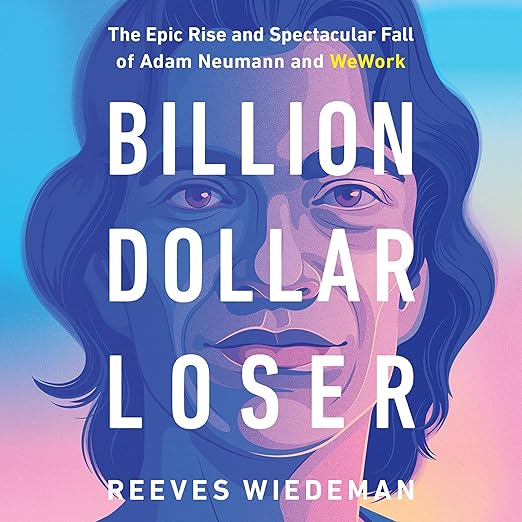
- Narrator: Will Collyer maintains a journalistic neutrality that suits the material well, he does not editorialize where Wiedeman already provides enough angle.
- Subjects: startup mythology and its collapse, charismatic leadership as manipulation, the enabling role of institutional capital
- Tone: Propulsive and gradually darkening, the comedy of excess curdles into something more troubling
- Bottom line: The most readable book about WeWork's collapse, and a useful case study in how institutional credibility enables founders who should have been questioned much earlier.
I listened to Billion Dollar Loser over two evenings in late spring, during a period when I had been thinking about a different corporate collapse and the specific ways that investors convince themselves they are not doing what they are clearly doing. Wiedeman's book arrived at exactly the right moment. By the second evening I was taking notes about institutional psychology that had nothing to do with WeWork specifically and everything to do with the larger question of how a $47 billion valuation happens.
Reeves Wiedeman is a journalist who covered WeWork for New York Magazine, which gave him unusually close access to the people and events that produced this story. The result reads differently from the two other major WeWork books, it has the texture of reporting rather than reconstruction, with specific scenes and specific voices rather than composite impressions. One reviewer who had read The Cult of We noted that Billion Dollar Loser offers more personal stories and less financial detail, which may frustrate readers who want the numbers but rewards readers who want to understand Adam Neumann as a human being rather than as a cautionary symbol.
What Reeves Wiedeman Delivers
Neumann is one of those figures who seems constructed to resist simple categorization. He arrived in America promoting baby knee pads, married Gwyneth Paltrow's cousin, served in the Israeli Navy, stands six feet five, and convinced SoftBank to give him billions of dollars based on a shared-office company that claimed it was actually a technology company. The gap between what WeWork claimed to be and what it was, a real estate business with a very good PR operation, is the book's central mystery, and Wiedeman is interested in how smart institutional actors convinced themselves the gap did not exist.
The marijuana-and-tequila boardrooms, the cult-like summer camps, the consciousness-raising sessions with Anthony Kiedis: Wiedeman reports these without embellishment because embellishment would be redundant. The company operated at a pitch of performative intensity that made normal due diligence feel pedestrian, which was, of course, the point.
Will Collyer's narration maintains a journalistic evenhandedness that suits the material. Wiedeman's prose is already analytical without being cold, and Collyer does not add editorial weight where the text already carries it. The ten-hour-and-fifty-one-minute runtime moves well, this is structured as a character-driven narrative rather than a chronological business history, and the pacing reflects that. The sections covering Neumann's early years are particularly vivid; the book earns its comparative reach to other charismatic-leader disasters (Elizabeth Holmes, Keith Ranieri appear in a review comparison that Wiedeman himself would probably endorse).
The book is well-produced by Little, Brown, and the audio quality is consistent throughout. It is the kind of business narrative that rewards listening at normal speed rather than accelerating, the details are dense enough that compression loses nuance.
Where Reeves Wiedeman Loses Some Ground
One substantive criticism from reviewers is that the book does not probe deeply enough into the institutional failures that enabled WeWork's rise. JP Morgan's role, the investment banking community's collective abdication of skepticism, the structural incentives that made it rational to believe in a $47 billion valuation, these are present in the book but not under the microscope the way the Neumann-and-Rebekah relationship is. Readers who come for the system critique will need to supplement with other reading.
The book also has a structural limitation inherent to the subject: without an autobiography from Neumann himself, the account of his inner motivations is necessarily speculative and assembled from surrounding testimony. Wiedeman is honest about this, but it shapes what the book can claim to know.
Who Should Pick Up Billion Dollar Loser
Business readers interested in startup culture, charismatic leadership, and the psychology of institutional credulity will get the most from this. Students of crisis communications and business ethics will find it useful as a case study, one reviewer encountered it as part of a class curriculum to strong effect. Readers who have already consumed The Cult of We will find some overlap but enough distinctive reporting to justify both. Skip it if you want a systematic analysis of the financial mechanics; this is people journalism, not forensic accounting.
Good to Know
How does this compare to The Cult of We, the other major WeWork book?
Billion Dollar Loser offers more personal storytelling and scene-level reporting; The Cult of We provides more financial detail. A reader who has done one will find the other complementary rather than redundant.
Does the book cover what happened to Neumann after the IPO collapse?
Wiedeman covers the collapse and immediate aftermath. For developments after 2020, including Neumann's subsequent ventures, readers will need more current sources.
How does Will Collyer's narration handle the book's tonal shifts between comedy and business tragedy?
Collyer maintains consistent journalistic neutrality throughout, which works because the tonal shifts are in the prose rather than requiring the narrator to signal them. He trusts the material, which is the right call.