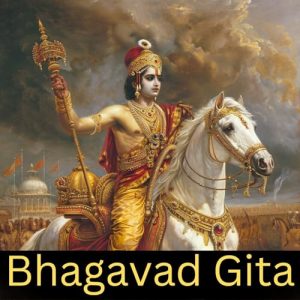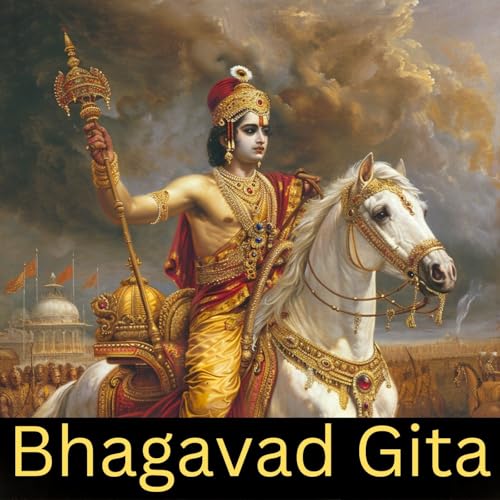
The Bhagavad Gita has been in continuous circulation for more than two thousand years, and the number of audio presentations, scholarly editions, and popular-press versions shows no sign of shrinking. The question for any listener encountering this particular audiobook is always the same: what does this specific recording offer that others do not? The Bhagavad Gita Complete Edition, published by Atman Press and narrated by Seth Andrews, arrives at under three hours, positioning it as an accessible, single-session entry point rather than a scholarly deep dive. For many listeners, that accessibility is precisely what they have been waiting for.
The text itself needs little introduction. The Bhagavad Gita is the dialogue between the warrior Arjuna and his charioteer Krishna on the eve of the great battle at Kurukshetra. Arjuna, faced with the prospect of fighting and killing members of his own family, puts down his bow. What follows is one of the most sustained philosophical conversations in world literature: 700 verses covering duty, action without attachment to outcomes, the nature of the self, devotion, and the structure of existence. The text has influenced figures as different as Gandhi, Thoreau, Emerson, and Oppenheimer. It is a foundational document in Hindu philosophy and one of the most widely read spiritual texts on earth, and hearing it in audio restores something of the oral tradition in which it was almost certainly first transmitted.
Seth Andrews narrates, and his approach is respectful without being reverential to the point of flattening the material. Andrews, known primarily from his work in skeptic media, brings a reading voice that is clear and deliberate, with measured pacing that lets the verses land without hurrying toward the next stanza. For listeners approaching the Gita for the first time, pace is crucial: the ideas accumulate, and a narrator who rushes denies the listener the beat of absorption each verse requires. Andrews does not rush. His measured delivery creates a kind of meditative momentum that suits the material's fundamental character.
The edition from Atman Press draws on a readable translation that prioritizes clarity without sacrificing the philosophical precision the text demands. The distinction between this approach and the more literal, scholarly translations is significant. Some Gita editions preserve Sanskrit terms throughout and require the reader to already know what 'dharma,' 'atman,' and 'moksha' mean contextually; this edition works to make the dialogue accessible without requiring prior immersion in Hindu philosophical vocabulary. For first-time listeners, that choice is appropriate and generous. Returning listeners who know the Sanskrit terms may occasionally find the more accessible rendering less satisfying, but the trade-off serves the audiobook format well.
The Strengths
The audio format suits the Bhagavad Gita in a way that surprises many first-time listeners. The dialogue structure, Krishna and Arjuna in conversation, is naturally oral. The original Sanskrit was almost certainly composed to be heard and recited rather than read silently. Listening to Andrews read the verses restores something of that tradition, and the rhythm of spoken verse creates a contemplative momentum that a page-turning read can sometimes interrupt. The text's fundamental question, how should a person act when duty and love are in conflict, lands with particular force when heard rather than processed visually.
At under three hours, this edition is genuinely completable in a single sitting. That accessibility matters. Many listeners feel the weight of the Bhagavad Gita's reputation and assume they need a guided course or weeks of preparation before approaching it. They do not. The ideas are demanding, but the text is remarkably direct. Krishna does not obscure his arguments. He makes them explicitly, from multiple angles, returning to the core themes of action, detachment, devotion, and knowledge with the patience of a great teacher who knows the student will need to hear the same truth differently several times before it settles.
Things to Know Before Starting Bhagavad Gita - Complete Edition
With a minimal synopsis and limited context about which translation is used or how the editorial apparatus is arranged, listeners should approach this edition with appropriate uncertainty about the depth of annotation. Scholarly listeners who want commentary, verse-by-verse analysis, or comparison with other major translations will find this edition too spare. The experience is the text itself, presented cleanly, without the apparatus of footnotes or interlinear explanations that longer academic editions provide. For some listeners, that spareness is a feature; for others, it will feel like context they needed.
The short runtime also means the presentation does not include significant introductory framing about the Mahabharata context, the battlefield setting, or the historical and philosophical reception of the text. Listeners who want the Gita placed firmly in its narrative and historical context will want a supplementary resource: commentaries by S. Radhakrishnan or Swami Vivekananda, or a modern popular introduction like Barbara Stoler Miller's translation, provide that scaffolding. The Atman Press edition works best as first contact with the text itself, leaving deeper contextualization to further study.
Recommended For
Listeners who want a clean, accessible, single-session encounter with one of the world's great spiritual texts will find this audiobook genuinely suited to that purpose. General interest readers curious about Hindu philosophy who find the scholarly editions daunting will find this a real entry point. Meditators and practitioners working with themes of detachment, duty, and right action will find the audio format particularly suited to using the text as a contemplative resource, returning to it across multiple listen-throughs as understanding deepens. Academic students who need scholarly apparatus, detailed commentary, or specific verse numbers for citation should choose a print edition instead. For listeners who have encountered the Gita in fragments, through quotations or secondary references, this is the most direct way to finally hear it whole.
A Few Questions About Bhagavad Gita - Complete Edition
How does Seth Andrews' narration suit the content of this audiobook?
Andrews reads with care and appropriate gravity without overdramatizing. His pacing allows the verses to accumulate naturally. For a text that rewards slow absorption, his measured delivery is an asset, and his clear pronunciation handles the translated terminology well.
At under three hours, is this audiobook really a complete edition of the Bhagavad Gita?
The Bhagavad Gita's 700 verses are actually relatively compact; a clean reading without extensive introductory material or chapter-by-chapter commentary sits comfortably under three hours. This edition presents the full text without surrounding scholarly apparatus.