The Short Version
- Voice: Reich reading his own text is the right call, giving the economic arguments the weight of a lecture from someone who has actually held the institutional positions he references.
- Big ideas: Wealth concentration, democratic erosion, the mobilization imperative
- Atmosphere: Urgent and plainspoken; structured as a call to action rather than an analysis
- Worth it?: A compact, forceful argument from Robert Reich that is dated in some of its specifics but accurate in ways that have only become more apparent since 2012.
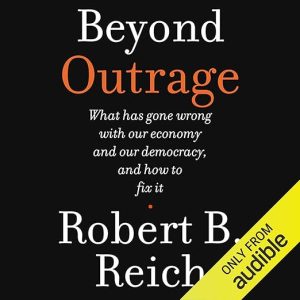
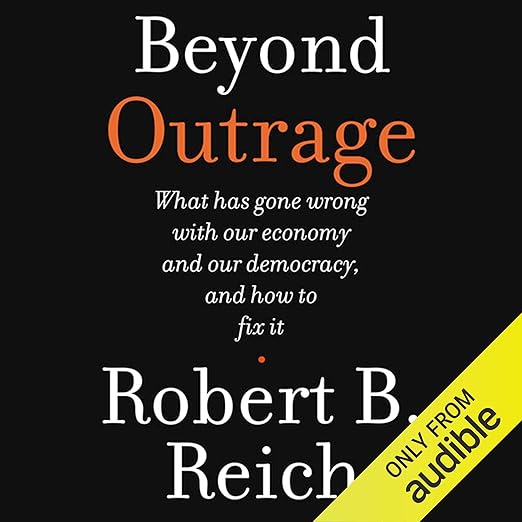
I listened to Beyond Outrage on a weekday morning when I had about three and a half hours to fill, and I finished it without once checking how much time remained. At 3 hours and 26 minutes, Robert Reich has written the most economical thing he's capable of writing: a pamphlet in the eighteenth-century sense, a direct argument addressed to citizens about a specific political and economic problem, with a specific recommended response. The form suits him. Reich is a professor and a former Secretary of Labor, and the speaking mode here is the mode of someone who has spent decades making complicated things clear to rooms of people who need to understand them.
Published in 2012, the book asks Americans to move beyond mere outrage about wealth concentration and corrupted politics toward organized action. From the vantage point of more than a decade later, the argument has the uncomfortable quality of having been right in its diagnosis while the prognosis failed to materialize. The problems Reich identifies, the increasing share of income and wealth going to the top hobbling jobs and growth for everyone else, while undermining democracy and increasing cynicism about public life, have not improved. The mobilization he calls for has happened in fragments but not in the sustained, organized form he argues is necessary.
Inequality and Democratic Dysfunction, Linked Directly
Reich's central intellectual contribution here is the explicit linking of economic inequality to democratic dysfunction. He is not arguing that rich people are bad. He is arguing that when wealth concentration reaches a certain threshold, it systematically distorts the political process in ways that prevent democratic correction from working, because the mechanisms of democratic correction are themselves subject to the influence of concentrated wealth. That argument, made in 2012, reads as almost self-evident by 2024. What felt like a liberal argument has become something closer to a structural observation.
The section addressing what he calls the regressive right is the most dated portion of the text. The political terrain Reich is mapping in 2012 has shifted substantially, and some of the specific policy arguments feel anchored to a debate that has moved on. Listeners who come to this book now should understand they are reading a document of its moment rather than a timeless tract, and adjust accordingly. The structural argument, however, is not dated. The mechanics of how wealth translates into political power, and the specific ways that translation undercuts working people's economic and political position, remain accurate.
Electing Good People Alone Is Not Enough
The book is interesting for what it argues against as much as what it argues for. Reich spends real time addressing the failure mode of progressive politics: the belief that electing good people is sufficient, that the quality of representation determines the quality of governance. His counter is blunt. Nothing positive happens in Washington unless good people outside Washington are organized to help make those things happen after the election. This is not a new observation in political theory, but Reich makes it with the specificity of someone who has watched it fail from the inside of the executive branch.
He also argues against the turn inward, the tendency of people alienated from public life to retreat into private solutions and individual choices. That retreat, he argues, is exactly what the concentration of wealth depends on. Organized, sustained civic participation is the only thing that has historically corrected these imbalances, and the book spends its final sections mapping what that looks like in practice. This is where the book is most explicitly a blueprint, as the subtitle promises, rather than an analysis.
Reich's Self-Narration Carries Real Conviction
Self-narrated audiobooks by public intellectuals work when the author has the kind of voice and delivery that communicates credibility. Reich has that voice. There's no performance anxiety in the narration, no sense of someone reading rather than speaking. The economic explanations are delivered with the clarity of someone who has made these arguments in front of audiences for years, and the passion in the civic sections is genuine rather than performed. The short runtime is appropriate to the text: this is not a book that benefits from being stretched, and the audiobook production respects that.
One French reviewer, writing from outside the United States, makes an observation worth noting: that what Reich describes in American terms is recognizable worldwide, that the face noire de la mondialisation manifests the same pattern in different national contexts. That external perspective validates the book's universality even when its specific legislative and electoral arguments are distinctly American.
Three and a Half Hours Well Spent
Beyond Outrage is worth three and a half hours of your time if you want to understand the framework that has shaped progressive economic thinking for the past decade. It is the clearest short statement of what Reich believes and why, and clarity is its own value. Listeners who want empirical depth should seek out his longer works or the scholarship he draws on. Those who want a call to action that still applies, even if the specific political moment has shifted, will find the argument as urgent as it was when it was published, possibly more so.