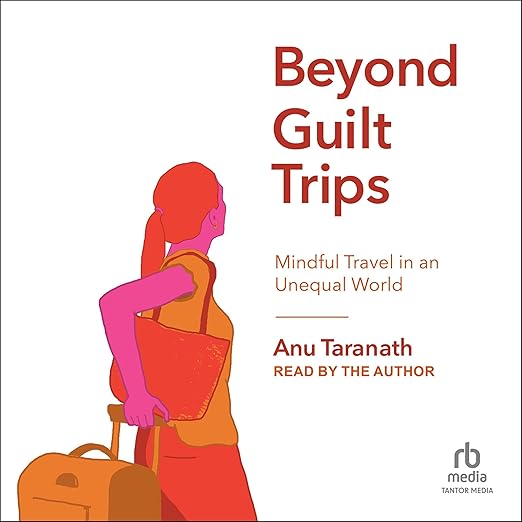
Anu Taranath's audiobook Beyond Guilt Trips: Mindful Travel in an Unequal World opens not with a destination but with a question about the traveler, which is exactly the right place to start. The context of this book matters: every year hundreds of thousands of students and well-intentioned young Westerners head abroad to study, volunteer, or simply observe. They return with photographs, Instagram posts, and a complicated residue of experiences they often cannot articulate. Taranath has spent years in both academia and storytelling working with precisely these people, and what she has developed is not a scolding but a framework, practical, personal, and rooted in her own layered identity as a person of color navigating between cultures.
The full title signals the book's dual ambition: "mindful travel" suggests practice, and "an unequal world" situates that practice within systems rather than individual choices. Taranath does not pretend that good intentions flatten global inequity. She also does not conclude from that premise that travel is irredeemable. What she argues, through personal stories and questions embedded throughout the text, is that travelers who have not done the interior work before departure are likely to reproduce the dynamics they hoped to escape. That argument is neither new nor comfortable, and she knows it.
A reviewer who had Taranath as a professor notes that the book covered topics of culture, identity, intersectionality, race, privilege, and power in ways that felt genuinely different from what they normally read. That observation points to something the book does well: it layers these categories without flattening them into a checklist. Taranath writes about her own experiences of navigating difference, of being an insider and an outsider simultaneously, with a candor that prevents the book from becoming merely prescriptive. The title is almost tongue-in-cheek; the book itself is not interested in generating guilt but in identifying what lies beyond it.
At eight hours and thirty-five minutes, Beyond Guilt Trips has room to breathe. Taranath is not in a hurry to reach her conclusions, which serves the material. The questions she poses throughout are not rhetorical; she genuinely expects the listener to sit with them. A reader who purchased the book for a son's girlfriend, both of them world travelers, reported that she found it "informative" in a way that landed. That kind of casual recommendation, the book as thoughtful gift, says something about how approachable the content is for engaged listeners who are not academic specialists.
What Anu Taranath Gets Right
Taranath narrating her own work is essential here. Her voice carries the ease of someone who has given many versions of this talk, refined the ideas through classroom conversations, and arrived at a version of the argument she genuinely believes. The self-narration is never performative; she reads the way she probably teaches, with pauses, with warmth, with a sense that she is in conversation with the listener rather than delivering a lecture at them. For material this personal, the authorial voice adds a layer of authenticity that a professional narrator, however skilled, would struggle to replicate.
The audio format suits the book's structure particularly well because Taranath embeds questions throughout the text, and hearing them read aloud gives them a different quality than seeing them on the page. They feel less like study-guide prompts and more like something a thoughtful person is genuinely asking you. That quality of direct address is easier to sustain in audio than in print, where the eye can skim past a question before the mind has engaged with it.
Where Anu Taranath Loses Some Ground
The book focuses primarily on the Western traveler headed toward the Global South, and its framework is built around that particular directional dynamic. Listeners whose travel experience falls outside that pattern, those moving between countries with comparable economic power, or those traveling from the Global South to the West, may find some of the framework requires translation. This is not a criticism so much as a scope note. Taranath is writing from a specific situated experience, and the book is most directly applicable to the audience she knows best: the study-abroad student, the gap-year volunteer, the conscientious Western traveler uncertain how to move through difference without exploitation.
The book does not conclude with a tidy resolution. It concludes with more questions and a call to ongoing practice. For listeners who prefer their nonfiction to arrive at firm answers, that will feel like an unsatisfying ending. For listeners who understand that the problems Taranath is addressing are structural and ongoing, the open-ended conclusion is intellectually honest. She says yes, travel. But be present. That is not a small ask dressed up as advice; it is a genuine orientation toward a different kind of movement through the world.
Who Should Pick Up Beyond Guilt Trips
This audiobook is well-matched for students preparing for study-abroad programs, educators who work in global education, and anyone who has returned from international travel with an unresolved sense of discomfort about what they witnessed. Intercultural educators have used it as a course text, and the listening experience reinforces its usability in those contexts.
Listeners who are looking for travel narrative, for the pleasures of evocative description of places and people, will find less of that here than they expect. This is a book about preparing to travel and about examining yourself in relation to where you are going. If that framing interests you, Beyond Guilt Trips is a serious and genuinely useful companion. If you want to be transported rather than interrogated, look elsewhere.
- Narrator: Anu Taranath self-narrates with warmth and earned authority, her academic background surfacing naturally rather than formally.
- Subjects: Ethical travel, privilege and accountability, cross-cultural identity
- Tone: Reflective and gently unsettling
- Bottom line: An honest reckoning with the contradictions of well-meaning travel that gives listeners real tools instead of just discomfort.
Frequently Asked Questions
Does Anu Taranath narrate the audiobook herself?
Yes, Taranath self-narrates Beyond Guilt Trips, and her performance is one of the audiobook's strengths. Her academic background and years of classroom experience with this material give her narration an ease and directness that works well for content built around personal reflection and conversation.
Does the audiobook offer practical guidance or is it mostly theoretical?
It leans toward the practical side of an academic framework. Taranath draws on personal storytelling throughout and provides tools for navigating discomfort across cultural difference. It is not a how-to checklist but it is also not purely theoretical; the emphasis is on equipping the listener to make different choices.