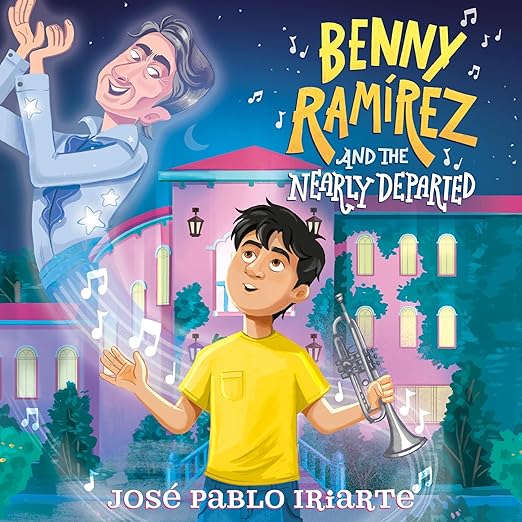
Ghosts with deadlines beat ghosts with grievances, and this audiobook happens to carry both in one. Ignacio Ramírez, a famous trumpet player, is dead, barred from the afterlife, and stuck in the Miami mansion he left behind. He has until New Year's Eve to do some good in the world or the door stays shut. The only person who can see him is his grandson Benny, who has just moved cross-country into that house, enrolled at a performing arts school alongside his siblings, and possesses no obvious talent whatsoever. Abuelo's plan is to make Benny a trumpet prodigy and a school celebrity. José Pablo Iriarte lets that go roughly as well as you would expect.
Benny's Two Jobs Pull Against Each Other
Structurally this is a double bind, and it is the smartest thing about the book. Benny has two jobs that pull directly against each other: survive as the new kid at a school where everybody else already has a talent, and help a grandfather he never really knew get out of the building. An August 2024 report puts it neatly, describing Benny as both the new kid trying to find his talent and the dutiful grandson helping his grandfather move on to the great beyond. Neither job can be done well while the other is going badly, and the comedy comes from watching a kid fail at both at once, in public, in front of people who are being graded. That same report credits Iriarte with weaving in the rich flavors that bring the wider family to life, which is where the book quietly spends most of its warmth.
Ignacio's trumpet matters more than his ghost does. Ignacio was great at the trumpet, Benny is not yet great at anything, and the gap between an inherited name and an earned one is the real subject underneath the supernatural machinery. Performing arts schools make unforgiving settings for a story about being ordinary, because everybody in the building is ranked constantly and visibly. Iriarte uses that pressure without letting it curdle into cruelty. The book's own promise, that more than one way to be great exists, could easily have been a cop-out, and the reason it is not is that Benny has to find the other way by himself while the person insisting on the first way is haunting his house.
This Recording Never Strips the Accent Away
Most instructive of the reports here comes from somebody who reads a lot of newly published middle grade and then reads the good ones out loud to two children. That is the audiobook reader's job performed at a kitchen table, and it is the closest thing here to a test of whether this material works as speech. The finding was that almost once per chapter came the thought, in the most delightful way possible, of not having expected that. Roughly once a chapter is a comic tempo, and tempo is the one thing a recording controls absolutely. On the page you can slow down before a reversal and see it coming. Here the pace is set for you, so the surprises land at the author's speed instead of yours. The same report hands the scene-stealing prize not to Benny but to Andrea, a goth playwright obsessed with food monsters.
Proper-noun load is the second reason. Benny Ramírez, Ignacio Ramírez, abuelo, a Miami mansion, and a cast that mixes English and Spanish inside the same sentences throughout. The accent on Ramírez is not decoration; it is an instruction about sound. One report on this page writes the title out in capital letters with the accent stripped away, which is exactly what print does to a name when a keyboard gets in the way. A recording is incapable of that mistake. Every name arrives already said correctly, and for a book about what a family hands down, having the family's name pronounced properly for six straight hours is not a small thing.
This Ghost Story Isn't Actually Very Spooky
Manage the ghost expectation before you press play. An October 2025 report states that the ghost level was not spooky at all, and calls it a fun ghost story regardless, with a lot of funny parts and some genuinely warm ones. That is accurate and it is also a warning in disguise. A child who wants to be frightened will not be. What the supernatural element actually does here is give a grief story permission to be funny, which is a difficult trick and an entirely different product from a scary book. The same report identifies the emotional core correctly as a family struggling to adjust to a new place, and that struggle, rather than the haunting, is what the story rests on.
Categories on this listing will not help anybody find the book. It sits under children's audiobooks with a single tag reading Music and Performing Arts, while carrying nothing whatsoever to indicate a ghost, a haunting or anything supernatural. A parent hunting for a funny paranormal story will never surface it. A listener browsing music will get a dead trumpet player and a boy who cannot play. Both halves of that tagging are technically true and the combination badly undersells the book, which is a shame, because funny paranormal middle grade is a category people actively search for. Six hours and eight minutes is also on the long side for the age band, so plan on several sittings rather than one long push.
Households That Have Recently Lost a Grandparent
Households listening together are the sweet spot, and a May 2025 report describes precisely that: a quick, witty listen that has you laughing alongside your young reader, with Benny relatable for children and adults alike. That double address is real and it is not automatic. Plenty of middle grade is perfectly good and completely inert for the adult in the room. This one keeps a second layer running, most of it inside Abuelo, who is impatient, dead, and entirely convinced that his plan is the correct one. Grown-ups will recognize that relative immediately. Children will enjoy watching a grandfather be wrong. Both audiences get served by the same joke, which is the hardest thing to manage in this category.
Jeopardy is the one thing this cannot supply, because nothing here threatens anybody and the deadline is the only real pressure in the story. Leave it alone too if a performing arts setting sounds exhausting rather than fun, since the school is present throughout and the ranking anxiety that comes with it is part of the texture. For everybody else, and particularly for a child who has recently moved, changed schools, or lost a grandparent, this handles all three at once without ever announcing that it is handling anything. Iriarte trusts the comedy to carry the grief, and the comedy carries it.