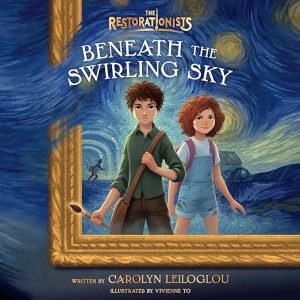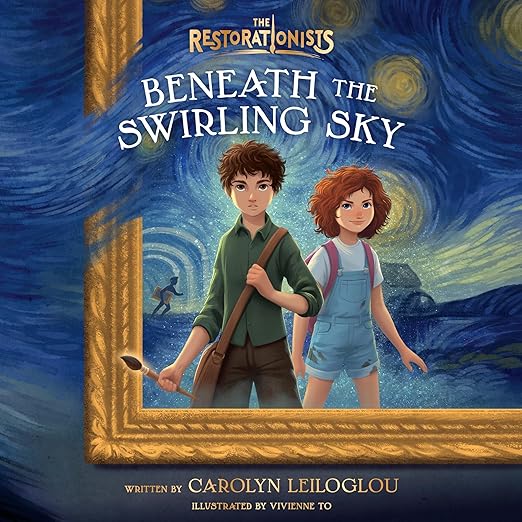
Sarah Mackenzie's line in the description recommends this one for reading aloud, and promises it will make you want to study Van Gogh and get the paintbrushes out. An audiobook is the industrial version of reading aloud, so the blurb and the format happen to point the same way. Michael Crouch reads it for Listening Library across five hours and thirty-nine minutes, which is one long weekend or a week of school runs, and Carolyn Leiloglou has built a portal fantasy whose doors are paintings.
Furious at the Adults Who Lied to Him
Vincent has decided he is finished with art after something he would rather not discuss, which is a sharper starting position than most middle-grade heroes get handed. He and his little sister Lili are parked for spring break with a great-uncle who restores paintings for a living, and the plan is to spend the week glued to a phone. Then Lili walks into one of the most famous paintings in the world and does not come back out, and the phone stops being an option.
One reader posting on September 12, 2023 under the handle Carlson 5 lays out the mechanic better than the description manages: certain groups of people can Travel into paintings, a skill available for great good or terrible ill, and new revelations about Traveling turn up around every corner because Vincent learns the rules at the same rate the audience does. That response also calls it the book it needed at twelve, which is exactly the right age to name.
What keeps this from being a theme-park ride is the family arrangement. Vincent has to work with Georgia, a know-it-all second cousin he did not choose, while carrying the discovery that his parents hid the whole Restorationist business from him. Leiloglou lets him stay angry about that for longer than the plot strictly requires, and the anger is the spine. A boy rescuing a sister is a chase; a boy rescuing a sister while furious at the adults who lied is a story.
Vincent Shares a First Name With the Painter
One buyer posting on October 4, 2023 under the handle L. Doose finished it in a single day on a camping trip and came away wanting to look up the paintings that had gone past unrecognized. That is the reaction the book is engineered for, and it argues for the audio rather than against it: hearing a canvas described, with no picture in front of you, sends you off to find the picture. The recording turns looking it up into a separate, deliberate act.
Rarer than the adventure is a second thing that response praises, which is that the story supports relationships among family members instead of manufacturing the division between children and their parents or siblings that the age band defaults to. Vincent's fury at his parents is real and it resolves toward them rather than away from them. For a household listening together that matters more than the magic system, because the argument the book models is one the back seat can actually have.
Art history arrives as plot rather than as homework. Traveling requires a painting, so every set piece is a specific work with a specific texture and a specific danger, and the boy at the center shares a first name with the painter the description sends you off to study. Leiloglou keeps the technique talk short and attaches it to something happening, so a nine-year-old picks up what an art conservator actually does without noticing that anything has been taught.
The Day This Recording Came Out
Faith content is the thing the shelf does not tell you. This entry sits under children's audiobooks with an Art tag and nothing else, while the description itself carries an ECPA Christian Book Award mention. Jenny's four stars, the only grade on this page below the top, put it precisely: the faith aspect runs all the way through, but in a thoughtful manner. That is a fair description and a useful one, and it belongs on the listing rather than buried in a response.
Look closely at that award mention and it is mangled. The description prints WINNER OF THE SELAH AWARD FINALIST FOR THE ECPA CHRISTIAN BOOK AWARD as one unbroken line, welding a win and a shortlisting together with no punctuation between them, so a buyer cannot tell which prize the book actually took. The same four-star response flags the artist material as an opportunity rather than a feature, which is a gentle way of saying the teaching is optional and easy to let slide past.
A Win and a Finalist Welded Together
Those four stars are dated September 12, 2023, the day this recording came out, which means the response describes a manuscript or an early copy rather than anything Michael Crouch did with it. That is normal for a series opener and worth knowing anyway, because the page's earliest enthusiasm was formed before the audio existed. A grade set that early tells you the story worked on paper; it cannot tell you whether the story works in a car.
One more thing to check before buying. The series entry reads The Restorationists, book one, which is accurate and unusually well filled in for a self-contained fantasy, so anyone who finishes wanting more knows where to look. The description also positions the book for fans of The Wingfeather Saga and Pages & Co., two comparisons pointing toward warmth and bookishness respectively. Both are fair, and neither prepares you for how much of the first stretch Vincent spends resenting everybody in the house.
Steer Clear if You Want No Religious Content
Families who read together are the obvious buy, and this is one of the rare middle-grade fantasies that gives the adults in the room something to do besides drive. One parent posting on December 6, 2025 under the handle MomMing read it with three boys aged eight to eleven and reports that all three asked for the next book, which is the only endorsement that counts at this age. Children who like art will take to it; children convinced they hate art are the actual target.
Steer clear as well if you want your children's fantasy free of religious content, since the framing is present throughout even where it stays quiet. Buyers hunting a painter's biography in disguise should also pass, because the canvases are doors first and subjects second. And a child who needs a fast opening may fidget through Vincent's phone-shaped sulk before Lili disappears and the book snaps awake. Once it does, the pace holds all the way to the fortress.
Leiloglou's real achievement is that the art never reads as a lesson smuggled into an adventure. The paintings are places, with weather and danger and consequences, and the family able to enter them treats the ability as a duty rather than a superpower. If you want a children's fantasy where the moral weight sits on protecting something beautiful instead of on defeating somebody ugly, this is a clean, fast and generous version of that, and it plainly intends to keep going.
What age does this audiobook actually suit?
Eight to twelve is the sweet spot, with confident younger listeners fine alongside an adult. The peril is real, since a child does vanish into a painting and the people hunting her are dangerous, but nothing is graphic and the tone stays hopeful throughout. Older middle-grade readers may find the phone-and-sulk opening a little young, though the plot outruns that quickly.
Do you need to know anything about art before starting?
None at all, and the book is aimed squarely at people who think they do not care. A reader posting on January 11, 2024 under the handle Mom of 9 came in with an artist husband, daily art in the house and firm opinions about how art gets handled in fiction, and still landed on five stars. Vincent starts the story wanting nothing to do with painting.
Does the story resolve, or does it stop on a cliffhanger?
The rescue plot resolves. This is the first Restorationists book and the description makes no secret of a wider conflict with forces that want the paintings, so threads are deliberately left open, but the sister storyline driving this volume closes inside it. You will not be stranded at the end, and you will probably want the next one.
Is the audiobook a good fit for a family car journey?
It suits one well. Five hours and thirty-nine minutes covers a road trip or several days of short journeys, the chapters end cleanly enough to stop on, and the blurb on the listing recommends the book for reading aloud, which is what a recording is. The one caution is that somebody will keep asking to see the paintings on a phone.