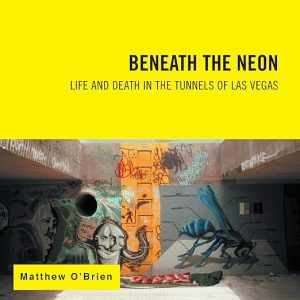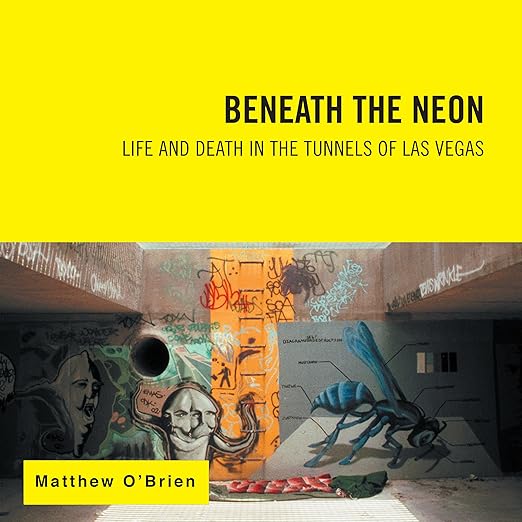
I listened to Beneath the Neon during a week when I was spending a lot of time thinking about cities - specifically about what cities hide and what they perform. Las Vegas is the ultimate performance: constructed spectacle, light as identity, money as moral framework. Matthew O'Brien's book goes under all of that, literally, and the contrast between what's above and what's below ground is so stark it sometimes reads like allegory. But it isn't allegory. The storm drains O'Brien crawled through for four years are real, and the people he met in them were living actual lives.
The book opens with a structural provocation: Rome's catacombs sheltered Christians. Paris's sewers yielded gold and revolution. New York's tunnels housed thousands in the 1980s and 90s. The question O'Brien poses - what do Las Vegas's drains hold? - positions this as part of a long tradition of subterranean documentary. What he finds is less history than present tense: crack addiction, meth production, flash flood danger, and people who have concluded that a concrete tunnel beneath a casino is preferable to their alternatives above ground.
Where This One Lands
O'Brien is a journalist by trade - at the time, a writer-editor at Las Vegas CityLife - and that shapes both the book's strengths and its limitations. He is a careful observer and a vivid renderer of physical detail. The reviewer who said the writing made her physically cringe at cockroach mentions was not exaggerating; the sensory specificity is relentless. O'Brien's description of bracing against a flood in a concrete corridor is the kind of passage that makes you involuntarily hold your breath. But some readers found his framing self-aggrandizing, and that critique is fair in moments. When he positions himself as a brave explorer, the people he encounters recede slightly into backdrop. The better chapters reverse that dynamic, and when O'Brien gets out of his own way, the portraits of tunnel residents are genuinely affecting.
Why Beneath the Neon: Life and Death in the Tunnels of Las Vegas Works as an Audiobook
Alan Carlson's narration navigates the book's tonal range with steady professionalism. The material moves between investigative reporting, personal essay, and social portrait, and Carlson doesn't try to force any of it into false drama. His pace gives O'Brien's more measured observations room to breathe. The audio format actually helps with the book's episodic structure - Carlson's consistency creates a through-line that a print reading might interrupt more easily with breaks. At just over seven hours, it lands in the ideal zone for nonfiction immersion without overstaying its welcome.
What Gives Us Pause
The book's primary tension - and its honest limitation - is one that the most critical reviewer raised directly: O'Brien's narrator-as-explorer framing can crowd out the people he's ostensibly writing about. This isn't the whole book, but it's present enough to notice. Readers coming specifically for deep sociological analysis of urban homelessness will find some of that, but will also find a significant amount of O'Brien's own processing and self-positioning. This is embedded journalism in the literary tradition, which means the author is part of the story. Whether that's a feature or a limitation depends on your tolerance for first-person nonfiction.
There's a moment O'Brien describes - parties with naked crack-heads in a flood drain corridor beneath a casino floor - that sits in the mind in a particular way. Not because it's salacious, but because of the cognitive whiplash it produces: this is happening simultaneously with the slot machines and the wedding chapels and the all-you-can-eat buffets directly above. That simultaneity is what the book is really about.
The comparison O'Brien draws at the outset - to Rome's catacombs, to Paris's sewers, to New York's tunnel communities - is doing real structural work. He's arguing that underground populations are not anomalies but persistent features of urban life, and that what a city hides underground is often a direct expression of what it cannot or will not acknowledge above ground. Las Vegas, the city that runs on illusion, turns out to have an extraordinarily honest underground.
The Right Listener for Beneath the Neon: Life and Death in the Tunnels of Las Vegas
Beneath the Neon is ideal for listeners drawn to immersive urban nonfiction - readers who have appreciated books like George Orwell's Down and Out in Paris and London or journalist-driven poverty reporting. It works well for anyone interested in Las Vegas as a cultural subject beyond the tourist surface, and for listeners drawn to the American homelessness crisis told through specific, human stories. Approach it with calibrated expectations about the author's role in the narrative, and you'll find a book that is genuinely hard to shake once you've finished it.
- Narration: Alan Carlson's measured, grounded delivery suits the journalistic tone - he never overdramatizes, which keeps the material from tipping into exploitation.
- Themes: Urban homelessness, subterranean America, the gap between spectacle and survival
- Mood: Gritty, claustrophobic, and unexpectedly moving
- Verdict: A singular piece of embedded journalism that holds up as a listening experience - uneven in places, but unforgettable in its portraits of tunnel life.
A Few Questions About Beneath the Neon: Life and Death in the Tunnels of Las Vegas
Is Beneath the Neon primarily about homelessness or is it more of an urban exploration book?
It's both, and the balance shifts by chapter. O'Brien enters the tunnels as an explorer-journalist and gradually becomes more invested in the people who live there permanently. The book works best when those two impulses align - the exploration reveals the humanity. Readers coming purely for tunnel geography or purely for social journalism will find the book sits somewhere between the two.
Does Alan Carlson's narration handle the more disturbing content - drug use, violence, flooding - with the right tone?
Yes. Carlson keeps a measured, even tone that actually serves the material. He doesn't sensationalize the more extreme episodes, which is the right call for a book that is trying to report rather than shock. His delivery gives the grimmer passages their full weight without tipping into performance.
How current is the information in Beneath the Neon - is the tunnel community it describes still there?
O'Brien explored the Las Vegas flood-control tunnels over four-plus years before the book's original publication. The audiobook was released in 2018. The phenomenon of people living in the Las Vegas storm drains is ongoing and has been documented by journalists and organizations since O'Brien's work. His specific portraits are historical, but the underlying conditions he describes have persisted.
Is this book suitable for listeners who are sensitive to descriptions of drug use and poverty?
Beneath the Neon contains frank descriptions of crack and meth use, encounters with people in acute crisis, and the physical realities of living in storm drains. O'Brien does not editorialize heavily, which keeps the tone from becoming exploitative, but the content is unflinching. Listeners who are sensitive to detailed depictions of addiction and extreme poverty should approach with that awareness.