- Narrator: David Eskridge's voice carries the soothing, measured quality that bedtime storytelling requires, and his pacing is well-calibrated for young listeners winding down.
- Subjects: courage and self-esteem, kindness and friendship, nighttime calm
- Tone: Gentle and reassuring, designed to transition children from alert to restful
- Bottom line: A thoughtfully constructed bedtime audiobook that serves a specific family need with genuine craft and a narrator whose voice suits the format well.
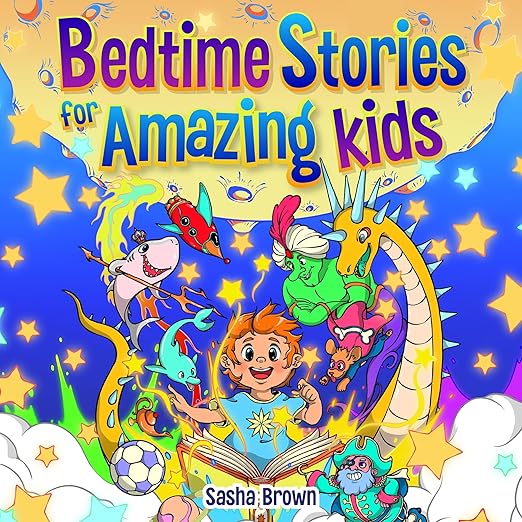
David Eskridge narrates Sasha Brown's Bedtime Stories For Amazing Kids, the first entry in The Amazing Kids Bedtime Collection, across five hours and sixteen minutes of soothing tales designed to ease children toward sleep while weaving in values like courage, empathy, confidence, and self-love. This is an audiobook with a clear and practical purpose: give parents a reliable, calming listening ritual for children ages roughly four through ten, something that reduces nighttime anxiety and replaces screen time at the end of the day. The narrator and the material are both working toward the same end, which makes the listening experience cohesive in a way that more ambitious children's audio sometimes is not.
Brown's approach to the bedtime story format is deliberate about its dual function: the stories are designed to engage young imaginations without exciting them into wakefulness, and the moral content is embedded in narrative rather than delivered as explicit instruction. A child who absorbs a lesson about courage through a story involving a character they care about is learning differently than a child being told to be brave. The variety of characters and situations across the collection, spanning magical scenarios and everyday circumstances, is a structural choice that prevents the material from feeling formulaic across the full five-hour runtime.
The inclusion of positive affirmations and activities designed to reinforce the stories' values is a detail that points to the book's design as more than passive listening content. Parents who engage with their children around these elements will find the audiobook functions as a springboard rather than simply an endpoint. That interactive dimension is worth noting for families who want to use the listening session as part of a broader bedtime routine rather than simply pressing play and waiting for the child to fall asleep.
Eskridge's Patient, Unhurried Storytelling Voice
David Eskridge's narration is the most important single factor in whether a bedtime audiobook works. The pace must be slow enough to invite relaxation without being so soporific that the child stops listening before the story concludes. Eskridge manages this balance effectively; his voice has the quality of a patient storyteller who is not hurried, and the warmth in his delivery signals safety and calm in a way that children, who are sensitive to tonal register even when they cannot name it, will respond to. For the specific purpose of reducing nighttime anxiety and easing the transition from waking to sleep, the narration is well-cast.
Five hours and sixteen minutes is generous for a first volume, and the material is organized so that individual stories within the collection can be listened to independently rather than requiring the entire runtime in one sitting. This gives parents flexibility to choose a story that matches the night's mood or a child's current preoccupation, whether that is friendship difficulty at school or a new situation requiring courage. The series designation The Amazing Kids Bedtime Collection suggests additional volumes to follow, which is relevant for families who find this one effective and want to rotate new material into their routine.
A Problem Kept at a Safe Remove
The stories involving animals and nature, which the genre tags suggest are well-represented in the collection, tend to be particularly effective as bedtime material because they draw on imagery that is both familiar and gently distanced from the child's immediate world. A child hearing about a small creature navigating something difficult is relating to a problem at one remove, which allows emotional engagement without the proximity that can trigger anxiety in a child already in a heightened state from the transition to bedtime.
Parents should pay attention to their child's response to the pacing of individual stories. Some children at the younger end of the target age range will fall asleep before the end of a story, while older children in the eight to ten range may want to listen through to the resolution. The collection's variety means there are stories calibrated to shorter and longer attention windows, and familiarity with the material over repeated listenings will help parents navigate to the right entry point for a given night.
Gentle Lessons With No Religious Framework
Parents of children roughly four through ten years old who struggle with the bedtime routine, whether because of nighttime anxiety, resistance to going to sleep, or simply the need for a calming ritual, will find this audiobook a practical and well-executed resource. Families reducing screen time in the evening and looking for audio alternatives that serve an explicit calming function will find the combination of Eskridge's narration and Brown's story design well-suited to the purpose.
Parents whose children fall asleep almost immediately at bedtime may find the full five-hour runtime difficult to use efficiently, though individual shorter stories can be selected for single sessions. The moral content is gentle and universal rather than tied to a specific religious framework, which makes it accessible across diverse family backgrounds.