At a Glance
- Performance: Brenda E Smith narrates her own memoir, and the self-narration gives the fear and wonder an authenticity no hired voice could replicate.
- What it covers: Stepping outside a safe life, confronting internal versus external fears, transformation through physical challenge
- Feel: Vivid and reflective, alternating between outdoor adventure intensity and honest self-examination
- Our call: A memoir that does exactly what it says, tracks a genuine transformation from comfortable safety to hard-won courage, and earns its emotional conclusions through lived specificity.
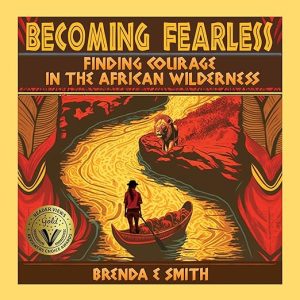
I started listening to Becoming Fearless on a Saturday morning when I was supposed to be preparing for a work trip that I had been quietly dreading for weeks. By the time Brenda Smith described her first sight of the Selous Game Reserve from a river raft, my own low-grade anxiety had company, and by the time she came face-to-face with a hippo defending its territory, it felt absurd in comparison. That's the particular gift of adventure memoir: it recalibrates the scale of what counts as hard. Smith does this without lecturing, which is the harder trick to pull off.
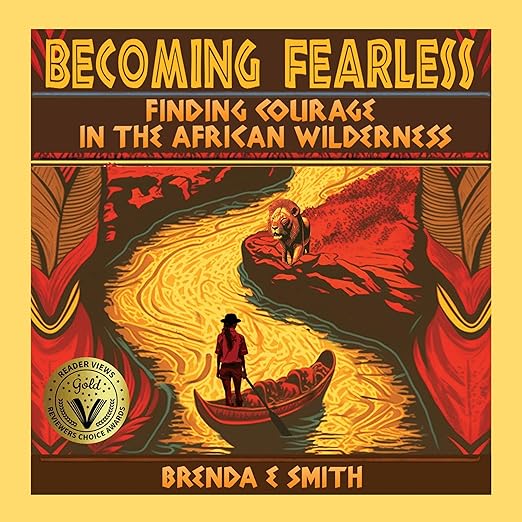
The memoir earned a Best Non-Fiction Travel Book award from Reader Views in 2023, and the recognition is understandable. Smith's story has an unusual structure that serves it well. She doesn't begin in Africa; she begins in Boston, where she was working as an accountant in what she describes as a safe and predictable life she had maintained for twenty-eight years. A colleague's offhand agreement to join her on a Colorado River rafting trip becomes the opening of something larger: Smith leaves accounting to work as a bookkeeper for OARS, the outfitting company that ran that first trip, and the trajectory carries her eventually to a twelve-day rafting expedition through Tanzania's remote Selous River system, followed by a climb of Kilimanjaro.
What distinguishes Smith's account from straightforward adventure writing is her sustained attention to the parallel interior journey. She is not just documenting what happened; she is tracking what changed inside her as a consequence of what happened. The hippos and crocodiles and roaring lions are real, and she writes them vividly, but she keeps returning to the question of where her fear actually lives and whether its address is as fixed as she had assumed. One reviewer called this 'colorful, descriptive and self-reflective,' which captures the balance she maintains.
The African wilderness sections are the book's strongest material. Smith writes the Selous and Kilimanjaro with genuine sensory precision: heat and cold, the smell of river mud, the physical demands of altitude sickness on the mountain. A reviewer who praised the 'clarity and craftsmanship of her writing' specifically mentioned being transported to the Tanzanian landscape, and that transportation effect is real. You don't need to have been to Tanzania to feel the specific weight of the days she describes.
What Makes Becoming Fearless Worth Hearing
Smith narrating her own memoir is the right call. Her voice carries the authentic ambivalence of someone who did something terrifying and is still slightly surprised that she did it. There's no performative bravado in the delivery, no retrospective shaping of the fear into something tidier than it was. She sounds like someone telling you the truth about her experience rather than a polished version of it, and that honesty is the memoir's primary asset. At ten hours and twenty-five minutes, it's a manageable length that allows the Tanzanian sections room to develop while keeping the Boston backstory proportionate.
The self-narration also means that pauses, emphasis, and pacing reflect choices that Smith herself made about what mattered in the telling. A professional narrator would have made competent decisions; Smith makes personal ones, and the difference is audible. The moment when she is on the mountain, dealing with altitude and exhaustion, is narrated with a quality of recall that sounds like someone who is still slightly inside that memory rather than observing it from outside.
Things to Know Before Starting Becoming Fearless
One reviewer offered a more measured assessment, rating it four stars and noting that despite being 'a decent read,' it didn't feel 'spectacular or particularly moving,' and that they didn't get a full sense of the intensity of feeling she describes being in such intense physical circumstances. This is worth taking seriously. Smith's approach to the interior journey is honest but somewhat controlled in its emotional register, which will suit some readers and leave others wanting something rawer. She is not an emotional exhibitionist, and the memoir's self-examination, while genuine, is shaped by a personality that tends toward description over disclosure.
The book also stays closely focused on the Tanzania expedition and Kilimanjaro climb, with the earlier portions of Smith's career transition covered at a higher level. Readers who want to understand the full arc from Boston accountant to wilderness guide may find some of those intermediate years compressed. The Africa experience is the book's center of gravity, and everything else orbits it rather than receiving equal development.
Who Brenda E Smith Is Writing For
This is a strong choice for listeners who enjoy adventure memoir with a genuine psychological dimension, particularly those drawn to Africa as a setting or to the specific genre of transformation-through-extreme-nature that Mary Morris and Cheryl Strayed have worked in. Armchair adventurers who want to feel the specificity of the Selous and Kilimanjaro will be rewarded. Those looking for a more emotionally volatile or disclosure-heavy memoir may find Smith's measured self-examination less satisfying. Reluctant travelers and anyone who has ever suspected that their safe life was not the only possible version of their life will find Smith's particular journey resonant and specific.
A Few Questions About Becoming Fearless
Does Brenda Smith narrate Becoming Fearless herself, and does it improve the listening experience?
Yes, Smith narrates her own memoir. The self-narration adds authenticity that a professional narrator would have difficulty replicating, she brings the specific quality of someone who is still slightly inside the memory she's describing, particularly in the more physically demanding sections on the Selous River and Kilimanjaro.
Is Becoming Fearless primarily an adventure book or more of a psychological memoir?
It's genuinely both. The physical adventure in Tanzania, the Selous rafting and the Kilimanjaro climb, is vividly written and specific. But Smith consistently returns to the parallel interior journey: where fear lives, how it operates, and what changes when you push past it. The balance between external and internal is one of the book's strengths.
Is Becoming Fearless suitable for listeners who have no experience with rafting or mountain climbing?
Completely. Smith was a nervous non-athlete when her Africa journey began, and she writes explicitly from that position of fearful inexperience. You don't need outdoor expertise to follow or enjoy the memoir; in fact, Smith's starting point of being genuinely afraid of what she's about to do is part of what makes the transformation feel real rather than inevitable.