- Performance: Michael Quinlan delivers a confident, conversational read that keeps financial instruction from feeling like a lecture.
- What it covers: Tax minimization strategies, wealth building through assets, financial independence
- Feel: Energetic and practical, occasionally aspirational in ways that require a skeptical ear
- Our call: A readable overview of wealth-building strategies that works best for listeners who already have investable assets and want a plain-language map of legal tax reduction tools.
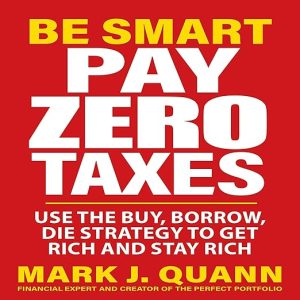
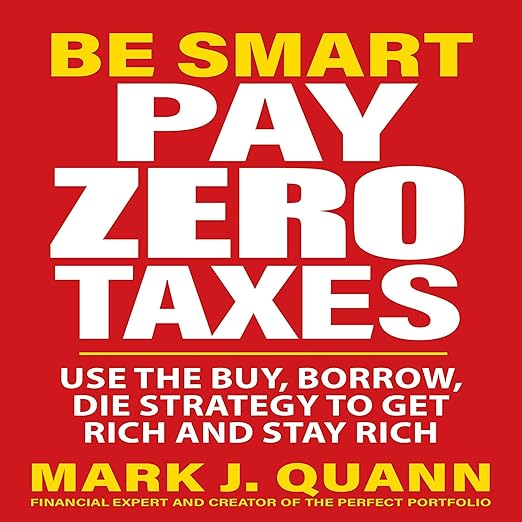
Tax season has a way of making everyone feel like they are playing the wrong game. I found Be Smart Pay Zero Taxes on a Wednesday evening after spending two hours organizing receipts and felt the title's promise somewhat acutely. Mark J. Quann's audiobook, narrated by Michael Quinlan, arrived at just the right moment of susceptibility. What I found was something more substantive than the bold marketing claim might suggest, though not without its own set of caveats worth examining carefully before you hand over seven hours of commute time.
Quann's central framework, which he calls the S.M.A.R.T. system (Strategies to Maximize Assets and Reduce Taxes), is built around five investment pillars: stocks, real estate, life insurance, cryptocurrency, and precious metals. The book argues that by holding appreciating assets, borrowing against them rather than selling, and structuring one's estate carefully, it is possible to dramatically reduce taxable income over a lifetime. The headline strategy, which Quann calls Buy, Borrow, Die, describes exactly what it sounds like: accumulate appreciating assets, borrow against their value for living expenses, and pass the stepped-up basis to heirs. It is a real and legal approach used by high-net-worth investors, and Quann explains it more clearly than most introductory finance books manage to do.
Borrowing Against Your Portfolio, Mapped in Five Pillars
The strongest sections of this audiobook are those dealing with tax-advantaged accounts, the mechanics of borrowing against investment portfolios, and the basic structure of how the ultra-wealthy reduce their taxable events. Reviewer Tracy Carvalho noted that Quann has a knack for breaking down complex financial concepts without losing the thread, and that observation is accurate. The writing has a popular finance directness that makes it easy to follow across seven hours of listening, and Michael Quinlan's narration supports this register well, adopting a tone that is enthusiastic without tipping into infomercial territory.
Where the book is most useful is in its orientation function. For listeners who have encountered terms like margin lending, whole life insurance as an investment vehicle, or stepped-up basis in conversation but never received a clear explanation of how they fit together into a coherent strategy, Quann provides a readable map. The five-pillar framework gives the material a structure that makes it easier to retain across multiple listening sessions rather than consuming it as a pile of disconnected tactics. This organizational quality, more than any individual strategy, is what distinguishes the book from the financial advice that circulates freely online.
Thirty-Five Percent Market Drops Test Buy Borrow Die
One reviewer, identified as Advantage Seeker, gave the audiobook four stars and made a point worth dwelling on: the Buy, Borrow, Die section does not adequately address what happens when markets decline significantly while you are borrowing heavily against your portfolio. A 30 to 35 percent market drop on a 50 percent leveraged position is not a hypothetical scenario. It is a real risk that has materialized multiple times in living memory, and listeners who absorb this strategy without understanding margin call mechanics could face serious financial exposure. The book does not pretend the strategy is risk-free, but it does not give the downside adequate room.
This is the fundamental tension in popular finance books of this genre. The strategies Quann describes are real. They are also, in most cases, most accessible and most safe for people who already have substantial assets and are working with sophisticated financial advisors who can manage the implementation details. The book's framing suggests that anyone can implement these approaches, and while that is technically true in a limited sense, the risk profile of borrowing against volatile assets is not communicated with the same energy as the upside case. That is not a reason to dismiss the book, but it is a reason to treat it as an introduction to a landscape rather than a complete roadmap.
Quinlan's Steady Pace Suits a Friend's Explanation
At seven hours and ten minutes, Be Smart Pay Zero Taxes is a manageable listen for a week of commutes or a long weekend of household tasks. Quinlan's pacing is steady without being rushed, and the material benefits from audio delivery specifically because the conversational tone Quann adopts translates well when spoken rather than read. The book was written to sound the way a knowledgeable friend explaining a financial concept sounds, and hearing that register performed rather than read off a page closes some of the distance between writer and listener.
Reviewer Hannah noted she got started implementing the strategies immediately after finishing, which speaks to how actionable the content feels in the moment. Reviewer Mot, using fewer words, called it excellent knowledge for the rest of us, which captures the democratizing intent of the project. Whether that sense of immediate applicability holds up under the scrutiny of a financial professional depends heavily on your personal situation and existing asset base. With a 4.5 rating across 723 reviews, the audiobook has clearly resonated with a significant audience looking for exactly this kind of orientation to wealth-building strategy, and the listener satisfaction is genuine even if the title slightly oversells what the strategies can deliver for every reader.
Aimed at Listeners Already in a Wealth-Building Phase
Listen to Be Smart Pay Zero Taxes if you are in a wealth-building phase with some existing investment assets and want to understand the tax optimization strategies discussed in financial media but never explained plainly. Listen if you are curious about the Buy, Borrow, Die approach and want a structured audio explanation before deciding whether to consult a professional about implementation. Listen if you want a framework for thinking about financial independence that goes beyond standard retirement account advice.
Approach with more caution if you have no existing investable assets, since many of the strategies require them, or if you are inclined to implement leveraged investment strategies without additional professional guidance. The book is a starting point, not a terminus, and the most honest reading of its value places it firmly in the orientation category rather than the implementation category.
Does Be Smart Pay Zero Taxes explain the Buy, Borrow, Die strategy in enough detail for listeners to understand both the upside and the risks?
The strategy is explained clearly in terms of its upside, but at least one reviewer noted that the risks of margin calls during significant market downturns are not adequately addressed. Treat this as an introduction to the concept rather than a complete implementation guide.
Is this audiobook relevant to listeners who are just starting to invest, or does it assume existing wealth?
Some sections apply to beginners, particularly the tax-advantaged account material, but many of the core strategies including borrowing against investment portfolios require existing assets to implement. Early-stage investors will find parts of it more aspirational than immediately actionable.
Does the audiobook cover cryptocurrency and precious metals as investment vehicles, or is it primarily focused on stocks and real estate?
Yes, all five pillars including cryptocurrency and precious metals are covered as part of Quann's tax-free investment framework. However, the depth of coverage varies, and cryptocurrency receives less detailed treatment than stocks and real estate.
Is Michael Quinlan's narration suitable for a financially dense topic, or does the delivery feel dry across seven hours?
Quinlan handles the material with a conversational energy that prevents it from becoming monotonous. The audiobook format works well for this content because Quann's writing style is already informal and direct, which translates effectively when spoken aloud.