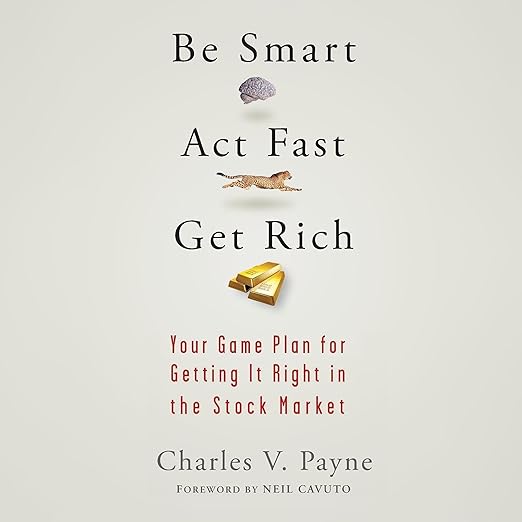
I came to Charles Payne's Be Smart, Act Fast, Get Rich with some skepticism about the title, which makes a promise that no investing book should be in a position to make. But within the first hour, something settled into place. Payne isn't promising you a formula. He's describing a disposition, a way of approaching the market that combines fundamental analysis with the psychological discipline to actually execute when you see an opportunity. That's a different and more honest book than the title suggests.
Payne, best known to audiences from Fox Business Network, has a voice that translates well to audio. He's direct without being aggressive, and he writes about technical analysis in a way that strips the intimidation factor from charts and graphs without pretending the complexity doesn't exist. Tom Dorsey's blurb captures the book's genuine strength: the section on charts and technical analysis is the kind of accessible introduction that takes real skill to write.
Three Words, One Nuanced Investing Framework
The title breaks into a three-part framework: "Be Smart" means understanding the fundamentals of what you're buying. "Act Fast" addresses the paralysis that keeps many investors watching opportunities rise without them. "Get Rich" is the long horizon that requires patience even after acting decisively. It's a more nuanced framework than the packaging suggests, and Payne illustrates each element through market behavior and real positioning decisions.
One reviewer noted that many of the specific stocks referenced in the book are no longer trading, which is an honest limitation of any investing book tied to particular market moments. The underlying principles, however, hold. The instruction on how to read charts, how to evaluate a company's fundamentals before buying, and how to manage the psychological temptation to second-guess a position are durable. The dated examples become illustrative rather than prescriptive once you frame the book that way.
Hite Matches the Cadence of Payne's Broadcasts
Cary Hite's narration serves the material well. He brings an authoritative but conversational tone that matches Payne's own delivery style without trying to impersonate him. For listeners who follow Payne on Varney and Company and are familiar with the cadence of his market commentary, Hite captures something close to that register.
The audiobook format works for the prose sections but has a real limitation that at least one reviewer flagged directly: the accompanying PDF of charts and graphs, which is available through Audible's library, is the only way to access the visual material Payne is referencing in the technical analysis sections. Listening without pausing to consult the PDF means following along through some sections on faith. This is worth knowing before you start.
Stock-Picking Enthusiasm Against an Indexing Consensus
The book was written over a decade before the 2026 audiobook release, and the market landscape it describes, including specific company profiles and sector analyses, reflects its original era. Listeners looking for current positioning advice will need to translate the framework into present contexts rather than following the specific examples. One reviewer who was actively using Payne's guidance and building a portfolio described starting with thirty shares as a meaningful position, a detail that speaks to the book's accessibility for entry-level investors rather than institutional players.
The tone is enthusiastic about individual stock picking in a way that runs counter to the passive index-fund consensus that has dominated personal finance advice in recent years. This isn't a weakness exactly, but it's a philosophical position that listeners should be aware of going in.
Suited to Newer Investors Already Following Payne
This works best for newer investors who find standard financial advice too conservative or too abstract, and for listeners already following Payne who want to go deeper into his methodology. Experienced investors who are comfortable with technical analysis won't find much new ground here. Those expecting a comprehensive, current market guide will be disappointed. What's on offer is an accessible, philosophically grounded introduction to active investing from someone who has lived through its risks and rewards.
Before You Listen
Does the audiobook version include the charts and graphs the book references?
The visual materials are available as a PDF in your Audible Library when you purchase the title, but they don't appear in the audio stream itself. You would need to pause and consult the PDF to follow the technical analysis sections fully.
Is Cary Hite a good narrator match for Charles Payne's style?
Yes. Hite brings a confident, conversational delivery that suits the material. Listeners who know Payne from television will find the audio version captures a similar energy, though it is Hite rather than Payne himself reading.
Is this book appropriate for someone who has never invested before, or is prior market knowledge assumed?
Payne explicitly wrote this for a range of investors, from first-time buyers to more seasoned participants. The early sections on fundamentals and the accessible treatment of technical analysis are specifically designed not to assume prior knowledge.