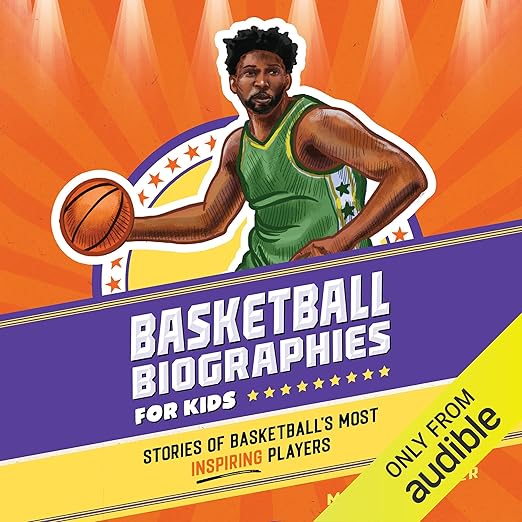
Basketball Biographies for Kids, authored by Matt Chandler and narrated by Ian Hackney, belongs to a category of children's sports audiobook that is harder to execute well than it appears. The challenge is that sports biography for young readers has to compete with the sport itself, meaning the text needs to convey something of what it felt like to watch LeBron James control a fourth quarter or Sue Bird orchestrate a WNBA offense, using only the tools of narration. The Sports Biographies for Kids series has made this its core project, and this audiobook, running 3 hours and 5 minutes, represents one of its stronger entries. Chandler's approach is to organize by position rather than by era, which is structurally smart: it gives young listeners a framework for understanding what different players actually do and why their particular achievements matter within that context. This is the kind of editorial choice that distinguishes a well-constructed sports audiobook from a list of facts with connecting prose.
The book's age range of 8 to 12 is accurately targeted. The biographical entries are long enough to convey genuine personality and career arc but short enough that a younger child can hold the thread. One reviewer specifically notes that their ten-year-old basketball player started reading immediately on receipt, which is the most honest endorsement a children's sports book can receive. The companion PDF, available alongside the audio in Audible's library system, includes a blank sheet for listeners to draft their own fantasy team based on the statistics covered, which is a genuinely clever engagement tool: it turns passive listening into active evaluation of what makes a strong lineup, and it gives the book a second life after the first listen.
Sue Bird Sits Beside LeBron, No Comment
The lineup spans the last sixty years of basketball history, covering players from both the NBA and WNBA. The decision to include WNBA players alongside NBA stars is worth noting because it is still unusual in children's sports publishing, and Chandler treats the league without qualification or comparative framing, simply presenting Sue Bird alongside LeBron James as two extraordinary players whose careers deserve equal biographical attention. Young listeners who have grown up watching both leagues will find this unremarkable, which is precisely the point: normalizing the WNBA in a child's sports library is done most effectively by presenting it without comment.
The position-based organization means you get a coherent picture of what, say, an attacking point guard does and why Kawhi Leonard's particular style of defensive play was historically significant, rather than simply a list of accomplishments. The career stats sections are integrated into each biography rather than presented as separate data dumps, which matters enormously in the audio format. Hackney handles these passages well, giving the numbers enough context that they feel like evidence of a story rather than interruptions to one. Statistics become legible as testimony rather than noise.
Hackney Keeps Statistics Intelligible, Never Numbing
Ian Hackney's narration is more important here than it would be with adult material. Children's audiobooks rise and fall on whether the narrator can hold attention across a room, and Hackney has the quality essential for this format: he sounds like someone who is actually interested in what he is talking about. The biographical style of the book is brisk and action-packed, and he matches that energy without losing clarity. Statistics, which can become monotonous in less careful narration, are delivered with enough rhythmic variation to keep them intelligible rather than numbing.
The listening experience also benefits from the format's natural fit with sports contexts. Basketball Biographies for Kids works well played in the car on the way to practice or a game, in a classroom between activities, or as a bedtime listen for young sports fans who need something engaging enough to hold attention but structured enough to wind down with. The chapter length makes natural stopping points easy to find, which matters for younger listeners who may not complete the full audiobook in a single session. At three hours, the full book is manageable in a single Saturday or spread across a school week.
Fantasy Team Sheets Turn Listening Active
One reviewer notes that the selection skews toward recent and current players, with even the honorable mentions weighted toward the contemporary game. This is partly a function of the recency bias inherent in any "best of sixty years" framing and partly a deliberate editorial choice to make the book feel relevant to children who are watching basketball now. Listeners hoping for deep coverage of 1980s legends or earlier eras may find the historical depth uneven. The book is strongest as a portrait of the current game's outstanding players, with historical context provided as background rather than as the book's primary subject.
The fantasy team sheet in the companion PDF is one of the book's cleverest features, but it rewards listeners who track the statistics as they go, which is a more active form of engagement than most audiobooks invite. Parents listening alongside their children can use this as a prompt for conversation: which players would you pick, and why? The book provides enough comparative data, games played, points, rebounds, assists, and blocks, to make those conversations substantive rather than purely preferential. This dual use as both audiobook and discussion starter extends the book's value beyond a single listening session.
Age Range Accuracy Confirmed by Two Kids
This audiobook is best suited for children aged 8 to 12 who already have some familiarity with basketball, either as players or fans. Young listeners without that baseline will still find the biographies compelling as human stories, but the statistics will carry less weight without context for why they matter. Parents and grandparents looking for a gift that engages a sports-focused child will find this well-matched to that purpose; reviewer accounts of an eight-year-old and a ten-year-old both responding immediately to the material confirm the age-range targeting is accurate. The audiobook format makes it especially useful as a shared listening experience. It is not a comprehensive basketball history, but it is an excellent primer on the players who have defined the sport's most recent and most globally watched generation.